

LabGrownMeat: What if Cultivated Meat is the Future of Food?
The world is a growing population and the need for meat is growing exponentially. The traditional agricultural production of agricultural products, which is important for feeding billions of people is also using huge land, water and energy resources. It is a major source of greenhouse gas emissions and is an ongoing animal welfare concern.
Scientists and food technology firms have come up with an innovative solution to these problems: lab-grown meat, or also referred to as “cultivated” or “cell-based” meat. This technology can revolutionize the world of food production by growing animals cells in a controlled environment instead of raising and slaughtering animals.
Lab-grown meat is still in its infancy, but it has already garnered significant attention from around the world, including from governments, investors, and consumers who are seeking more sustainable food options.
What is lab-grown meat?Lab-grown meat is meat produced through lab methods.
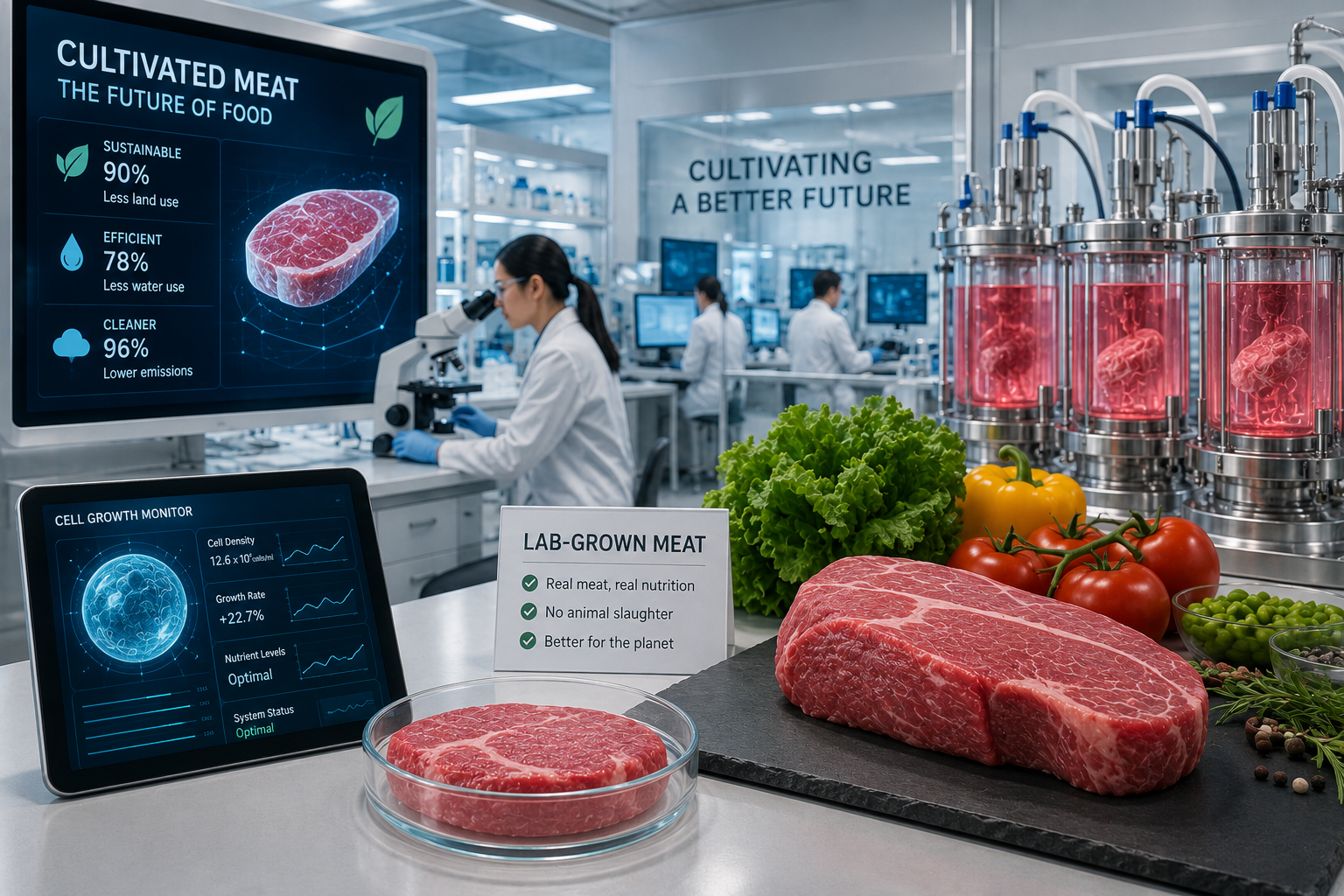
Lab-grown meat is genuine meat that is grown in a laboratory or food manufacturing plant. The scientists take a small number of cells from an animal, put the cells in a nutrient rich solution and let the cells reproduce naturally.
These cells then take on muscular structure and taste, texture, and nutrition of traditional meat over time.
Cultivated meat is produced from real animal cells, which makes it similar to real meat, unlike plant-based meat alternatives.
Why is the food industry interested?
Protein demand will increase markedly in the next 20 years or so. Meanwhile, climate change, declining soils and water scarcity create greater difficulties for traditional livestock rearing.
Lab-grown meat has a number of possible benefits:
Lower greenhouse gas levels.
* Lower water consumption.
Less land needed for production.
Resolve the problem of large-scale slaughter of animals.
Better controlled and sanitary production areas.
As a result of these benefits, the major food companies and investors have backed the research and commercial development efforts.
Environmental Benefits
In the eyes of many, the environmental impact is one of the best reasons for using cultivated meat.
Rural practices of livestock rearing involve significant land use and generate methane gas which is a greenhouse gas.
Lab-grown meat companies may significantly cut down on land use and on natural resources. Because production is going on in a controlled area, it also may lower the use of antibiotics normally used in animal production.
Powered by renewable energy, cultivated meat can be an even more sustainable food production technique.
The obstacles to the success of lab-grown meat.The barriers to lab-grown meat’s success.
Though promising, there are still some obstacles to overcome before cultivated meat is widely available.
High Production Costs
While the cost of production has been reduced considerably in the last ten years, the production of cultivated meat is still quite costly compared to regular meat.
Consumer Acceptance
There is a lot of confusion among consumers about eating lab grown meat. Building trust will be key to public education and transparency.
Government Regulations
Food safety regulations and approval processes are still being developed for cultivated meat products in countries. The technology may be adopted at different rate by different markets.
Scaling Up Production
It is quite different to make a few kilograms in a research lab, as opposed to millions for consumption globally in supermarkets. It is one of the key difficulties to establish large-scale production facilities.
Technology is driving innovation in a variety of ways.There are several ways that technology is driving innovation.
The production of cultivated meat is advancing through the acceleration of progress in AI and biotechnology.
AI supports researchers to fine-tune nutrient formulas, track cell growth, and enhance production yields. Food safety and consistency are also being improved, as are manufacturing costs, through automation.
Researchers are trying to duplicate the texture of higher quality cuts like steaks, which are more challenging to make than burgers and chicken nuggets.
What are the prospects for the future?
Experts in the sector feel that the cultivated meat will gradually replace the traditional livestock farming.
First, lab-grown meat will probably be available in high-end restaurants and specialty grocery stores and make its way to the middle mass market later.
As food security gets increasingly under threat to climate change, governments and private investors are still pouring billions of dollars into food innovation.
With the rapidly evolving technological advancements and the decreasing production costs, cultured meat has the potential to become a common component of the global food supply.
Conclusion
One of the major innovations in modern food technology is lab-grown meat. It’s a way to make real meat using less natural resources and with less impact on the environment, which could provide some answers to the world’s food problems.
Despite economic, technical and regulatory challenges that remain, ongoing research and investment efforts are paving the way for cultivated meat to gain a foothold in the mainstream market. Whether it is a staple item for dinner tables or will continue to be a specialty, the lab-grown meat is certainly a new factor in the game of sustainable food production.