

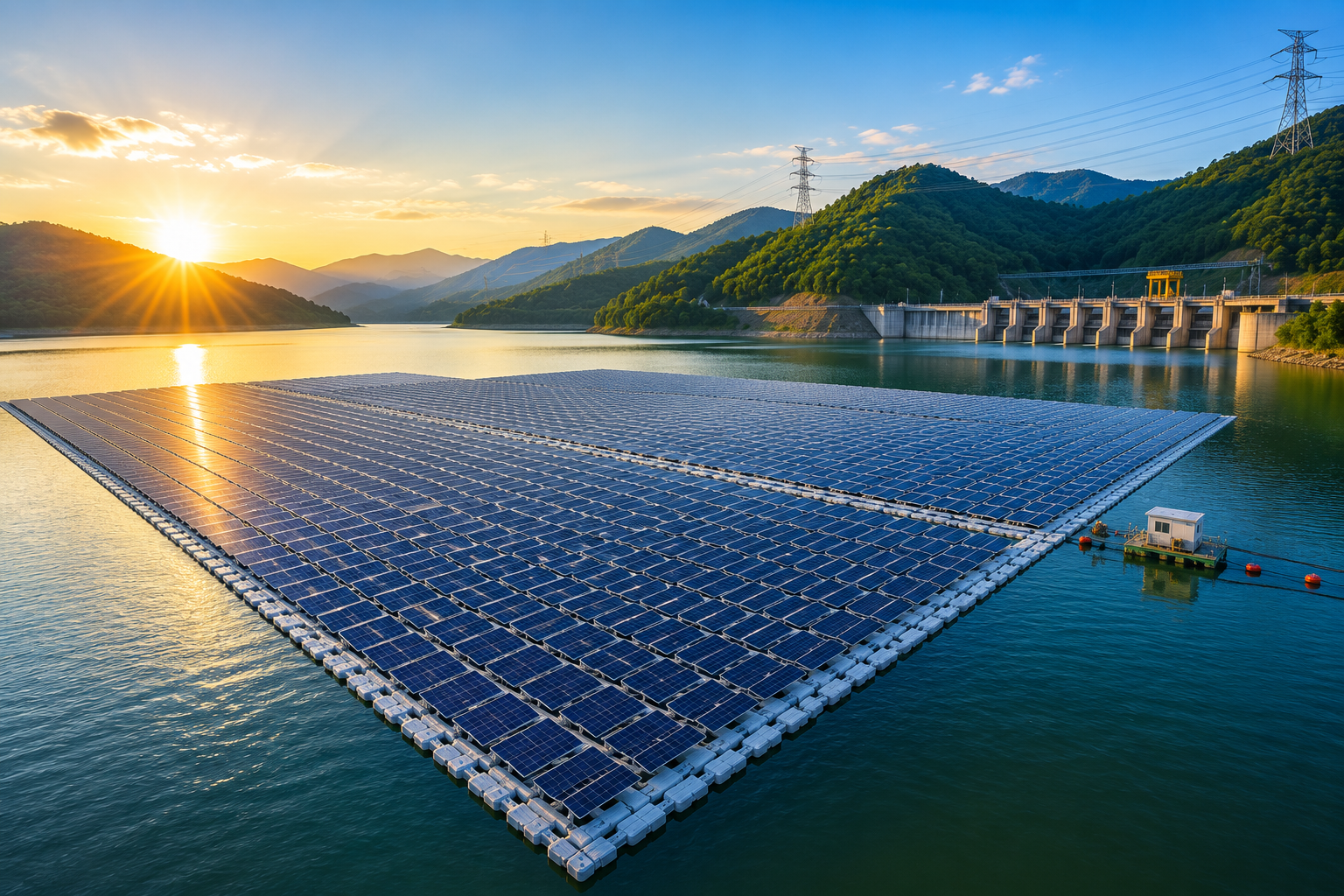
The Renewable Energy Innovation that is Changing the Future.
To address this, engineers have come up with an innovative solution, dubbed floating solar farms. These systems are not installed on land but instead on lakes, reservoirs, dams, etc. to provide renewables-derived electricity without requiring land.
The global market for floating solar is on the rise as governments are looking for more innovative and sustainable solutions to satisfy the increased energy needs.
Floating Solar Farms” are PV panels that are anchored to the ocean floor and floated on the water.
The floating solar farms, also known as floating photovoltaic (FPV) systems, are solar panels attached to specially designed floating platforms which are fixed to the bottom or the edge of a water body.
These platforms are designed to resist the fluctuation of water levels, the wind and weather, all the time producing electricity.
The energy generated is sent out via underwater cables to the electrical grid, suitable for reservoirs, irrigation ponds, quarry lakes and hydroelectric dams.
For what reasons do countries invest in floating solar?
The greatest benefit of floating solar farms is that they can produce clean energy without taking up any farmland or forest.
There is a scarcity of land available for big solar projects in many countries. It is important to make use of unused water surfaces for maximum renewable energy generation and to spare land for agriculture, housing and biodiversity.
Another benefit of floating is that it can generally be designed to be more efficient than rooftop or ground-mounted panels due to the cooling effect of the water, which enhances panel electrical efficiencies during hot weather.
Environmental Benefits
In addition to electricity generation, floating solar farms have a number of environmental benefits.
Conserving Water
Solar panels on surface of water to reduce evaporation from reservoirs. This is especially beneficial in areas where water conservation is critical, such as drought-stricken areas.
Lower Carbon Emissions
Floating solar farms, similar to other types of solar power, produce electricity without combustion of fossil fuels, thereby lowering greenhouse gas emissions.
Better Land Management
Governments can use existing water bodies to avoid deforestation and land-use change to energy projects.
Supporting Hydropower
With the rising popularity of hydroelectric sources, floating solar farms are now being deployed alongside hydroelectric dams. The two renewable energy systems can share energy infrastructure and enhance overall energy reliability.
The floating solar technology faces several challenges. There are several challenges for floating solar technology.
Despite the advantages the technology presents, there are still a number of challenges.
The installation expenses related to floating solar power systems are typically more significant than for traditional onshore solar farms, particularly as a result of the unique floating platforms and anchoring methods.
Work may also be more challenging due to the need to navigate with boats or floating platforms.
Aquatic scientists are still researching the long-term impacts of reduced sunlight on aquatic ecosystems, but initial studies indicate these projects do not have significant impacts if designed properly.
Hurricanes and strong storms are also extreme weather events, which need robust engineering solutions for protecting floating installations.
Current state of Floating Solar worldwide. The current situation of Floating Solar around the world.
Floating solar power is rapidly scaling up in countries around the world in Asia, Europe and the Middle East.
, floating solar is likely to be a significant element of national energy plans.
The potential and future of Floating Solar Farms. Potential and Future of Floating Solar Farms.
With continued development, floating solar farms may be widely adopted on reservoirs globally, as costs continue to drop.
Conclusion
This technology not only helps conserve land and carbon emissions, but it also helps manage water resources.