

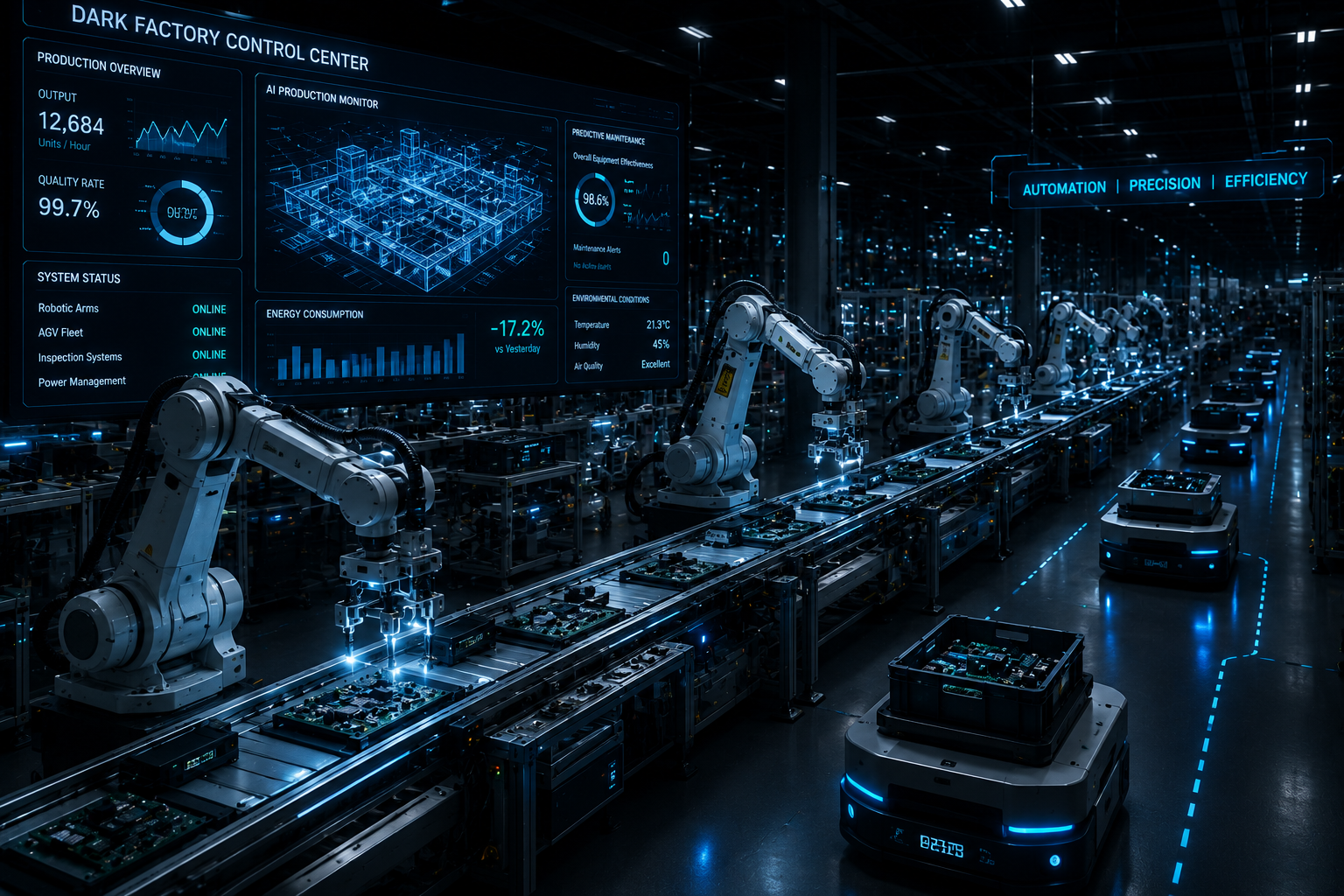
Dark Factories: Behind the World’s Fully Automated Manufacturing Revolution” is the title of the eBook. The title of the eBook is Dark Factories: Inside the World’s Fully Automated Manufacturing Revolution.
“Dark factory” refers to their low-lighting requirement as humans are not likely to be on the shop floor.
Dark factories are becoming a sign of the times as industries struggle with labor shortages, growing production costs and the global competition.
So, what is a dark factory? Well, what is a dark factory?
A dark factory is a factory in which very little human intervention takes place. AI systems continuously monitor and analyze production data, fine-tune machine settings, foresee maintenance needs and optimize workflows in real time.
How do dark factories work?
Industrial Robots
Robotic arms are quick and precise in manufacturing and do not get tired.
Artificial Intelligence
AI tracks production performance, forecasts equipment breakdowns and optimizes production processes automatically.
Machine Vision
Manual quality checks are not as accurate as quality checks using high-resolution cameras.
Autonomous Mobile Robots
Robotic vehicles drive by themselves to move raw materials, and finished goods, between production areas.
Internet of Things (IoT)
Thousands of sensors are connected, providing current data on machine performance, temperature, energy use and production output.
The pros of fully automated manufacturing are numerous. The pros of fully automated manufacturing are many.
24-Hour Production
Dark factories are no different from a conventional factory in that they run around the clock without any shifts and thus improve the overall productivity.
Higher Product Quality
Automated quality inspection helps to minimize industrial defects and maintain uniform industrial quality.
Lower Operating Costs
Lower manpower requirements and energy use can lower the total cost of production in the long term.
Improved Workplace Safety
Robots are used to carry out hazardous tasks with heavy machinery, high temperature, and dangerous materials, thereby decreasing the number of accidents in the workplace.
This was a difficult time for the dark factories. It was a rough period for dark factories.
The capital cost of robotics, AI systems and sophisticated automation equipment is very high.
To achieve complete automation, small and medium sized manufacturers might find the technology expensive.
The industries that are driving this change. The industries driving this change.
Different manufacturers of electronics make computer components and smartphones with a high degree of accuracy through automation.
The future of Dark Factories is green. Dark Factories will be green in the future.
Experts in the field think that upcoming dark factories will be even smarter.
Conclusion
The factory of the future may not have employees; it may be the factory of intelligent machines working in silence in the dark.