

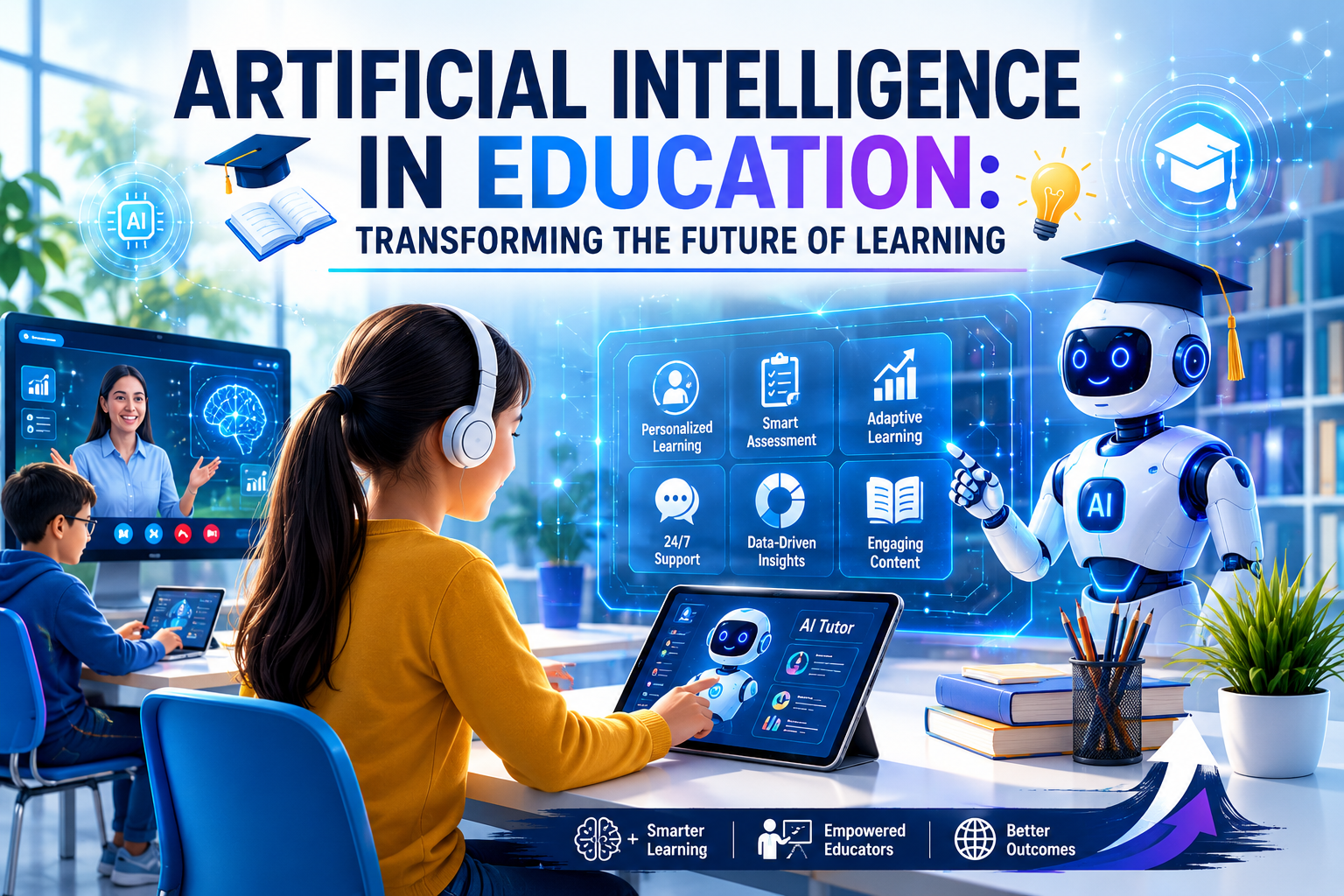
Technologies have always been a part of education. Whether on blackboard or via smart classrooms, every innovation has altered the way students learn and teachers teach. In today’s context, Artificial Intelligence (AI) is a technology that is rapidly becoming one of the most powerful in the field of education. AI is a field of computer science where machines learn to do the same things that humans are able to do, including problem-solving, decision-making, understanding language and learning.
AI’s potential in education is transforming learning experiences, making them more personalized, accessible, and efficient. With the increasing use of digital tools by students, AI has become a vital component of today’s educational landscape around the globe.
What is Artificial Intelligence in Education?
AI in education refers to the application of AI technologies, algorithms, and intelligent software to enhance the educational process. An AI-based platform can evaluate student performance, determine areas of need, create customized suggestions and perform administrative tasks.
Some AI applications in the field of education encompass virtual tutors, intelligent learning platforms, automated grading systems, chatbots, language-learning apps, and adaptive assessment tools.
Artificial Intelligence in Education offers a variety of advantages.There are several advantages of Artificial Intelligence in Education.
Benefits of Artificial Intelligence in Education
1. Personalized Learning
Personalization of learning experiences is one of the greatest benefits of AI. All students grow at their own speed and have their own strengths and challenges. The platforms powered by AI can evaluate a student’s performance and offer tailored lessons, practice exercises, and study resources based on each student’s needs.
This will help the students to learn concepts better and enhance learning outcomes.
2. Enhanced Accessibility
AI enhances education for those with disability and in remote areas. Capabilities like speech recognition, text-to-speech conversion, live translation and subtitles allow students to access educational content effortlessly.
AI thus supports inclusive education and aids to overcome learning barriers.
Aim to give children immediate feedback and assessment.
3. Instant Feedback and Assessment
Traditional assessments can be time consuming. AI systems can instantly assess quizzes, assignments, and tests, providing immediate feedback to students. This enables students to detect errors easily, and correct them without delay.
Teachers are also relieved of the time that they can spend talking to one another and assisting students.
4. Improved Administrative Efficiency
A lot of time is spent by educational institutions on administrative duties like attendance tracking, planning, record keeping, and grading. Many of these tasks can be automated using AI, which can save time and increase efficiency.
This will allow teachers to spend more time teaching and mentoring students.
5. 24/7 Learning Support
Students can access support round the clock from AI-powered chatbots and virtual assistants. From assisting with academic queries to clarifying concepts or guiding students through study resources, AI makes help readily accessible.
This ongoing support fosters greater students’ involvement and autonomy in learning.
Challenges and Concerns
While AI offers many advantages in the field of education, it also comes with its own set of challenges.
1.Data Privacy and Security
These AI systems gather vast student data for customised experiences. It is important to safeguard this data from any misuse and cyber threats. Schools have a responsibility to ensure that data is protected in order to keep the trust and security.
2. Reduced Human Interaction
Learning isn’t just about gaining knowledge, it’s also about giving and getting information, understanding how to feel and how to act in a social setting. There is a risk of limiting human interaction between students and teachers when relying heavily on AI.
Thus, AI must not take the place of human teachers, but must supplement the teaching process.
3. Digital Divide
There are not equal opportunities to access technology, internet, or digital devices for all students. AI has the potential to benefit those in need, but unless attention is given to building digital infrastructure and accessibility, this benefit will likely be limited.
4. Accuracy and Bias
An AI system is only as useful as the data it’s trained upon. Unrepresentative or flawed data can result in unequal results and recommendations. To maintain fairness and reliability, continuous monitoring and ethical AI development are essential.
The Future of AI in Education
AI technologies and human educators will work together more.Collaboration between human educators and AI technologies will be more in the future. Intelligent tutoring systems, virtual reality classrooms, predictive analytics, and personalized learning environments will be more prevalent.
AI will not replace teachers but will be a useful assistant to them to improve their teaching performance and help students succeed. Teachers will remain a key component in offering emotional support, critical thinking direction, creativity and mentorship, none of which can be fully replaced by technology.
To make sure that AI is utilized in a responsible and ethical way, promoting its benefits for all students, it is essential to foster collaboration between educational institutions, governments, and technology companies.
Conclusion
Education is undergoing a revolution with Artificial Intelligence, revolutionizing the way learning is personalized, efficient, and accessible. AI can be used in many ways to enhance educational experiences and equip pupils for a world driven by technology.Whether it’s through adaptive learning platforms or virtual assistants, AI provides a host of possibilities for improving educational outcomes and preparing pupils for a technology-driven world. Yet, issues like data privacy, digital inequity and lessening human engagement need to be handled with great care.
AI can be leveraged to develop an inclusive and effective learning environment if it is used responsibly. With the advancement of technology, Artificial Intelligence will undoubtedly lead the future of learning and will be an important tool to help the next generation of students.