


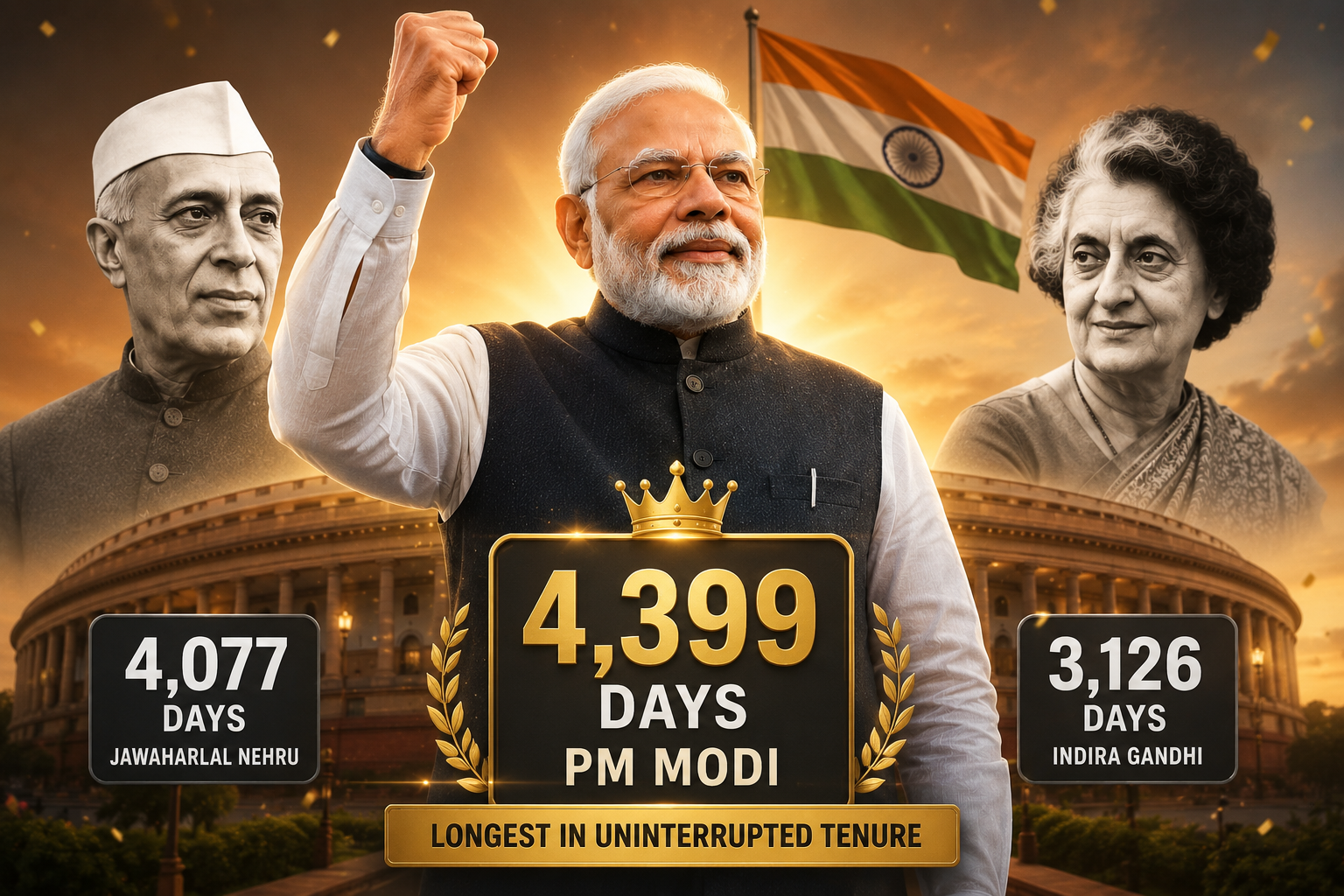
Prime Minister Narendra Modi has crossed the milestone of 4,399 consecutive days in office, becoming one of India’s longest-serving prime ministers in uninterrupted tenure. The achievement places him ahead of former prime ministers Jawaharlal Nehru and Indira Gandhi in terms of continuous service at the country’s highest elected office.
The milestone comes more than a decade after Modi first assumed office in May 2014. Since then, he has led the government through multiple electoral victories and overseen a range of policy initiatives, infrastructure projects, and administrative reforms. His uninterrupted tenure reflects sustained political support and electoral success at the national level.
Political observers note that longevity in office is often viewed as an indicator of leadership stability and public mandate. Over the years, the Modi government has focused on areas such as economic development, digital governance, welfare schemes, infrastructure expansion, and foreign policy engagement. Supporters describe the milestone as a significant moment in contemporary Indian politics.
At the same time, opposition parties have continued to scrutinize and challenge various government policies, highlighting the dynamic nature of India’s democratic system. The achievement has therefore sparked discussion across political circles regarding leadership, governance, and the evolving political landscape of the country.
The latest milestone adds another chapter to India’s parliamentary history, where several leaders have left a lasting impact through long tenures in office. As Modi continues his term, attention will remain focused on the government’s policy agenda and its approach to addressing national priorities in the years ahead.
The record underscores the Prime Minister’s enduring presence in Indian politics and marks a notable moment in the nation’s democratic journey.