

Introduction
It is always been a matter of expression, identity, and belonging with fashion. However, a major change has taken place over the past 10 years. Now trends are not only being created on the runway! A teenager in Mumbai can make a difference to the choice of clothing in New York, and now a viral TikTok can sell out a dress in mere hours! The use of social media has revolutionized the way we learn about fashion, pick out styles, and then consider them.
I have been considering a lot about this lately: my own buying of clothes is influenced by what I see every day on the scrolls. And I’m not alone. I’m going to explain how social media is changing fashion for everyone.
The Rise of the Influencer
Social media has changed all of that; fashion flows from magazines to stores to consumers before the days of social media. This was a gradual and deliberate process. Today, influencers have thrown a wrench in this whole system.
They were just regular folks, in some cases with extra-ordinary style, who created audiences by posting about their outfits, their shopping binges, and how they styled themselves. They’re more engaging than glossy magazine spreads, more relatable. When a favorite influencer that I follow wears a certain jacket, it is not a marketing message, it’s like a friend telling me.
This is a personal connection that can’t be underestimated. Research indicates that people put as much faith in influencer advice as they do in tips they receive from their friends and family. Brands have noticed. Due to the effectiveness of influencer marketing, budgets for fashion marketing have been drastically reallocated to influencer partnerships. Just one post by the right person can result in thousands of sales.
Trends are accelerating even faster than they used to.
Forget the days of seasons long trends. Those days are gone and never to return.
Social media has fostered a culture of micro-trends – which are styles that pop in, sweep across feeds for a couple of weeks and then vanish. Consider “cottagecore” style, “clean girl” makeup, or the return of low-rise jeans. The moves are not from fashion houses. They are a natural by-product of platforms such as TikTok and Instagram, are popular based on hashtags and algorithms, and disappear as soon as the next trend comes in.
The fashion world becomes more democratic and exciting on one hand, but on the other hand, it’s also faster than ever. Trends can be set by anyone and everyone. However, it also puts pressure on you to keep your clothes current, and that’s bad for the wallet or the planet.
Algorithms and the nature of what we can see (and desire)
It’s something I had to discover myself that I am not just selecting what fashion content I am consuming. Algorithms are telling me what to do.
All platforms adopt sophisticated features that will demonstrate content that is likely to be interesting to us. If I focus on a picture of someone who’s wearing vintage denim I see more vintage denim. If I see a video about minimalism on my Pinterest feed or Instagram, my Pinterest feed and Instagram will be flooded with more such videos.
This forms a circle, a feedback loop. The algorithm that catches my eye, exposes me to more of it, and slowly moulds my definition of what’s hot or cool! It’s not manipulation per se, I’m still making choices, but those choices are being pushed in certain directions by unseeing systems.
Hence, two individuals on the identical platform might have completely different thoughts concerning what’s “in” today. Everyone experiences our lives in our own personal fashion bubbles.
Shopping Has Become Seamless
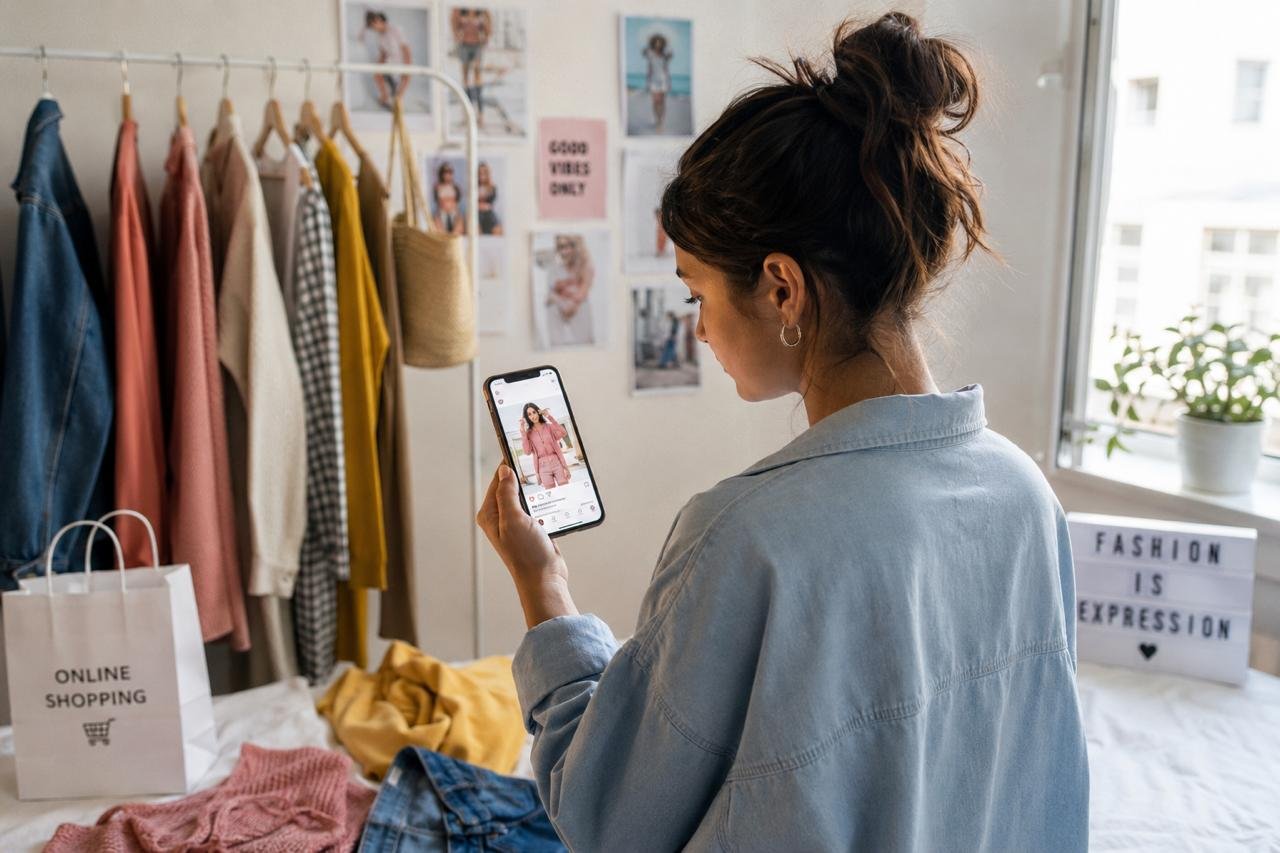
Social media have become not only a place of discovery for fashion, but a place of purchase. The distance between seeing something and owning it has been bridged by Instagram Shopping, TikTok Shop and Pinterest’s buyable pins.
If I see a dress that I like in a post, I tap it and move on in 60 seconds. There’s no need to look for the brand, go to their website or even go searching for the exact product. There’s been a nearly complete merger between inspiration and purchase.
This is very handy from time to time. However, it also makes it very easy to make impulse purchases. The sensation of “Oh, this is so beautiful!”, and the feeling of “I can buy this now!” occur almost the same instant. It’s important to be aware of how these platforms are supposed to encourage you to spend.
Democratization of Style
The best thing about social media is that it has brought fashion down from the rarefied heights of luxury brands and into the realm of the common man. No longer is it only the wealthy, connected, fashion capital-dwelling elite that can have influence.
Everyone from every walk of life, every shape and every place is creating platforms based on their own style. This has led to more diversity and representation within the industry. Brands that once aimed to appeal to a specific model and size have now expanded their offerings to include a broader spectrum of beauty choices, which they were willing to trial in response to social media audiences’ requests.
But now, street style is getting the same attention in the media as Paris and Milan, with styles from Lagos to Tokyo, to São Paulo to smaller towns around the world all getting the recognition they deserve. Fashion truly goes international.
The Sustainability Question
The conflict in social media fashion culture lies at its center. Constant trend-change influences over-consumption. Fast fashion brands capitalise on this cycle making copies of viral fashion in a matter of a matter of weeks.
Social media has also become the medium through which an increasing number of voices have been raised for sustainability. Thrifting content is very popular. Capsule wardrobe ideas, swaps, and do-it-yourself styling. Those ‘fast fashion’ platforms that drive fast fashion are also spreading awareness of its environmental impact.
This balance rests on all of us—what we take in, share, purchase.
Final Thoughts
Social media has not only altered the way we purchase clothes, but it has also impacted our experience of shopping. It has revolutionized the fashion connection in itself. Today there’s no limit to and no hesitation about what to wear for inspiration. Trends are populist, but short-lived. The shopping experience is smooth and seamless, both good and bad.
The one thing I learned is to be purposeful. I am influenced by stories of inspiration, not pressure. I stop and think before purchasing something because it’s trending. And I remind myself that personal style is not about staying up with all the trends, it’s about being what I think I am.
Social media is a tool. The impact it has on our wardrobe will depend on how we use it.