


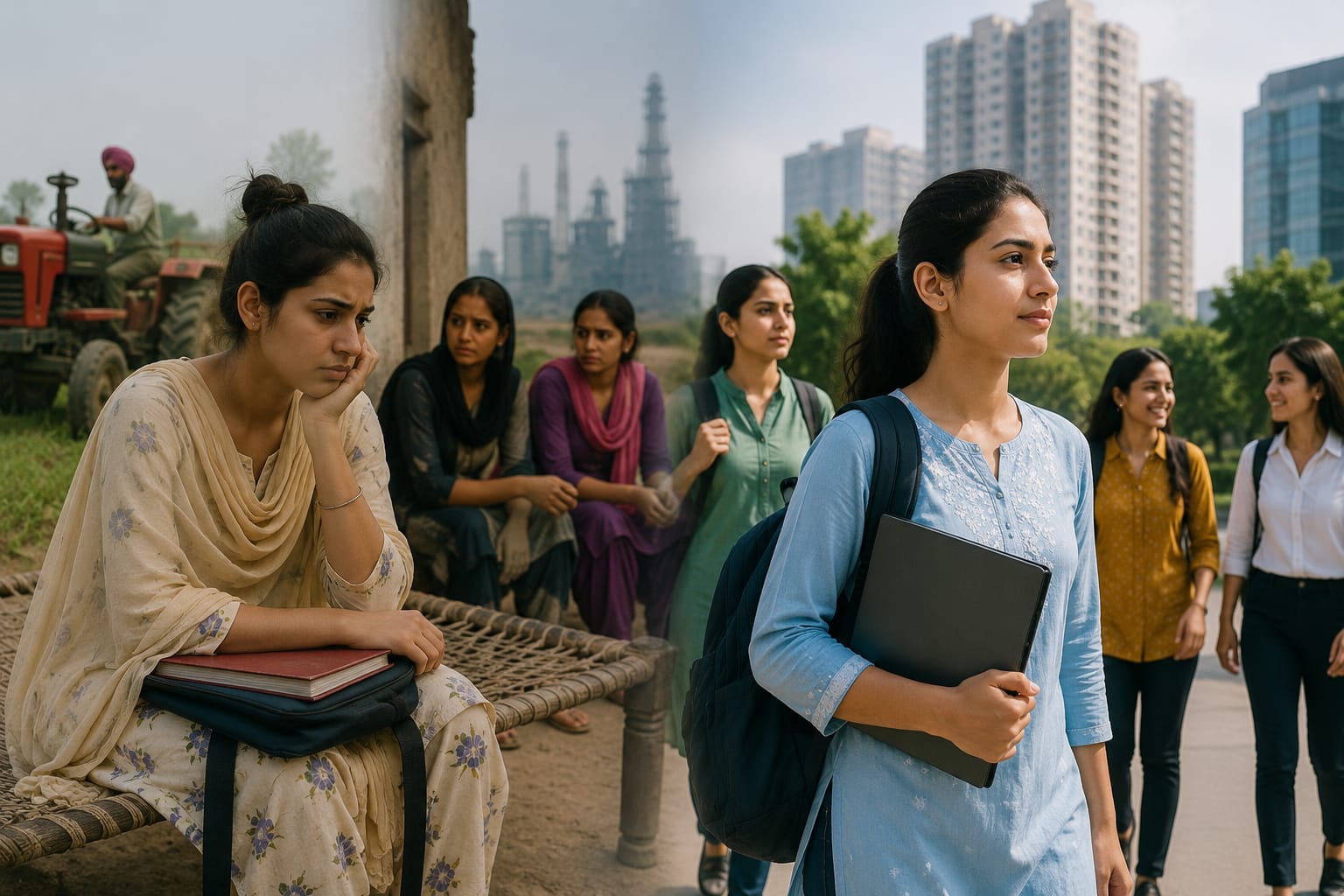
Recent findings from the Periodic Labour Force Survey (PLFS) have highlighted contrasting labour market challenges facing young women in Punjab and Haryana, pointing to both employment shortages and participation gaps that continue to shape the region’s workforce landscape.
The PLFS data indicates that Punjab continues to face a broader job crisis, reflected in lower employment opportunities for youth, including young women. Despite relatively higher education levels among women in the state, a significant proportion remain outside the labour force or are unable to find suitable employment. Experts suggest that limited industrial expansion, agricultural dependence, and a mismatch between skills and job availability are contributing factors.
In contrast, Haryana shows a different challenge. While employment opportunities exist in certain sectors, the labour force participation rate of young women remains comparatively low. According to PLFS trends, a large share of young women in Haryana are neither working nor actively seeking employment. This points to a participation gap rather than purely an unemployment issue.
Analysts attribute this gap to a combination of socio-economic factors, including cultural norms, safety concerns, mobility restrictions, and household responsibilities. Rural-urban differences also play a role, with participation rates typically higher in urban centres but still below national averages for women.
In both states, education has not fully translated into workforce entry for young women. While enrollment in higher education has improved, the transition from education to employment remains weak, particularly in semi-skilled and formal job sectors.
Experts note that the divergence between Punjab and Haryana reflects broader structural issues in India’s labour market. Punjab’s challenge is largely demand-side, driven by insufficient job creation, while Haryana’s issue is more supply-side, where social and structural barriers limit participation.
Policy analysts emphasize the need for targeted interventions, including skill development programs aligned with market demand, improved workplace safety, and greater support for women entering the workforce. Expanding flexible work opportunities and encouraging local employment generation are also seen as critical steps.
The PLFS findings underscore the urgency of addressing both unemployment and participation barriers to ensure that young women in both states can meaningfully contribute to and benefit from economic growth.