


Black holes are commonly understood to form when massive stars exhaust their nuclear fuel and collapse under their own gravity, creating a region in space from which nothing, not even light, can escape. However, new theoretical research suggests that black holes may also be connected to a far more unusual possibility rooted in the structure of spacetime itself.
In Einstein’s theory of general relativity, gravity is described as the curvature of spacetime caused by mass and energy. Under extreme conditions, such as the collapse of a massive star, this curvature can become so intense that an event horizon forms, marking the boundary of a black hole. Traditionally, this process has been associated with astrophysical objects like dying stars.
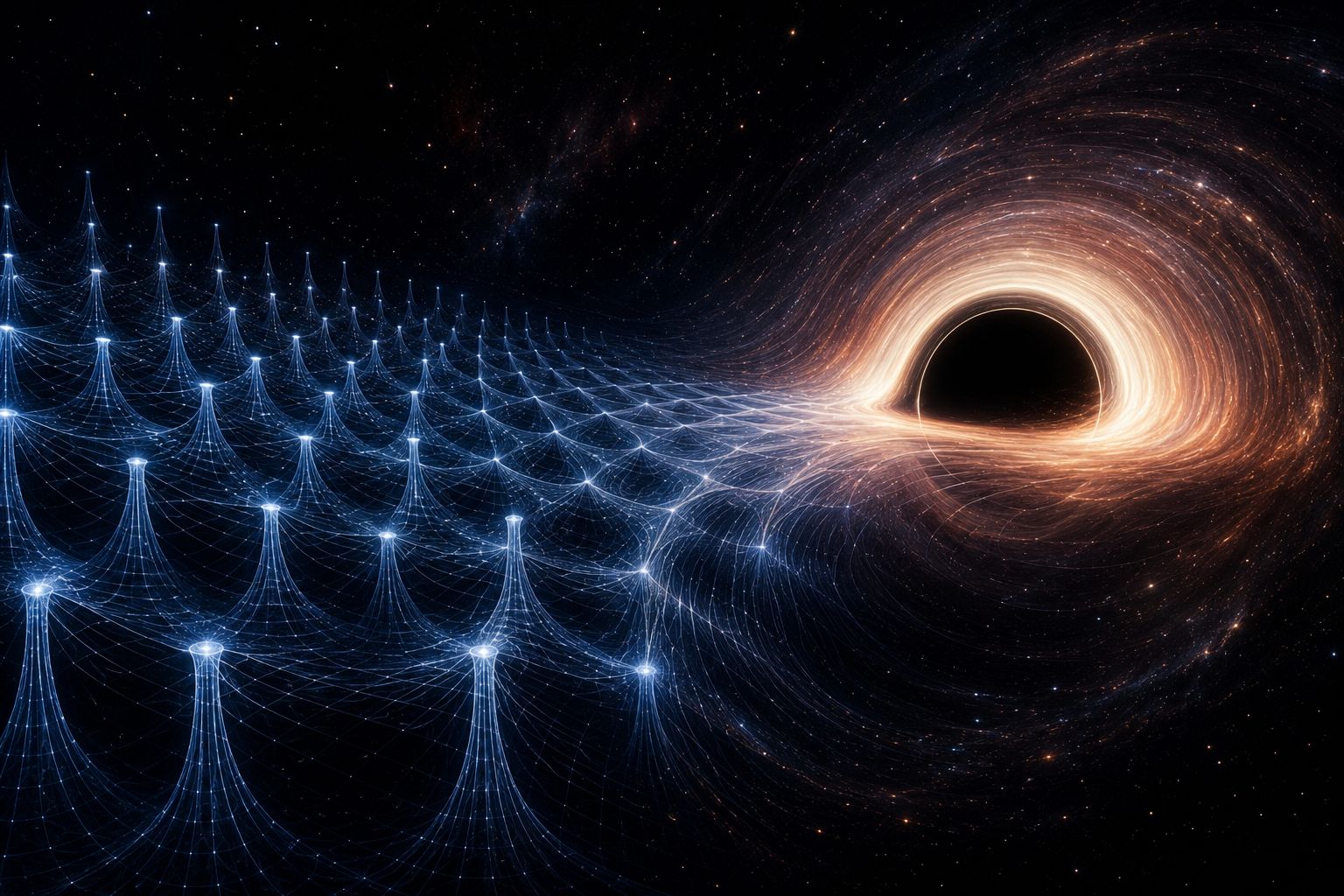
The new study introduces a more abstract scenario involving so-called “spacetime crystals.” These are theoretical configurations predicted within general relativity, in which spacetime can organize into repeating, ordered patterns when it is close to the threshold of gravitational collapse. Rather than requiring a physical star or matter distribution, these structures emerge from the mathematical properties of spacetime itself under specific conditions.
Researchers from Goethe University Frankfurt and TU Wien have now reportedly derived an exact mathematical formula describing how these spacetime crystal structures form. The work also outlines the precise conditions under which such ordered configurations become unstable and transition into black holes.
According to the study, the formula provides a clearer framework for understanding how spacetime behaves in extreme gravitational regimes. While the concept of spacetime crystals remains theoretical, the results offer a new way to explore the boundary between stable spacetime configurations and gravitational collapse.
Physicists note that such mathematical models are important for probing the limits of general relativity and for exploring how spacetime might behave under conditions that cannot yet be reproduced experimentally. The idea also contributes to ongoing discussions about the nature of gravity and the possible structures that could exist near black hole formation thresholds.
Importantly, the findings remain within the realm of theoretical physics. The spacetime crystal structure has not been observed in nature, and the results are based on mathematical solutions rather than direct astronomical evidence.
Researchers emphasize that further study will be needed to determine whether these theoretical configurations have observable consequences or can be linked to physical processes in the universe. The work nonetheless provides a new perspective on how black holes and spacetime geometry may be connected at a fundamental level.