


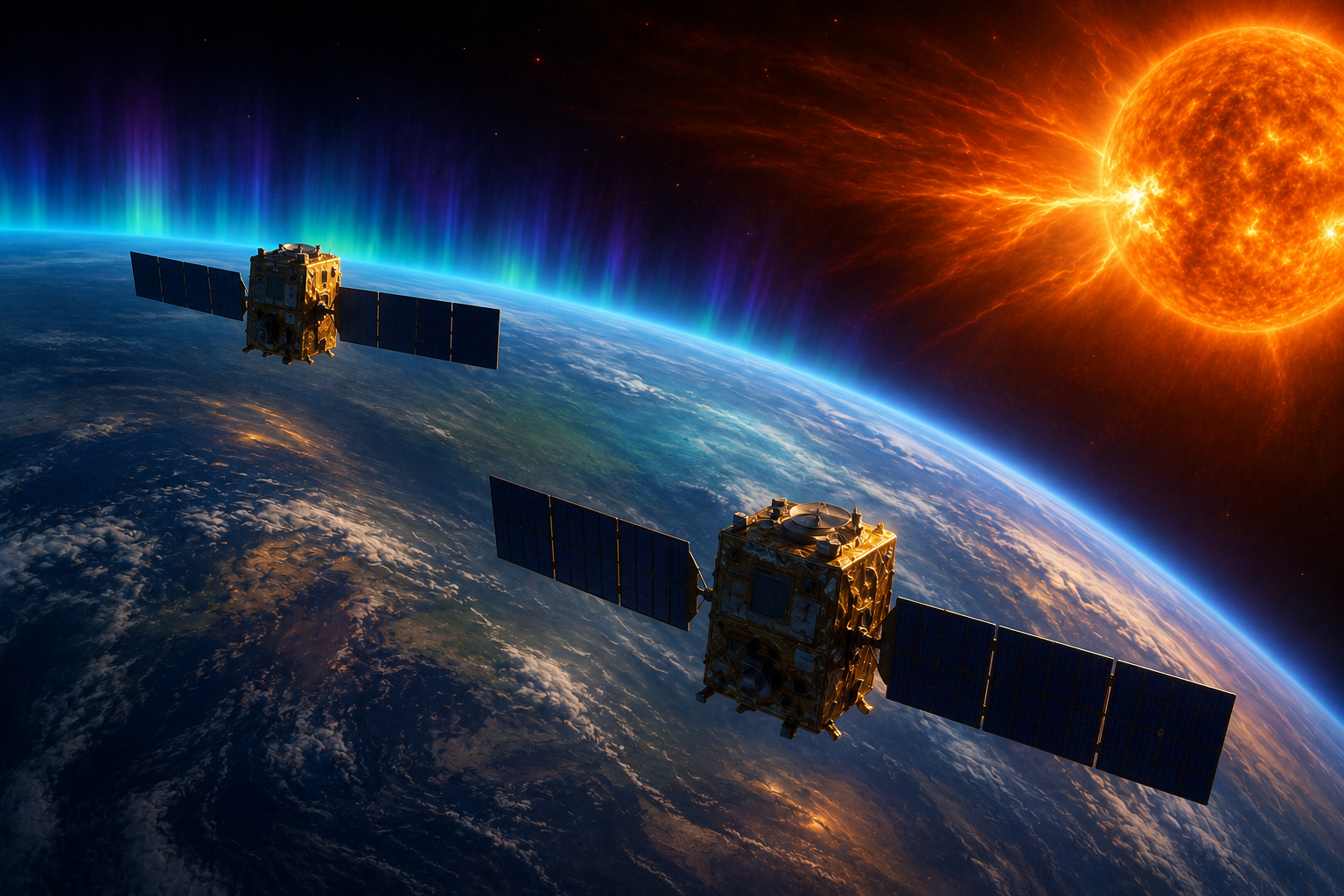
NASA has selected the DAPHNE (Dynamic Atmosphere-Ionosphere Explorer) mission to improve scientists’ understanding of how Earth’s atmosphere influences space weather and affects critical technologies. The mission marks a significant step toward enhancing forecasts that protect GPS systems, low Earth orbit satellites, and astronauts operating in space.
DAPHNE will use two identical satellites to study the connection between Earth’s lower and upper atmosphere. Scientists aim to understand how atmospheric changes travel upward and influence the ionosphere and thermosphere, regions where space weather events occur. These areas play a crucial role in satellite communications, navigation systems, and space operations.
NASA officials believe the mission will provide valuable data to help predict disruptions caused by solar activity and atmospheric changes. The findings could improve the reliability of technologies that people rely on every day, including navigation, communication, and weather-monitoring systems.
According to NASA, DAPHNE will gather measurements of neutral winds, temperature, and atmospheric composition. Researchers will combine this information with lower-atmosphere energy data to build more accurate space weather prediction models.
The mission is led by Aimee Merkel from the Laboratory for Atmospheric and Space Physics at the University of Colorado Boulder. NASA plans to conduct a confirmation review in 2027 before moving forward with full development. If approved, DAPHNE could launch no earlier than 2029 with a mission budget of up to $250 million, excluding launch costs.
As NASA prepares for future missions to the Moon, Mars, and beyond, DAPHNE will help scientists better understand and predict the space environment, improving safety for both technology and human exploration.