

Introduction
The world of technology moves at an astounding pace and one of the biggest developments of the last few years is the introduction of 5G technology. 5G is the fifth generation of wireless telecommunication networks that will offer significantly higher speeds of Internet, much lower latency time and more network capacity than the previous generations. This is not just another 4G upgrade; it is a game-changer that can transform industries, enhance everyday communication, and pave the way for innovation worldwide.
The impact of 5G is far-reaching, with promises of revolutionizing services ranging from high-definition video streaming to supporting smart cities and advanced healthcare applications. With the businesses and consumers increasingly turning to digital technologies, knowing the benefits of 5G helps appreciate its part in the future.
So, what is 5G Technology?
5G is the FIFTH Generation of mobile network technology. It provides much faster data transmission, quicker response time and the capability to connect millions of devices at once. In contrast to previous mobile networks, 5G can enable new technologies like the Internet of Things, AI, cloud computing, VR and autonomous vehicles.
This enhanced efficiency enables individuals and entities to access information more easily and efficiently and helps meet the increasing needs for digital communication.
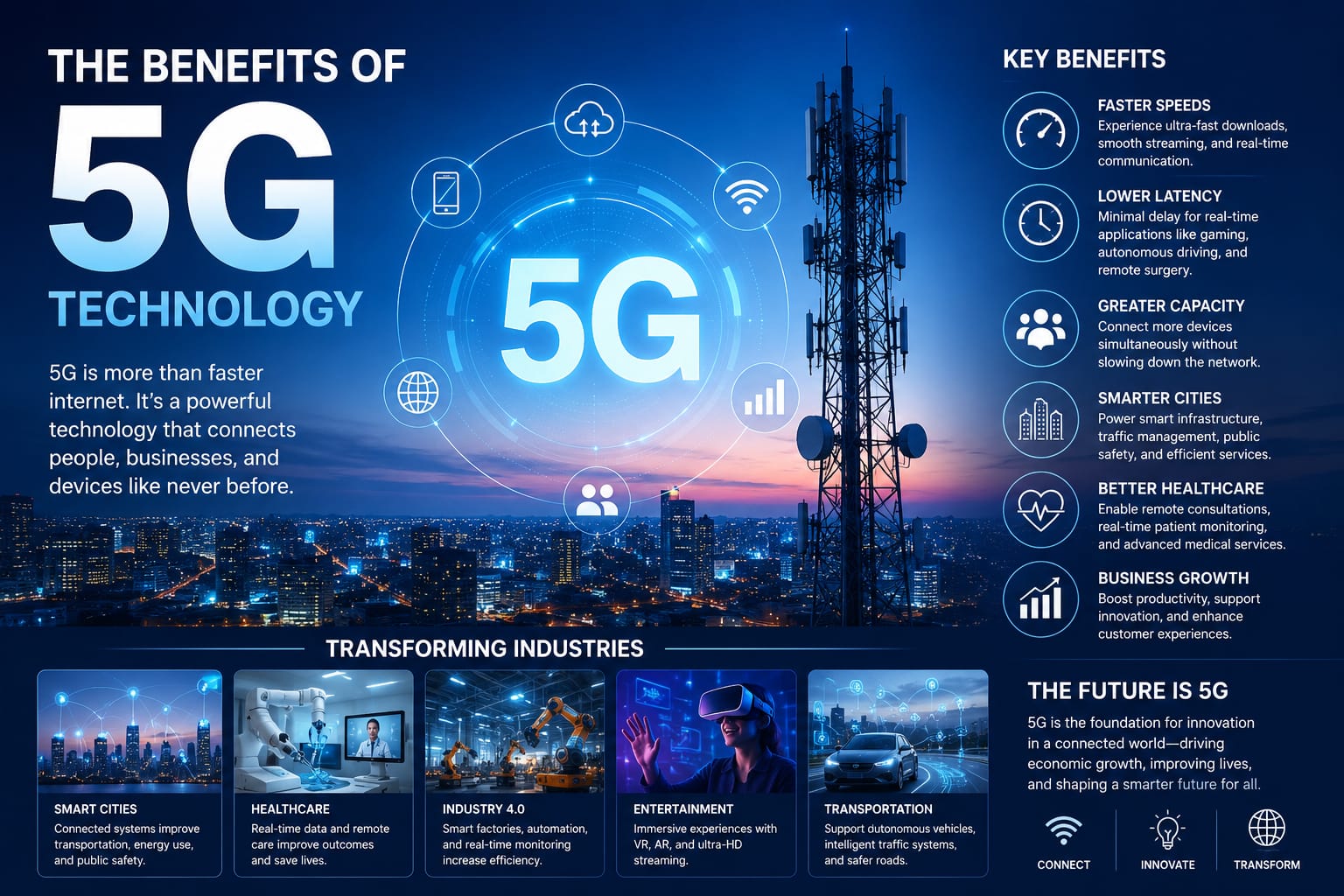
Key Benefits of 5G Technology
1. Faster Internet Speeds
The most significant benefit of 5G is its incredible speed. Compared with the earlier generations, users can download large files, stream ultrahigh definition videos and access cloud-based services much quicker. The faster the connectivity, the better an individual or business will be in terms of productivity, entertainment and communication.
2. Lower Latency
Latency: Time required for data to pass from one device to another. This delay can be significantly reduced with 5G, allowing real-time communication. For applications like online gaming, remote surgery, autonomous vehicles, and industrial automation, every millisecond counts, and that’s where low-latency comes into play.
3. Improved Network Capacity
However, with the increasing number of devices attached, traditional mobile networks can become congested. The promise of 5G is to be able to handle a lot more devices at once without compromising performance. This is perfect for places where lots of people are, such as public gatherings, stadiums, and airports.
4.Improved Support of Smart Cities
5G will be a pivotal technology in the smart cities movement, enabling traffic management systems, public transportation, surveillance cameras, street lighting, and environmental monitoring devices to be linked together. These interlocking systems not only have the power to enhance urban life but also to safeguard the public, save energy and improve the quality of urban life.
5. Growth of the Internet of Things (IoT)
Reliable and efficient connectivity is vital to the Internet of Things. With its high capacity and low latency, 5G enables smart homes, wearable devices, connected factories, and agricultural sensors to communicate seamlessly. This is what it means to make more intelligent environments and to optimize operations.
6. Better Healthcare Services
One of the sectors that is poised to greatly benefit from 5G is healthcare. A doctor can use the video to have a consultation with a patient remotely, track a patient with connected medical devices, and even assist with advanced robotic surgeries with minimal delay. This helps to promote quality health care, particularly in rural areas.
7. Increased Business Productivity
Efficient data transfer, cloud based collaboration and fast communication benefits businesses. Workers can remotely access with enhanced connectivity, and companies can implement digital transformation tactics more effectively. This means improved productivity and improved customer experiences.
8. Enhanced Education and online learning.
Technologies like virtual reality and augmented reality can be used to provide interactive virtual classrooms, live lectures, and immersive learning experiences for educational institutions. Stable connections, high quality video conferencing and instant access to learning resources are provided for students.
9. Support for Innovation
The development of new technologies like artificial intelligence, robotics, autonomous transport, and smart manufacturing demands high-speed networks and reliable connections. 5G brings the technology and infrastructure to enable these innovations to be scaled up.
10. Growth and job creation
5G is driving investment in technology and infrastructure, manufacturing and digital services. This leads to new jobs and innovation and improved business efficiencies to stimulate the economy.
5G Technology Challenges and Problems
While there are many benefits to 5G, there are some drawbacks. The 5G infrastructure requires substantial capital investment, such as new towers and equipment. The deployment may take longer in rural areas because of the higher cost. Also, higher connectivity demands robust cybersecurity measures to ensure user data security and network system safety.
The Future of 5G
5G is not all about faster smartphones. It will enable, connected vehicle, smart factories, advanced healthcare, precision agriculture, intelligent transportation systems and immersive digital experiences. With global network coverage, 5G will be a major catalyst for innovation and facilitate businesses and communities to adopt digital transformation.
As the technology continues to evolve, it could also lead to even newer and more sophisticated technologies, offering opportunities that could not have been realized with the now-older communication networks.
Conclusion
5G is a significant leap in wireless technology. It has high-speed connectivity, low latency, enhanced reliability and capacity for networks, which allows for new opportunities in various industries and daily life. As 5G is poised to revolutionize connectivity, communication, and collaboration, it has the potential to transform the world in many ways, including its impact on healthcare, education, smart cities, and business innovation.
With the ongoing spread of adoption, the value of the 5G technology will be more and more noticeable, which is one of the most significant technological advancements of the modern time. Investing in solid 5G infrastructure now will help to create a smarter, more connected and digital future for generations to come.