

Introduction
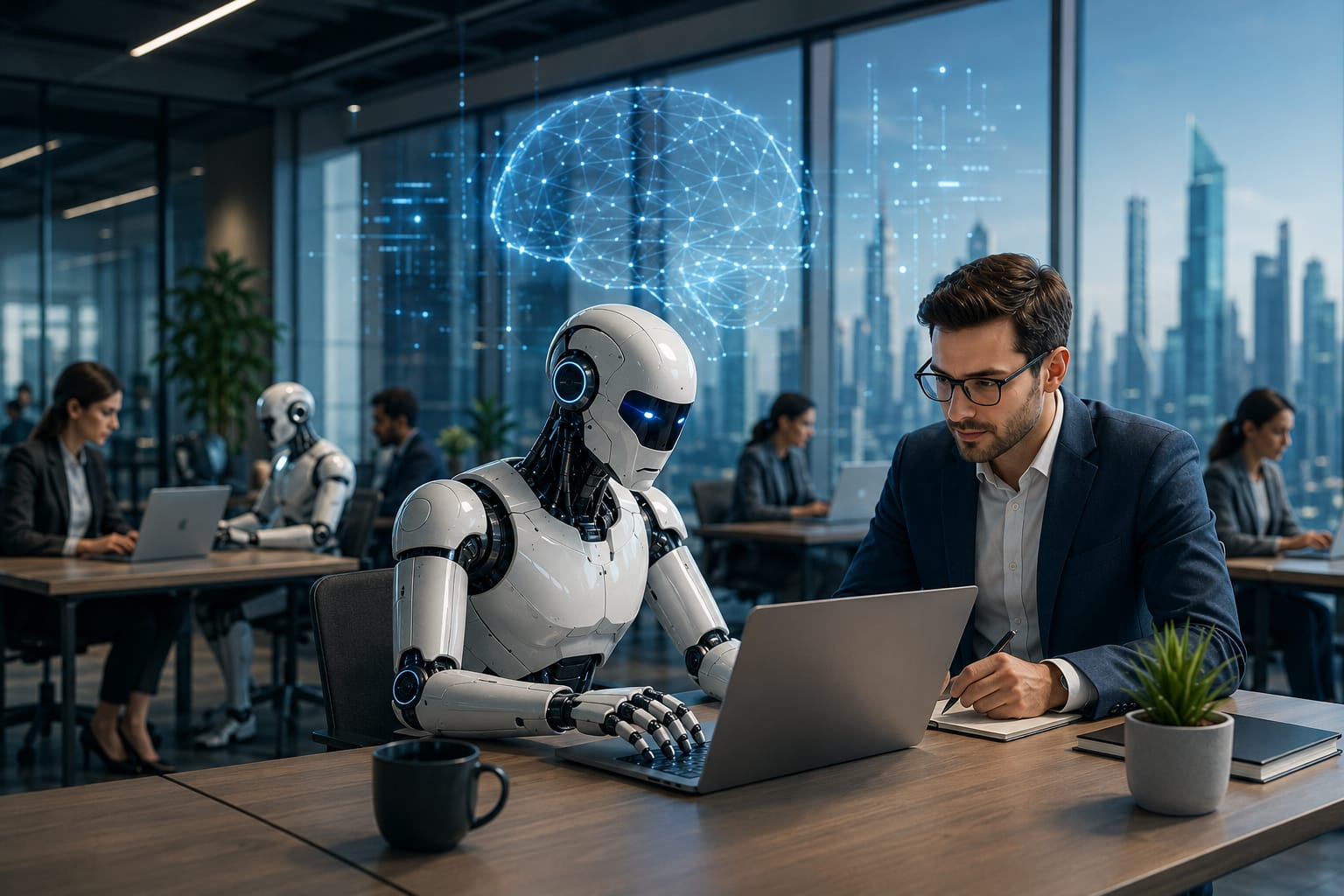
In today’s modern world, Artificial Intelligence (AI) is one of the most impacting technologies. AI is revolutionizing many aspects of everyday life, from health care and education to business and entertainment. AI technologies are reshaping workplaces and have the potential to impact human work, enhancing efficiency, automating tasks, and opening up new opportunities. New skills, creativity and adaptability will be needed, as will humans working alongside machines in the future of work.
AI isn’t just taking the place of traditional approaches; it’s transforming entire industries and changing the dynamics between people and technology. To prepare for future changes, it is vital to have an understanding of the implications of AI on the future of work on an individual, business and societal level.
Automating repetitive tasks.2. Automation of repetitive tasks.
One of the major impacts of AI on the workplace is the automation of repetitive and time-consuming tasks. AI systems can be used for tasks like data entry, customer support, scheduling, and analysis, which are faster and more accurate than human systems.
Automation frees up employees to work on more creative and strategic, complex tasks. With AI tools, professionals can save hours on repetitive tasks and make informed decisions.
2. Development of new jobs
There are fears that perhaps AI will take jobs away, but there are also many new job opportunities. The rise of AI has created a need for individuals in roles like AI developer, technology manager, cybersecurity, machine learning, and data science.
The new roles are not only emerging that they were not present previously, but also the new roles are reshaping the existing job patterns which signifies that technological development can generate new jobs.
3. Changing Skill Requirements
In the future workplace people will have to learn new skills. Knowledge and an understanding of how the digital world works, and how to work with AI tools, will become more important.
In addition to the technical skills, human skills like creativity, communication, critical thinking, emotional intelligence, and problem solving will continue to be helpful. While AI can handle information, human traits such as innovation and empathy are harder to replace.
The continuous learning and skill development will help employees adjust to the changing work environment.
4. Greater productivity & efficiency
AI is pivotal in enhancing productivity by sifting through vast amounts of data, forecasting trends, and offering precise solutions for organizations. AI can help businesses make quicker decisions and enhance their processes.
AI can, for instance, enable companies to grasp customer preferences, resource management, and enhance service quality. This will enable businesses to become more efficient and competitive in the global market.
5. AI in various industries.5. AI across various industry sectors.
AI is transforming various industries in different ways.
Healthcare: AI facilitates doctors in diagnosing diseases, interpreting medical reports, and enhancing patient care.
Education: AI can provide personalized learning, online learning, and intelligent learning platforms.
The use of AI in finance focuses on fraud detection, risk assessment, and financial planning. In finance, AI is applied to fraud detection, risk analysis, and financial planning.
Manufacturing: AI-powered machines improve production processes and quality control.
Marketing: AI can be used to analyze customer behavior and develop marketing strategies.
These applications highlight the critical role of AI in today’s working lives.
Leveraging AI for remote work using AI to support remote working.
AI is also playing a role in the rise of remote work. Teams work efficiently from various locations with digital assistants, communication tools and AI-based project management systems.
Employees can work together more efficiently, plan their work and manage workflow with the help of AI. AI and remote job availability are opening up opportunities and making work more flexible and accessible.
7. Challenges of AI in the Workplace
While AI offers many advantages, it also presents some challenges. A primary worry is the loss of employment due to automation. Individuals in some sectors may require to acquire new skills to be competitive.
Data privacy and ethical considerations of using AI are another challenge. Ensuring responsible and ethical use of AI systems is crucial for organizations, as they need to ensure that their applications do not make unfair decisions or misuse personal information.
There is also a balance that must be achieved between what humans decide to do and what a machine can do.
8. Importance of Human Skills in the AI Era
Despite the use of advanced AI technology, human skills will remain essential. Human workers are special because they have this ability to be creative, to lead, to be a part of a team, and to understand emotions.
What the future of work will look like isn’t going to be humans vs. AI, it’s going to be humans and AI. Those who master the use of AI will enjoy better prospects for development and success.
Enhancing future work capacity.
The key to success in an AI-driven world is continuous learning and adaptability. Suitable training for future-ready skills should be offered in educational institutions and organizations.
It is also beneficial for governments and businesses to facilitate the transition of workers through digital education, reskilling initiatives, and responsible development of AI.
Adopting for the future involves facing the changes in technology and making sure that people are the ones who are at the forefront of the changes.