

AI in Daily Work and Education
Introduction
Artificial Intelligence (AI) has become an important part of modern life. It is changing the way people work, learn, and communicate. From virtual assistants and smart devices to educational platforms and workplace automation, AI helps people complete tasks more efficiently. As technology continues to advance, AI is becoming increasingly valuable in both professional and educational settings. Its ability to process information quickly and provide useful insights makes it a powerful tool for improving productivity and learning experiences.
Understanding AI
Artificial Intelligence refers to computer systems that can perform tasks that normally require human intelligence. These tasks include problem-solving, decision-making, language understanding, and data analysis. AI systems learn from data and improve their performance over time. Today, AI is widely used in industries such as healthcare, finance, education, manufacturing, and customer service.
AI in Daily Work
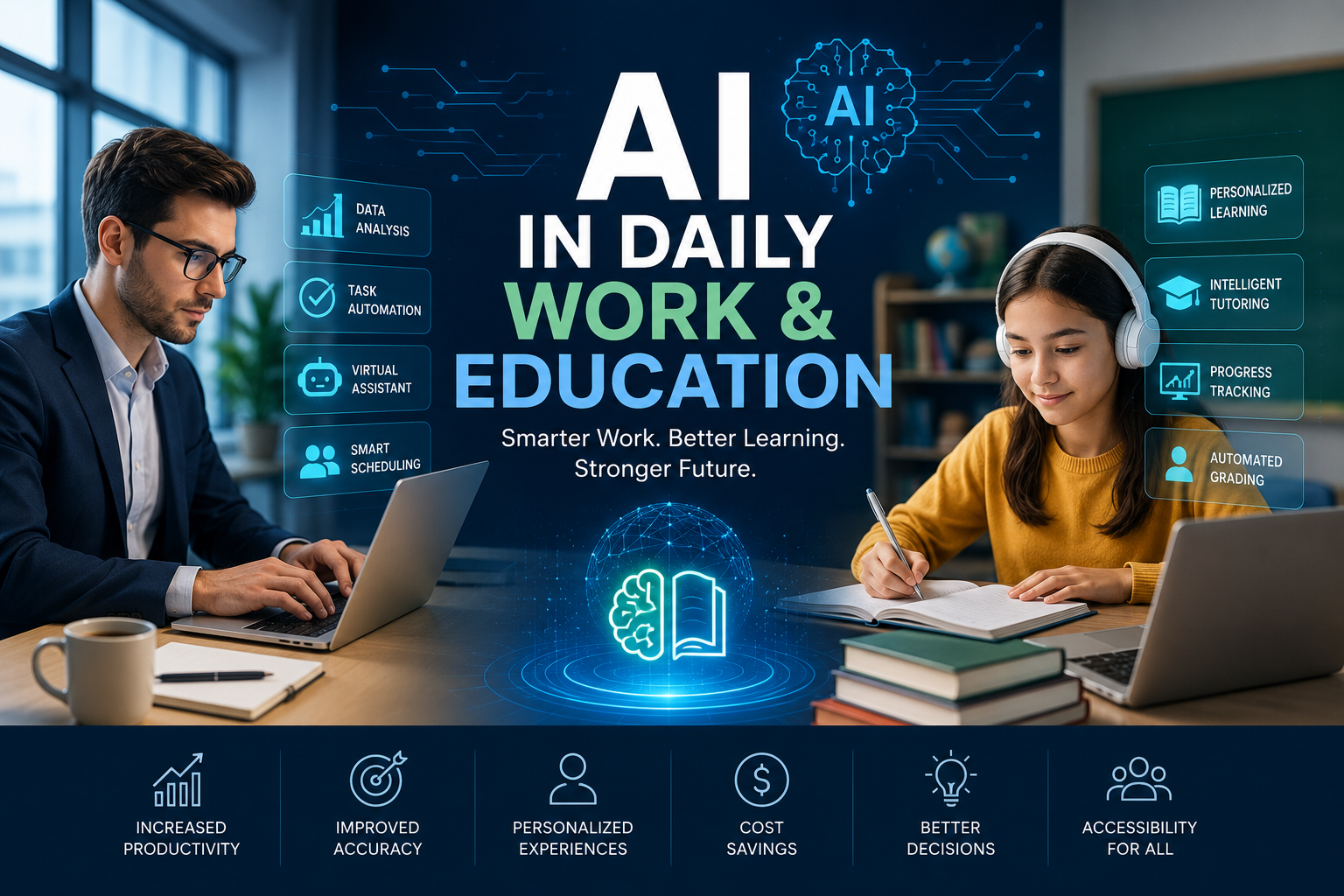
AI has transformed workplaces by simplifying routine tasks and increasing efficiency. Many businesses use AI-powered software to automate repetitive activities such as data entry, scheduling, and report generation. This allows employees to focus on more important and creative responsibilities.
One of the most common workplace applications of AI is virtual assistants. These tools can organize meetings, send reminders, manage emails, and answer basic questions. Customer service departments also benefit from AI through chatbots that provide instant support to customers around the clock.
AI also helps organizations analyze large amounts of data quickly. Businesses use AI to identify trends, predict customer behavior, and make informed decisions. In the finance sector, AI assists in detecting fraudulent activities and managing risks. In healthcare, it supports doctors by analyzing medical records and helping diagnose diseases more accurately.
Remote work has become easier with AI-powered collaboration tools. Features such as automatic transcription, language translation, and smart scheduling improve communication among team members working from different locations.
AI in Education
Education is one of the sectors experiencing significant changes due to AI. Modern educational platforms use AI to create personalized learning experiences for students. Instead of following the same learning path, students receive content tailored to their abilities, strengths, and weaknesses.
AI-powered learning systems can track student progress and provide immediate feedback. This helps learners understand their mistakes and improve their performance more effectively. Teachers can also use AI tools to identify students who may need additional support.
Language learning applications use AI to improve pronunciation, grammar, and vocabulary skills. Intelligent tutoring systems provide explanations and practice exercises based on individual learning needs. These technologies make education more accessible and engaging.
Administrative tasks in educational institutions are also becoming more efficient through AI. Automated grading systems, attendance tracking, and timetable management reduce the workload of teachers and administrators. As a result, educators can dedicate more time to teaching and interacting with students.
Benefits of AI in Work and Education
AI offers numerous benefits in both professional and educational environments. One major advantage is increased productivity. By automating repetitive tasks, AI saves time and allows people to focus on higher-value activities.
Another benefit is improved accuracy. AI systems can process large volumes of information with fewer errors than manual methods. This leads to better decision-making and more reliable outcomes.
AI also supports personalized experiences. In education, students receive customized learning materials, while employees gain access to tools that match their specific needs. Additionally, AI enhances accessibility by providing translation services, speech recognition, and assistive technologies for individuals with disabilities.
Cost savings are another important advantage. Organizations can reduce operational expenses through automation, while educational institutions can improve resource management and administrative efficiency.
Challenges and Concerns
Despite its advantages, AI also presents certain challenges. One major concern is job displacement. As automation increases, some routine jobs may become less necessary, requiring workers to learn new skills and adapt to changing roles.
Privacy and data security are also important issues. AI systems often rely on large amounts of personal data, making it essential to protect sensitive information from misuse or unauthorized access.
In education, excessive dependence on AI may reduce critical thinking and problem-solving skills if students rely too heavily on automated assistance. Therefore, AI should be used as a supportive tool rather than a replacement for human learning and creativity.
Another challenge is ensuring fairness and reducing bias in AI systems. If AI is trained on incomplete or biased data, it may produce unfair results. Developers and organizations must work to create ethical, transparent, and responsible AI solutions.
The Future of AI
The future of AI in daily work and education appears highly promising. As technology advances, AI systems are expected to become more intelligent, efficient, and accessible. Future workplaces may use AI for advanced decision support, while educational institutions may offer even more personalized learning environments.
However, the successful integration of AI will depend on responsible use, proper regulation, and continuous skill development. People will need to work alongside AI rather than compete with it. By combining human creativity, judgment, and emotional intelligence with AI capabilities, society can achieve greater innovation and productivity.
Conclusion
Artificial Intelligence is reshaping both work and education by improving efficiency, accuracy, and accessibility. It helps businesses automate tasks, supports better decision-making, and creates personalized learning experiences for students. Although challenges such as privacy concerns, job displacement, and ethical issues remain, the benefits of AI are significant. With responsible implementation and continuous learning, AI can serve as a valuable partner in building a more productive, innovative, and knowledge-driven future.