

Introduction
. Digital twins are now becoming an integral part of today’s industry, from manufacturing plants to hospitals to smart cities.
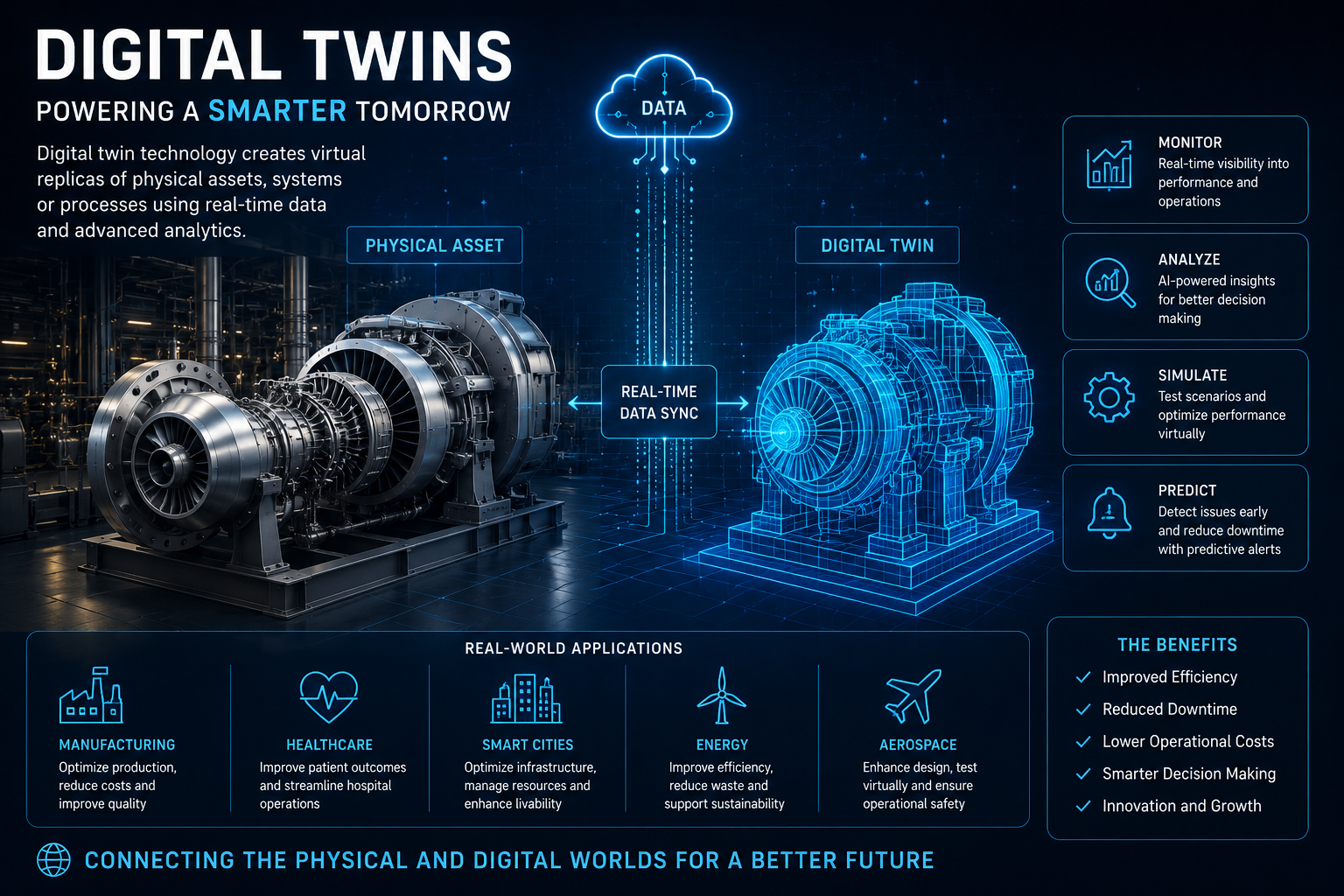
A Digital Twin is the digital representation of a real-world object or process.
The real-time sync can offer organizations important data on the system’s performance for various scenarios.
Transforming Manufacturing
One of the top applications of digital twin technology is in manufacturing. Digital twins are used effectively in modern factories to keep track of machine, production line and equipment health 24/7.
.This proactive maintenance scheduling can minimize downtime and boost productivity by companies not waiting for equipment failures.
Improving Healthcare
Personalized digital twins of patients might enable doctors to anticipate how patients will progress and provide individualized treatment plans based on patient-specific health information in the future.
Building Smarter Cities
Digital twin technology is a vital component to smart city development. In the field of urban planning, virtual city models are used for the analysis of traffic flows, monitoring of public infrastructure, management of utilities and disaster preparedness.
City officials can establish solutions that stop problems from escalating into larger issues by combining data from public services, power systems, weather stations and transportation systems. This results in better management of resources and a better quality of life for the inhabitants.
Driving Sustainability
Sustainability has become a key pillar in the agenda of governments and businesses around the world. Digital twins enable organizations to save waste, optimize energy use, and decrease environmental footprint.
Electricity consumption is being tracked in real-time at factories and commercial buildings are using digital twins to optimize heating, cooling and lighting systems. Renewable energy operators can model wind turbines and solar panels to make sure that they can generate power at a maximum rate with minimal maintenance.
Challenges to Adoption
Creating precise virtual models needs top-tier sensors, dependable internet connections, and solid cloud systems.
The other challenge is the lack of skilled professionals who can handle the latest technology like AI, IoT, and data analysis. As more and more people adopt, ongoing training of the workforce will be critical.
The future of digital twins.
As technology in computing power, artificial intelligence and sensor technology advances, the future of digital twin technology is looking bright. The experts say that digital twins will be ubiquitous in the industries helping companies make faster decisions, mitigate risks in operations, and boost efficiency.
Robotics and smart infrastructure are becoming more common as autonomous systems, and digital twins will give intelligence to manage increasingly complex operations. In the future, companies who invest in this technology will have an edge in the digital economy.
Conclusion
Digital Twin technology is reshaping the way industries work by generating smart virtual representations of real systems. The applications of digital twins are varied, ranging from manufacturing and healthcare to smart cities and renewable energy, where they play a role in decision-making by providing real-time monitoring and predictive analysis. Meantime, digital twins will be one of the most impactful technologies of the future in terms of innovation and digital transformation in industry.