

Introduction
The demand for data centers has been growing at a phenomenal rate, as the world becomes more reliant on cloud computing, artificial intelligence and digital services. They drive a variety of applications, including online banking, video streaming, e-commerce and AI applications. The rapid growth has also garnered attention for their energy use and environmental effects, though. To respond to this, governments and technology companies are putting significant work into green data centers, which aim to cut down on carbon emissions whilst maximizing efficiency in the data center.
The trend of sustainable digital infrastructure is becoming more of a necessity than a trend in corporations around the world. Green data centers are becoming a significant answer to the dilemma of technological advancement and environmental consciousness.
What is a “Green” Data Center?
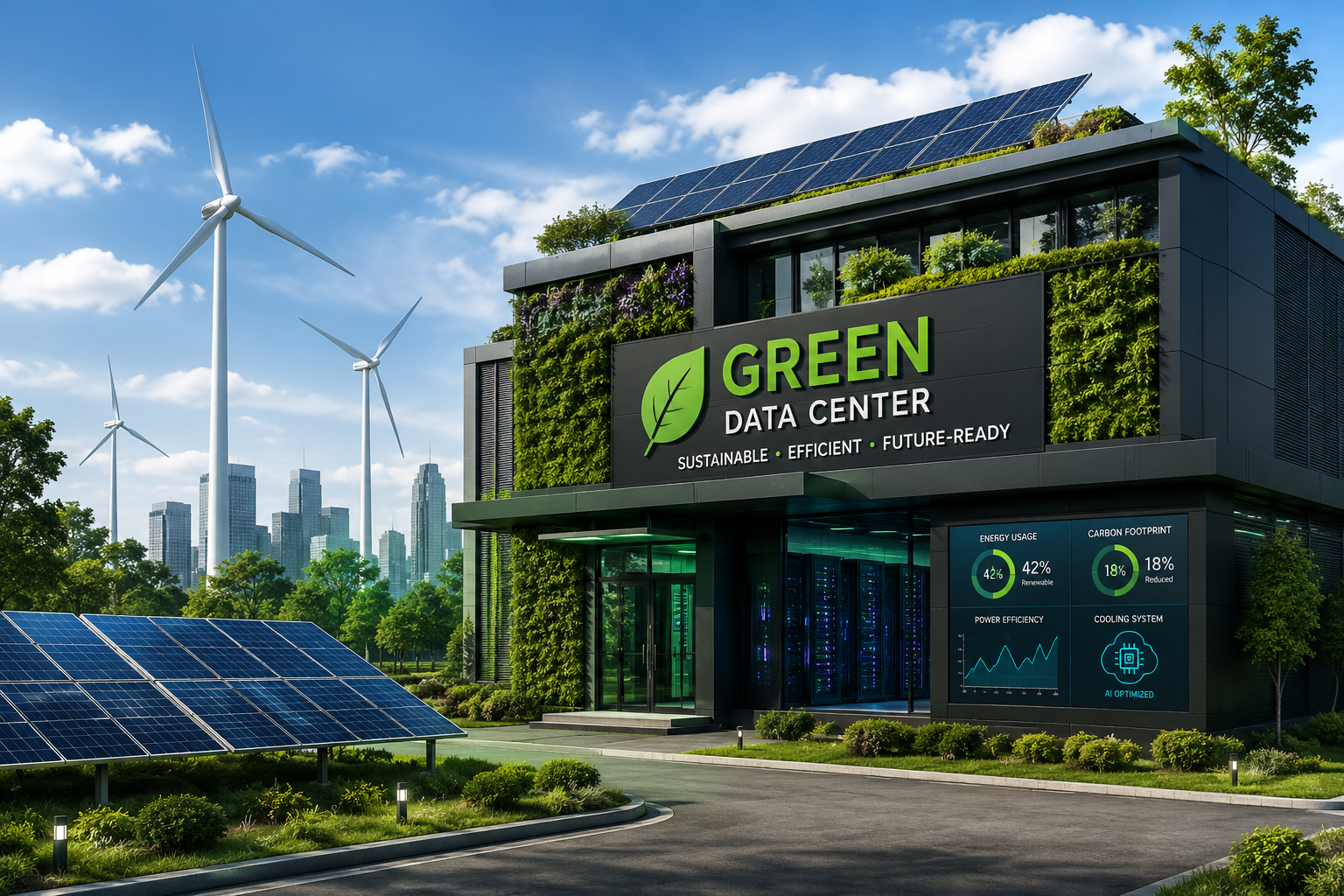
A green data center is one that has gone to great lengths to minimize its environmental impact through the utilization of energy-efficient technologies, the use of renewable energy sources and the implementation of green building strategies. Green Data Centers use less energy overall than traditional Data Centers, which require a lot of electricity for computing and cooling.
The centers are frequently solar, wind or water powered, have sophisticated cooling systems, intelligent energy management software, and cutting edge server technologies that perform more efficiently while consuming less electricity.
In a digital world, it’s more vital than ever to focus on sustainability. Sustainability is becoming more critical than ever in the digital age.
Internet use is steadily increasing worldwide as businesses undertake digital transformation. The growing demand for artificial intelligence, machine learning, and cloud services further strains current infrastructure. The use of artificial intelligence, machine learning and cloud services also makes use of a lot of computing power, adding to the strain on current infrastructure.
Data centers are on-the-go operations, making energy consumption a major concern. If these actions are not taken, electric use and GHGs could rise substantially over the years.
Green data centers help to overcome this challenge by decreasing energy waste and fostering the increasing digital economy. They also support organizations to achieve environmental commitments and meet increasingly stringent sustainability standards.
Innovations Driving Green Data Centers
Innovative technologies are gaining popularity in modern data centers in order to make it more efficient. AI tools are employed to track equipment performance, anticipate maintenance requirements and fine-tune cooling systems as they operate. This minimizes waste of energy and enhances reliability.
In many high-performance computing environments, liquid cooling is becoming the preferred method of cooling in lieu of traditional air conditioning. Liquid transfer heats more efficiently than air, which means there’s a substantial decrease in electricity use.
A second noteworthy innovation is server virtualization, which runs multiple applications on a single physical server. This helps reduce hardware needs and operating costs, and makes use of the resources.
Additionally, numerous companies are developing the modular data center design, which allows for data center expansion as needed to minimize construction waste and maximize data center efficiency over time.
Benefits for Businesses
The investment in green data centers is both economically and environmentally beneficial. While there can be a higher initial cost, companies can realize significantly lower electricity bills, maintenance costs, and equipment lifecycle.
In addition to its environmental benefits, sustainable infrastructure also boosts corporate reputation. Today’s customers, investors and business partners want companies to prove their environmental commitment. Going green and reducing carbon emissions can be real competitive advantages in today’s business world.
Furthermore, energy efficient infrastructure helps to enhance the operational resilience by minimizing reliance on fluctuating energy markets and fostering continuity of business operations.
Mitigating the effects of climate change in cities is a significant challenge. The need of the hour for cities is to tackle climate change impacts.
The digital economy in India is growing at a fast pace, which is driving the call for sophisticated data center equipment. This sector is seeing substantial investment as a result of government initiatives for digital services, growing internet penetration, and rising use of AI-powered businesses.
The country has significant solar energy potential that allows to build facilities with renewable energy resources and environmentally friendly. Some companies in the technology industry are already using renewable energy in their operations and are exploring new cooling solutions for India’s climate.
With the increased demand for digital services, green data centers may have a significant contribution in national sustainability targets and supporting economic development.
Challenges Ahead
Despite its advantages, there are still some obstacles. The availability of renewable energy sources is region dependent, and the modification of existing facilities requires large investments. Additional expense can be added by advanced cooling technologies and the use of energy-efficient hardware.
A key challenge is to ensure that a competent workforce is available to design, operate and maintain highly efficient digital infrastructure. The development of the skills necessary for the next generation of sustainable data centers will be a collaboration effort between governments, education and industry.
Conclusion
Green Data Centers are the future of digital infrastructure. They provide a practical solution to the environmental problems created by the digital revolution due to the integration of renewable energy, intelligent automation and energy saving technologies. In the future, particularly as businesses increasingly