

By Anjali Sharma
Introduction
Food security and nutrition remain central concerns for governments across India, particularly for economically weaker sections struggling against rising prices of essential commodities. In response to this challenge, Punjab Chief Minister Bhagwant Singh Mann launched the “Meri Rasoi Yojana,” a welfare scheme designed to ease the burden of household kitchen expenses for lakhs of poor and middle-class families across the state. Announced as part of the Aam Aadmi Party government’s broader welfare agenda, the scheme aims to ensure that no household kitchen remains empty and no child goes to bed hungry. This article examines the objectives, features, eligibility criteria, and significance of this ambitious welfare initiative.
Background of the Scheme
The Need for the Initiative
Punjab, like many other states, has a significant population dependent on subsidised food grains under the National Food Security Act (NFSA). However, while wheat and basic grains have traditionally been provided, other essential kitchen items such as pulses, oil, sugar, and spices have remained a financial strain on low-income households, especially amid persistent inflation. CM Mann pointed out that previous governments limited welfare efforts primarily to wheat and pulses, leaving a gap in comprehensive nutritional support for vulnerable families.
Launch of Meri Rasoi Yojana
The scheme was launched from Bhalwan village in Sangrur district, CM Mann’s home constituency, reflecting the government’s intent to root the initiative in grassroots outreach. During the launch, Mann emphasized that a strong and prosperous Punjab can only be built when every household kitchen functions properly and families do not have to compromise on nutrition due to financial hardship.
Key Features of the Scheme
Free Quarterly Food Kits
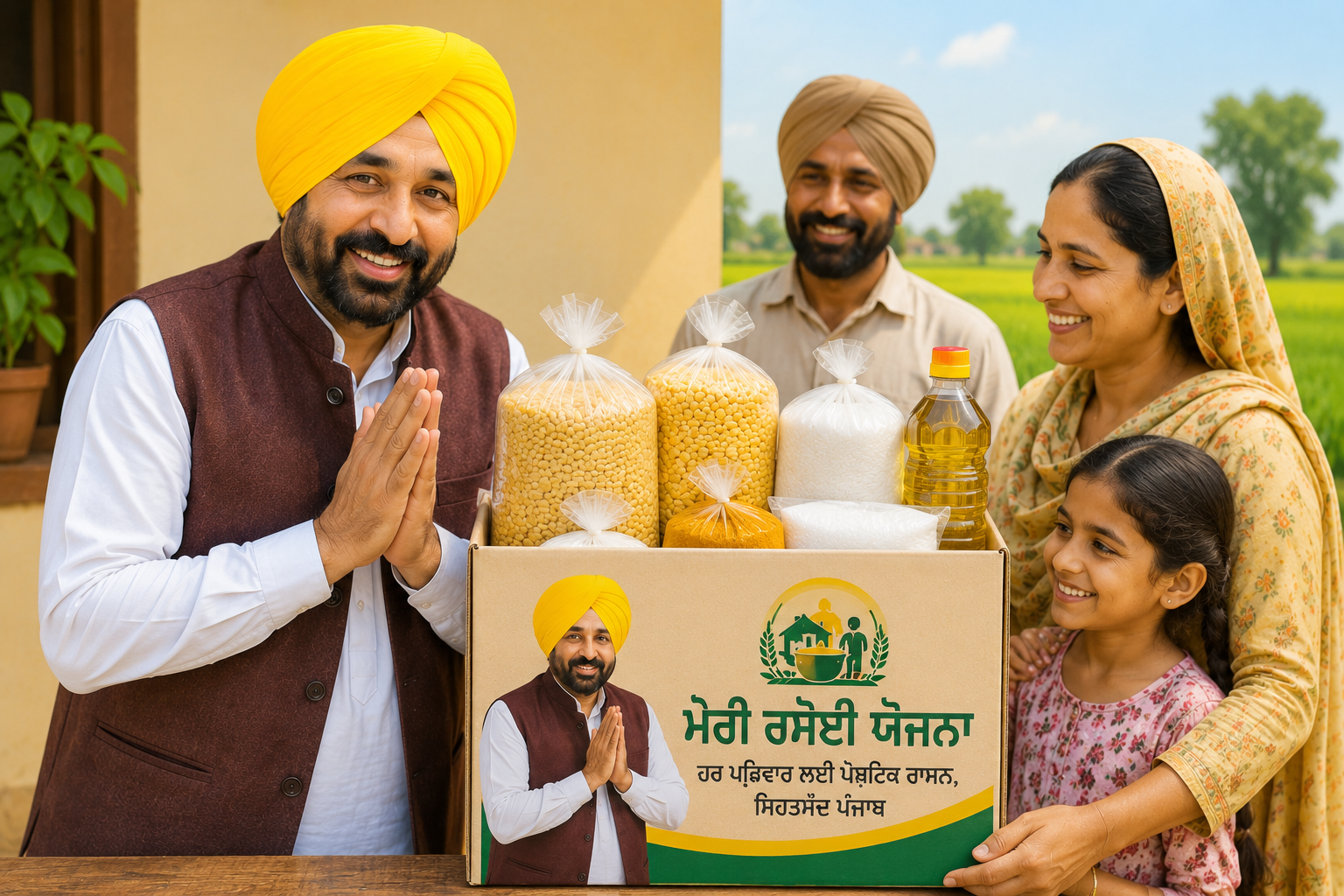
Under the Meri Rasoi Yojana, eligible beneficiary families receive a specially prepared kitchen kit once every three months, completely free of cost. Each kit is designed to supplement the household’s basic cooking needs and typically includes:
- Mustard oil
- Chana dal (pulses)
- Sugar
- Iodised salt
- Turmeric powder
These essential grocery items are provided in addition to the subsidised wheat that beneficiaries already receive under the National Food Security Act, making the scheme a more holistic approach to food security.
Scale and Budget
The scheme is designed to benefit nearly 40 lakh poor and economically weaker families across Punjab, making it one of the most extensive welfare initiatives undertaken by the state government. To support this large-scale rollout, the Punjab government has earmarked approximately ₹950 crore for the scheme’s implementation, underlining the scale of financial commitment behind the initiative.
Implementation and Quality Control
The food kits under Meri Rasoi Yojana are prepared by MARKFED, Punjab’s cooperative marketing federation, ensuring standardized quality across the state. Distribution is carried out by the Department of Food and Civil Supplies. CM Mann has assured that there will be no compromise on the quality of items distributed, with strict monitoring and inspection mechanisms in place to address any complaints or irregularities promptly.
Eligibility and Registration Process
Who Can Benefit
The scheme primarily targets families who are already covered under the National Food Security Act and hold a Blue Ration Card. Additional criteria reportedly include an annual family income not exceeding a specified low-income threshold, ensuring that the benefits reach the most economically vulnerable households.
Simplified Verification Process
One of the notable aspects of the scheme’s rollout has been the simplification of the registration and verification process. CM Mann highlighted that earlier welfare schemes often required biometric verification, which posed difficulties for many beneficiaries—particularly women engaged in household labor, whose fingerprints can fade over time, making biometric authentication unreliable. To address this, the Punjab government has shifted to photograph-based verification, reducing bureaucratic hurdles and making the process more accessible, especially for women and elderly citizens. Notably, families already linked with Aadhaar and holding the requisite ration card are automatically enrolled, eliminating the need for a separate application process.
Broader Significance of the Scheme
Strengthening Food and Nutrition Security
The Meri Rasoi Yojana is positioned as more than a mere distribution scheme; it is framed as a comprehensive step toward strengthening food and nutrition security across Punjab. By supplementing wheat rations with essential cooking items, the scheme seeks to directly improve dietary quality, particularly benefiting children in low-income households who are most vulnerable to malnutrition.
Part of a Larger Welfare Framework
The scheme fits within the AAP government’s broader welfare framework, which includes free electricity, healthcare initiatives, and women-centric programs. CM Mann has repeatedly emphasized that alongside these social welfare measures, the government is also investing in infrastructure modernization, positioning Meri Rasoi Yojana as one component of a wider vision for the state’s development.
Political and Social Context
Observers note that welfare schemes of this scale often carry political significance, as governments seek to visibly demonstrate the delivery of grassroots benefits to citizens. Regardless of the political dimensions, the scheme’s direct impact lies in its potential to ease financial pressure on millions of families grappling with the rising cost of living.
Conclusion
The Meri Rasoi Yojana represents a significant step by the Punjab government under Chief Minister Bhagwant Mann to address household food insecurity in a more comprehensive manner than previous welfare schemes. By providing free quarterly kitchen kits to nearly 40 lakh families, simplifying the verification process, and ensuring quality control through structured implementation, the scheme aims to make a tangible difference in the daily lives of Punjab’s poor and economically weaker sections. As the initiative continues its rollout across the state, its success will ultimately be measured by how effectively it reaches its intended beneficiaries and improves nutritional outcomes for vulnerable families, especially children, across Punjab.