

Introduction
In the past, classical computers have provided the power that has fueled the digital world, from navigating the internet to powering artificial intelligence. But with the advent of new technology and the increasing difficulty of computational problems, researchers are resorting to a revolutionary method called quantum computing. .
While in its nascent stages, quantum computing has the potential to transform industries from healthcare to finance, cybersecurity to climate research. This transformative era may be coming in a decade, experts believe.
Understanding Quantum Computing
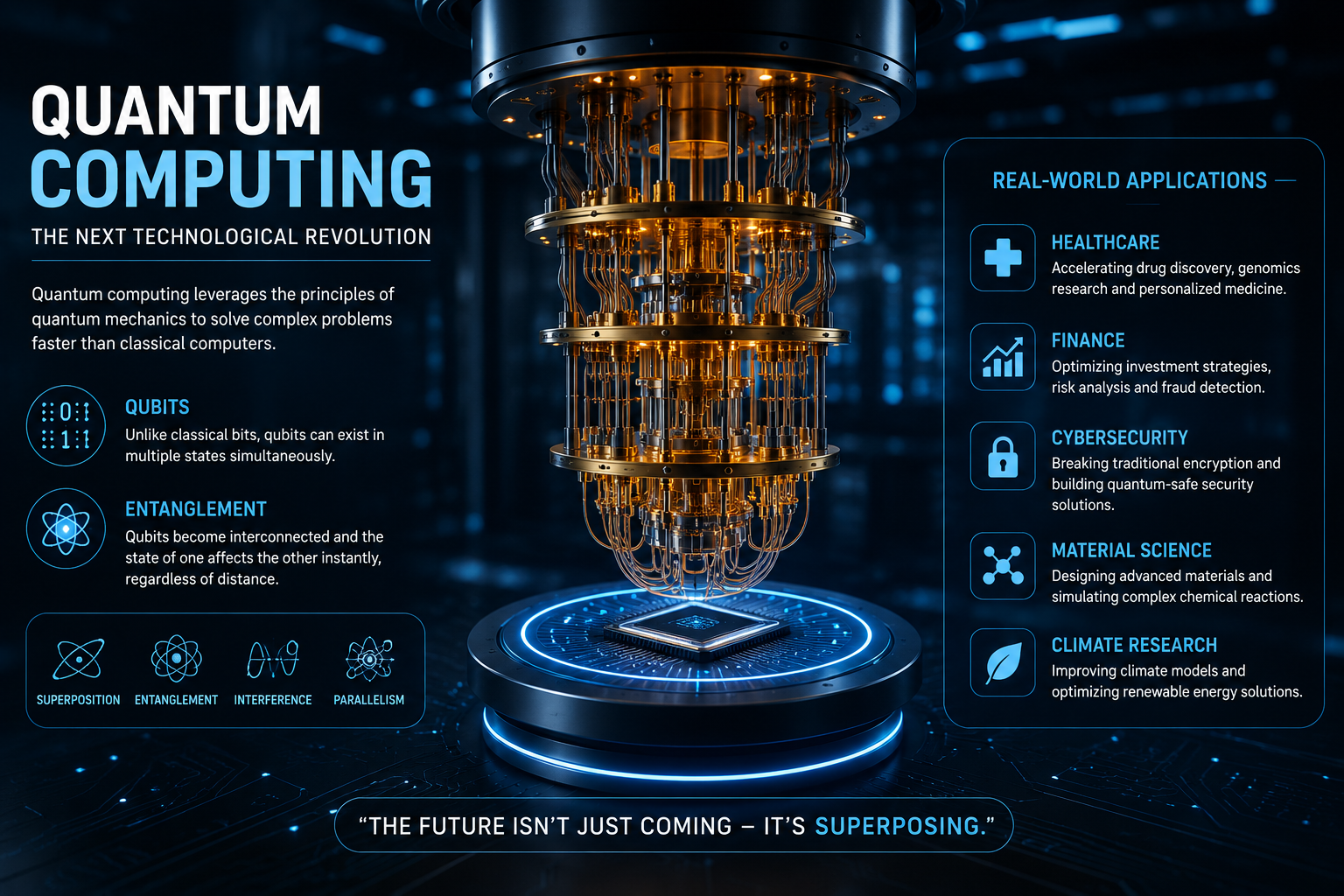
In conventional computers, the bits can only be either 0 or 1. The qubits in quantum computers can exist in more than one state at the same time in a phenomenon called superposition. Combined with another quantum property known as entanglement, qubits enable quantum computers to solve highly complex mathematical problems much faster than today’s most powerful supercomputers.
The unique feature gives the researcher the ability to do calculations that would take thousands or even millions of years on a traditional computing machine.
Applications Across Industries
In medicine, scientists can gain a more realistic understanding of molecular interactions, which can speed up the development of new drugs and enhance individual medical care.
The financial sector could gain from quicker portfolio optimization, fraud identification, and in-depth risk evaluation. Banks and investment companies may analyze gigantic amounts of data within seconds, speeding up the decision-making process.
The development of quantum computing is promising substantial benefits to manufacturing companies, including optimizing supply chains, optimizing logistics, and designing stronger, lighter materials in fields ranging from aerospace to automotive engineering.
In 2013, AI gained widespread popularity and gained traction.AI became widely popular and had traction in 2013.
Artificial Intelligence makes the most of huge quantities of data.
Quantum computers can process intricate operations and solve computational problems that are currently unsolvable, while also recognizing patterns more efficiently and optimizing complex operations in the future. The integration of AI and quantum computing has the potential to drive breakthroughs in fields such as robotics, autonomous vehicles, and predictive analytics.
Challenges That Remain
However, quantum computing has numerous technical hurdles to overcome before it can come into fruition. In Qubits, calculations are susceptible to disturbances in the surroundings, which makes it challenging to maintain consistent calculations. Work is ongoing on error correction techniques and more reliable hardware.
The technology is also demanding in terms of infrastructure and extremely cold temperatures in which it functions, making quantum computers very costly to build and maintain. This means that commercialization is still some years away.
Cyber security is another issue of concern. Some cryptography approaches used to secure sensitive data might be vulnerable to quantum computers in the future, which could spur the creation of new methods of quantum-resistant security by governments and technology firms.
In what ways is quantum research being funded around the world? How is quantum research funded globally?
The governments and private companies of the world are spending billions of dollars on research into quantum. Researchers at universities, research institutions and technology companies are working together to create scalable quantum systems which can solve real world problems.
Contestation in the quantum computing marketplace is likely to grow, with countries vying for technologic leadership in the nascent quantum computing industry. This boost in funding is driving innovation and making it much closer to practical quantum applications.
India’s Growing Role
National research programs and collaborations among Indian universities and institutions are contributing to India’s progress in quantum technology. Quantum education is growing in universities and research institutions, and start-ups are considering commercial applications.
The quantum research sector offers potential benefits across various fields, including cybersecurity, pharmaceuticals, finance, and agriculture, as well as scientific innovation, which will be increasingly relevant as India’s digital economy expands. Developing a high-quality workforce in quantum science will be critical to long-term success.
The Road Ahead
Classical and quantum computing are unlikely to completely supersede each other, but they are expected to coexist. Everyday problems will be handled by classical computers, and some out-of-the-way problems that require the power of a quantum computer will be solved.
Within the next 10 years, industries that get on board with quantum technologies first could get advantages that will be quite substantial. With ongoing research, quantum computing could be one of the most impactful innovations of the 21st century.
Conclusion
Quantum computing would be a giant step in the field of computation. Its speed and capability to solve complex problems has the potential to revolutionize healthcare, finance, artificial intelligence, manufacturing and scientific research. While there are still technical hurdles to overcome, this groundbreaking technology is moving towards becoming a common reality due to ongoing investments and innovations. The world is also transitioning to the quantum age; those that are ready for it now will be ready for the digital future.