

Introduction
Over the years, marketing has undergone a lot of change. Of course, traditional marketing channels like television, radio, newspaper and billboards are still relevant but today, businesses are spending more and more on performance marketing for measurable results. Knowing about the difference between performance marketing and traditional marketing can enable businesses to select the appropriate marketing method for them based on their goals, budget, and target audience.
What is genuine marketing?
Traditional marketing is a method used in the traditional way with the traditional tools, with the aim of promoting products and/or services away from the online environment. These include TV commercials, newspaper ads, magazine ads, radio ads, brochures, direct mail and billboards.
Using traditional marketing methods is very effective in gaining brand awareness to a wide target market. But it is difficult to determine the actual return on investment (ROI) since many businesses cannot determine how many customers actually converted straight from these advertisements.
Advantages of Traditional Marketing
Establishes a powerful brand image.
Can reach a wide audience of people via mass media.
For local and regional advertising, these apply.
Builds trust through trusted media.
Ideal for businesses that would like to attract offline customers.
There are certain drawbacks to traditional marketing.Traditional marketing has some drawbacks.
Higher advertising costs.
Limited audience targeting.
Difficult to measure campaign performance.
Lack of flexibility after campaigns have been launched.
Limited ability to adapt to market fluctuations.
What is Performance Marketing?
Performance marketing is a digital marketing approach that involves paying for actions that can be tracked, like clicks, leads, app downloads or sales. No campaign is lost or left untracked, and each one is optimized based on real-time data.
Channels to consider for performance marketing are:
Pay-Per-Click (PPC) advertising
Social media advertising
Search engine marketing (SEM)
Affiliate marketing
Display advertising
Native advertising
There are various key metrics to track the success of a campaign, such as conversions, click-through rates (CTR), cost per click (CPC), return on ad spend (ROAS), and customer acquisition cost (CAC).
Performance marketing offers a variety of benefits.Performance marketing has several advantages.
Measurable Results
Transparency is one of the foremost benefits of performance marketing. Businesses are completely aware of their expenditure and the outcome.
Precise Audience Targeting
Businesses can target customers using digital advertising platforms by targeting them by:
Location
Age
Gender
Interests
Online behavior
Search intent
Device type
This will make the campaigns more effective and save on advertising costs.
Cost-Effective
The size of the business doesn’t matter as it allows one to set a cap on the amount they want to spend on advertising and pay only when the user takes particular actions.
Real-Time Optimization
Campaigns can be optimized on-the-fly based on real-time performance information, including changes to keywords, targeting, bids, and creatives.
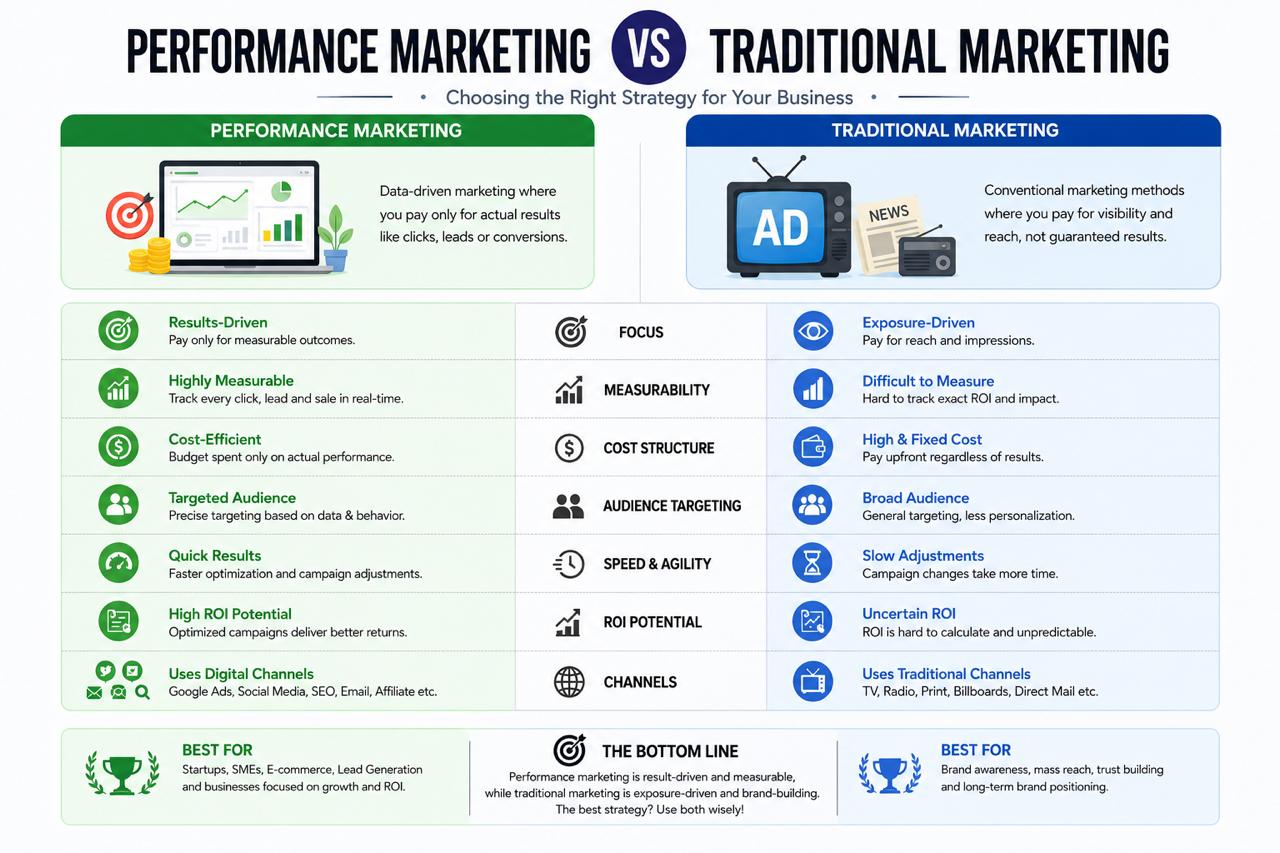
Performance Marketing is compared to Traditional Marketing.
Feature
Performance Marketing
Traditional Marketing
Cost
Flexible and scalable
Generally expensive
Measurement
Fully measurable
Difficult to measure
Targeting
Highly specific
Broad audience
ROI Tracking
Real-time
Limited
Campaign Changes
Instant optimization
Limited flexibility
Customer Engagement
Interactive
Mostly one-way communication
What strategy would you choose?
All of this will depend on the objectives of your business.
It’s effective for traditional marketing to be done with:
Large-scale brand awareness
Local community promotions
Offline businesses that are focusing on offline audiences.
Long-term brand building
Performance marketing is a great choice for:
Lead generation
Online sales
Website traffic
Customer acquisition
Measurable business growth
Entrepreneurs and small companies that don’t have a lot of capital.
Numerous successful businesses mix both strategies for maximum results and reach.
The reasons behind the shift toward performance marketing are varied.There are several reasons behind the shift toward performance marketing.
The landscape of consumer behavior is now drastically different in today’s digital world. Nowadays, most customers do their research about the products online before deciding to buy. With performance marketing, companies can connect with these customers at each point of their purchase process.
Using advanced analytics, automation and AI-driven optimization, companies can continuously optimize campaign performance, and maximize ROI.
Conclusion
There is no best or worst between performance marketing vs traditional marketing. The importance of traditional marketing, in terms of building brand visibility and awareness, is undeniable, while performance marketing is more effective at generating measurable and data-driven results.
Performance marketing provides more flexibility, more specific targeting of your audiences, and ongoing optimisation for those businesses aiming to create leads, boost online sales and deliver maximum ROI. Companies can design a well-rounded marketing plan that promotes sustainable business growth by understanding the pros and cons of each strategy.