

Introduction
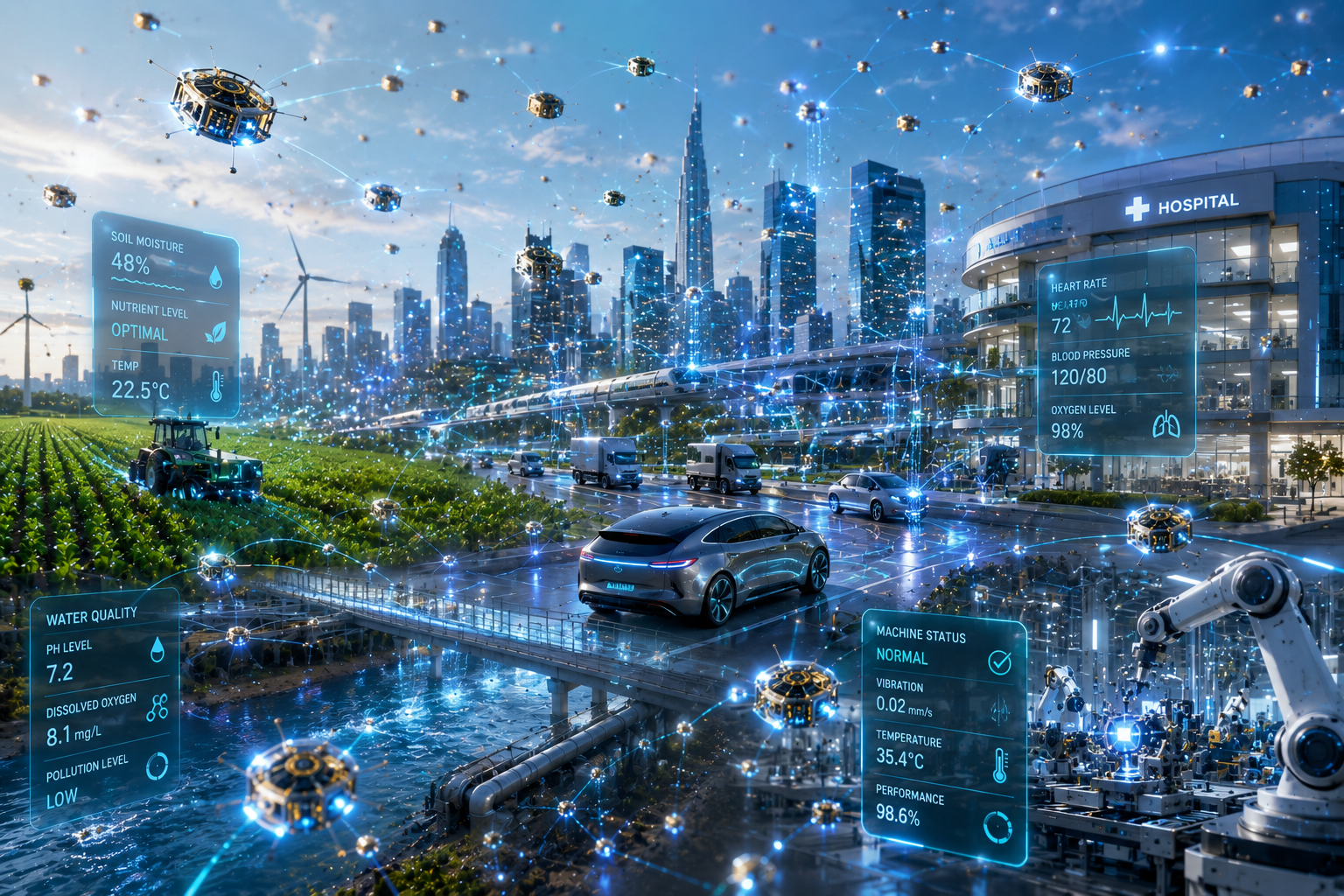
Suppose you had millions of tiny sensors spread out all over a farm, factory, hospital or even an entire city, gathering valuable information and communicating wirelessly in real time, without any human intervention. This futuristic idea is called the “Smart Dust Technology” and is one of the most intriguing in the electronics and the Internet of Things (IoT) world.
While at an early stage of research and development, Smart Dust could transform the way humans gather information, observe their surroundings and make decisions. Smart Dust is an innovative platform merging the concept of tiny sensors, wireless communication, artificial intelligence, and sophisticated microelectronics, which promises to be a cornerstone of the digital future.
What is smart dust technology?
Smart Dust is a term for small wireless devices, known as “motes,” which sense, compute and communicate information. These minuscule devices are able to gauge temperature, pressure, humidity, light, vibration, motion, chemical composition, or even biological activity.
The miniature sensors, processor, power source and wireless communication system are all found in each mote. When connected together as a network, thousands of these devices can collaborate to form a detailed map of the environment around them, without needing to constantly be monitored by human operators.
One of the largest applications of the Smart Dust technology is expected to be healthcare. The researchers see tiny sensors being safely implanted in the human body to monitor vital signs, detect diseases at early stages, and send health data straight to health care professionals.
Doctors would not need to visit the hospital periodically for updates on the patients’ health; instead, they would be able to get updates directly. Rather than having to come to the hospital now and then, physicians would get regular updates on the patient’s health, allowing earlier diagnoses and better tailored treatment. Chronic disease patients, like diabetes or heart disease, might be able to take advantage of real-time monitoring to enhance long-term care.
Precision agriculture is increasingly the norm in modern agriculture, and Smart Dust may bring precision agriculture to the next level. Micro-sensors are placed all over fields to measure soil moisture, nutrients, crop condition, and environmental data.
Farmers would have accurate information on how much irrigation water they need, the amount of fertilizer required and when and if potential disease break-outs occur. Such data-driven approach can help to enhance the yield of crops without consuming too much water and have lesser environmental footprint due to the agricultural practices.
For a long time, the world has been in a state of chaos. The world has been in turmoil for a long time.
Smart Dust can be employed to monitor machinery, to detect equipment wear and to identify safety risks at factories and industrial facilities before they happen. Structural weaknesses in infrastructure, such as bridges, tunnels, railways and pipelines, could also be constantly monitored.
Engineers would be notified immediately if abnormal conditions are seen, avoiding manual inspections, which can help to lower maintenance expenses and enhance public safety.
There are huge possibilities for Smart Dust use in the field of environmental monitoring. Networks of microscopic sensors could monitor air quality, water quality, forest health and vitality, wildlife habitats and climate conditions over vast geographical areas.
Scientists could also collect very detailed information about the environment which is hard to collect or costly. The information could be used by governments to be more responsive to natural disasters, pollution incidents and climate-related challenges.
What are the challenges and ethical issues? What are the challenges and ethical issues?
While the technology of Smart Dust is promising, it has many important technical and ethical challenges. Creating micro-devices that can operate for long periods with reliable power supplies is still a major engineering problem.
There are other key challenges, such as privacy. However, as the devices can gather significant information, governments and companies must define policies for data ownership, security, and appropriate use of the information gathered by the Smart Dust devices.
However, the environment should also be taken into account. Scientists are developing materials that will degrade and designs that are more eco-friendly to prevent electronic waste from the widespread use.
The Future of Smart Dust. The Future of Smart Dust.
Smart dust is beginning to emerge into reality in a variety of ways, with each step of nanotechnology, artificial intelligence, wireless communication and battery technology being made increasingly possible. Future systems could be built using 5G and next generation communication networks, enabling intelligent environment that is able to dynamically adjust its response to changes in the environment.
Miniature sensing technologies are predicted to be very much in demand in the next few decades for industries from healthcare and agriculture to transport and defense.
Now that computing devices are getting smaller and more powerful, Smart Dust could become invisible, but necessary part of everyday life.
Conclusion
Smart Dust Technology is one of the most ambitious of current science and engineering innovations. It integrates tiny sensors, wireless connectivity and artificial intelligence, creating opportunities for a new way to monitor the world with unprecedented accuracy. Technical, environmental and privacy issues are still to be overcome, but research is currently underway to bring the technology closer to reality. Over the coming years, Smart Dust will find its way into industries, healthcare systems, protection and monitoring of environment and into the way humans will relate to their physical surroundings.