

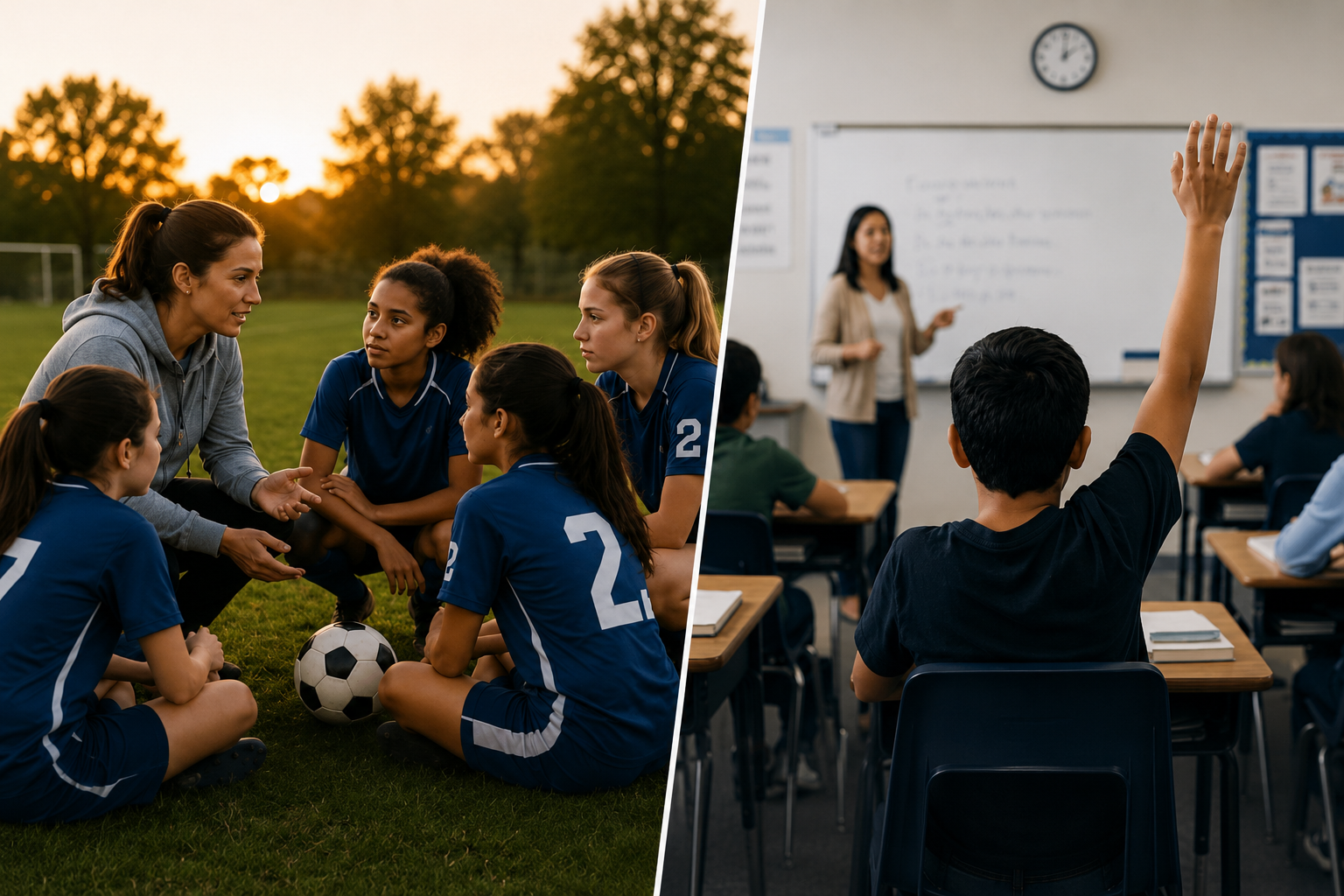
Some lessons arrive through lectures, textbooks, and examinations. Others only show up when you are sprinting in the final minute, exhausted and still have to make the right call. Classroom education builds the mind and it does that brilliantly. But sport builds the person around that mind. The two do not compete; they complete each other. Here is what stepping onto a field adds to everything a classroom already gives you.
Punctuality With Real Stakes
When you arrive late to a training session, you do not just miss content , you let down nine other people who showed up for you. That is a weight no attendance register can replicate. Sport turns punctuality from a rule into a form of respect and athletes carry that understanding long after the final whistle. It sits alongside everything a classroom instils about time management, but it lands differently because the cost of getting it wrong is immediate and personal.
Conduct That Speaks Before You Do
You shake hands with the opponent after a tough loss. You hold your composure when a decision goes against you. You carry yourself with dignity regardless of the scoreline. Nobody schedules a class on any of this , players absorb it through participation, through watching seniors handle pressure well and through the quiet disapproval of a dressing room when someone gets it wrong.
What makes this stick is that the standard does not disappear when the game ends. Athletes who grow up holding themselves to that unwritten code tend to bring it into every room they walk into , not because someone asks them to, but because it has simply become the default.
The Art of Opening Up to People
For many people , especially those who are naturally reserved , a team environment is where the social walls first come down. There is something about shared exhaustion, shared pressure and shared loss that accelerates trust between people in ways that are hard to manufacture elsewhere.
And once those walls come down, something shifts in how you communicate altogether. You stop waiting to be asked. You start voicing ideas earlier, reading a room faster and holding conversations with people you would have avoided before. Sport does not just teach you to open up to teammates , it quietly rewires how you engage with people in general.
Discipline You Build With Your Own Hands
Nobody drags you to early morning training. Nobody forces you to repeat a drill twenty times until it clicks. You choose to do it and you carry the result either way. That is the kind of discipline sport demands – self-driven, unglamorous and built entirely from the inside.
The interesting part is what happens when that muscle transfers. Athletes tend to approach unstructured situations like a new job, a personal project, an uncertain goal with a steadiness that others find difficult to replicate. They already know how to work without a scoreboard. That is a rare edge and it compounds over time.
Confidence That Comes From Within
There is a particular kind of self-belief that does not show up on a marksheet – the kind that lets you back yourself when the pressure is real and the outcome uncertain. Sport builds exactly that. Athletes learn to trust their preparation, hold their ground in difficult moments and perform without waiting for external validation.
Perhaps the clearest place it shows up is in self-expression. Many athletes who once struggled to articulate their thoughts find that sport gives them a voice , not through any formal exercise, but through the constant need to communicate, assert and make themselves understood under conditions that do not allow hesitation.
Growing Comfortable With Falling Short
You lose games. You miss selections. You train hard for months and still fall short on the day. And then you return to training the next morning. Sport makes this cycle unavoidable and in doing so, it teaches something no curriculum has quite figured out how to deliver: how to fail without it defining you.
That shift in relationship with failure is what makes athletes more willing to take risks later in life. When you have already lost in front of a crowd and walked back onto the field anyway, the fear of trying something new and falling short loses a lot of its grip. Resilience, at its most useful, is not just recovery , it is the willingness to keep attempting things that might not work.
The classroom sharpens how you think. Sport shapes how you show up. Together, they build something that neither can produce alone – a person who is not only knowledgeable and skilled, but also disciplined, resilient, and genuinely ready for what the world actually asks of you.