


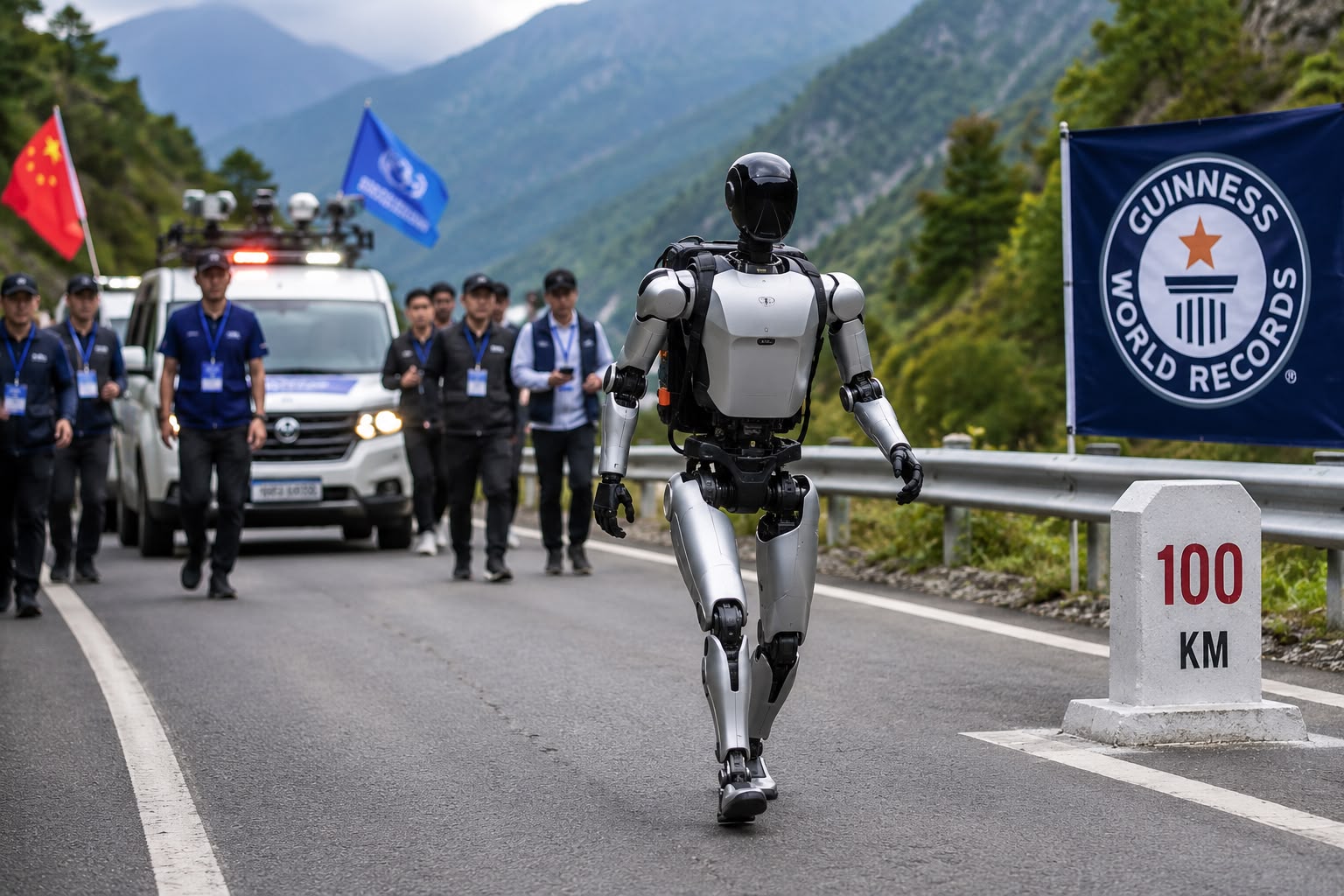
A Chinese-developed humanoid robot has captured global attention after successfully completing a 100-kilometer trek in just three days, earning a Guinness World Record and showcasing the rapid progress being made in robotics and artificial intelligence. The achievement is being hailed by engineers and technology experts as a major milestone in the development of autonomous machines capable of operating in real-world environments for extended periods.
The robot, designed by a Chinese robotics company and supported by advanced artificial intelligence systems, was equipped with sophisticated sensors, vision systems, navigation software, and battery technology that enabled it to undertake the challenging journey. Engineers say the project was intended to test the robot’s endurance, mobility, balance, and ability to adapt to changing environmental conditions outside a controlled laboratory setting.
According to project officials, the 100-kilometer route included a variety of terrain conditions, requiring the robot to navigate roads, uneven surfaces, inclines, and other obstacles. The journey was completed over three days, with engineers closely monitoring performance data while allowing the machine to operate largely through autonomous navigation systems. The robot reportedly maintained stability and operational efficiency throughout much of the trek despite facing weather changes and physical challenges along the route.
The accomplishment has been recognized by Guinness World Records, which confirmed the achievement as a new benchmark for humanoid robotic endurance. While developers have highlighted the event as a demonstration of cutting-edge engineering and AI integration, independent verification through Guinness has helped distinguish the record-setting performance from promotional claims often associated with technology demonstrations.
Researchers involved in the project described the trek as an important test of real-world robotic capabilities. They said the robot’s ability to sustain movement over long distances reflects significant improvements in energy management, motion control, environmental awareness, and autonomous decision-making. Such capabilities are considered essential for future applications where robots may need to operate independently for extended periods.
The achievement also highlights China’s growing investment in robotics, artificial intelligence, and advanced manufacturing. In recent years, Chinese technology firms, universities, and research institutions have accelerated efforts to develop humanoid robots capable of supporting industrial operations, healthcare services, logistics, and customer-facing roles. Government initiatives promoting innovation have further strengthened the country’s position in the global robotics race.
Industry analysts say the successful trek demonstrates how quickly humanoid robot technology is advancing. Supporters argue that endurance milestones provide valuable data that can accelerate commercial development and improve reliability. However, some experts caution that record-setting demonstrations do not necessarily translate into immediate widespread deployment, noting that cost, safety, scalability, and practical usefulness remain important challenges.
Beyond the record itself, the event reflects intensifying global competition in robotics and AI. Companies around the world are racing to create machines capable of assisting humans in manufacturing, disaster response, healthcare, exploration, and other demanding environments.
The successful 100-kilometer journey marks a significant step forward in humanoid robotics and underscores the accelerating pace of technological innovation. As AI-powered machines become increasingly capable, achievements such as this are helping shape the future of automation and redefining what robots can accomplish in the real world.