


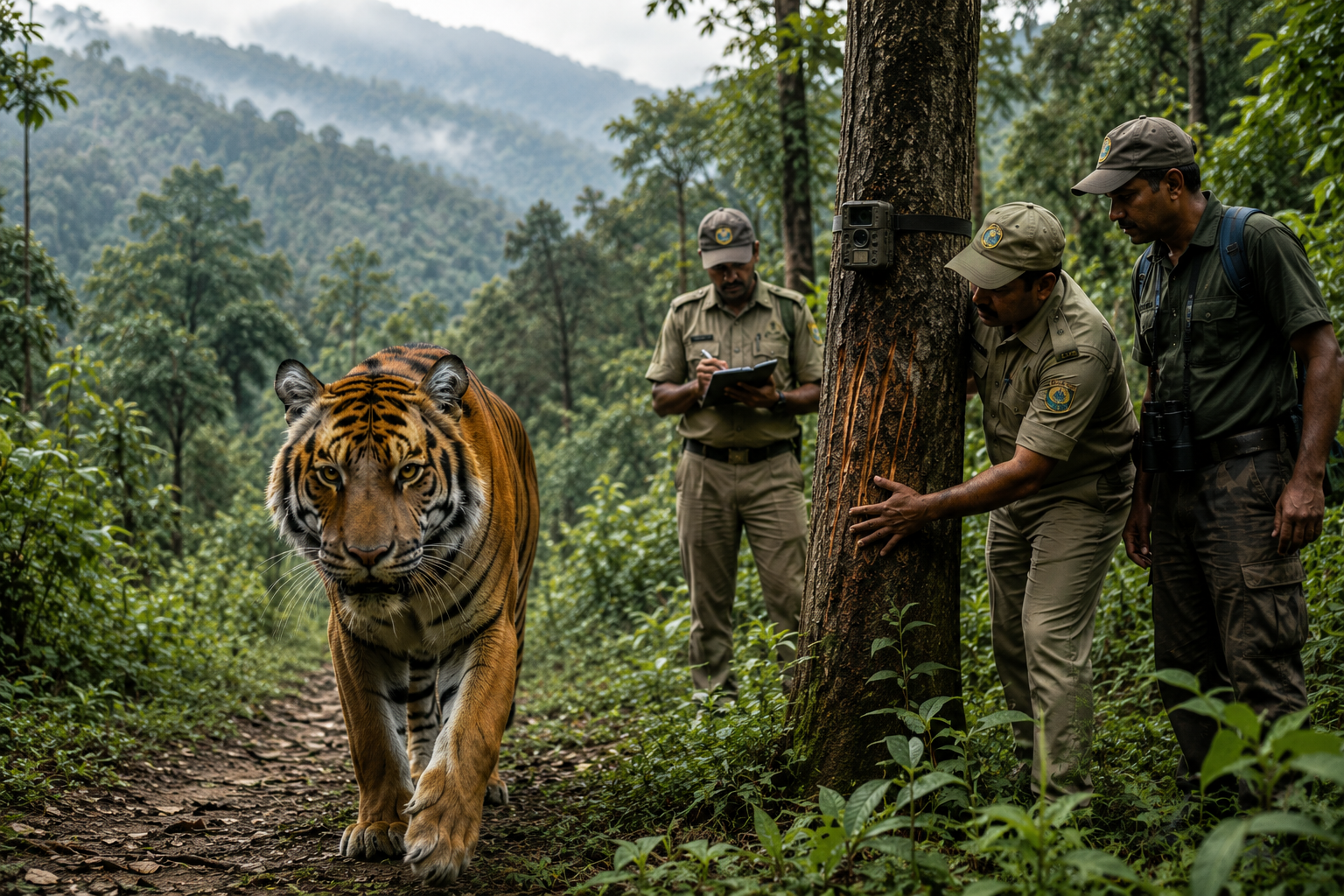
Wildlife authorities in Himachal Pradesh have reported the presence of an endangered Bengal Tiger in the Paonta forest region of Sirmaur district, a development that has generated significant interest among forest officials, conservationists, and local communities. The sighting is being viewed as an important indicator of ecological connectivity in the lower Shivalik landscape and may provide valuable insights into wildlife movement patterns across northern India.
According to Forest Department officials, the tiger’s presence was confirmed through camera-trap imagery obtained during routine wildlife monitoring operations in the Paonta forest landscape. Officials also reported finding fresh claw marks and other field signs in nearby forest areas, further supporting evidence that the animal had recently moved through the region. Forest personnel subsequently intensified surveillance activities to monitor the tiger’s movement and assess its behavior within the landscape.
The latest observation is particularly noteworthy because Bengal Tigers are rarely documented in Himachal Pradesh. Wildlife officials noted that the sighting comes several years after the state’s first confirmed camera-trap record of a tiger in the nearby Simbalbara National Park, located in the Paonta Valley of Sirmaur district. That historic record demonstrated that tigers occasionally use the forested corridor connecting the region with neighboring wildlife habitats.
Forest officers stated that the current sighting was detected as part of ongoing wildlife monitoring efforts that employ camera traps, field patrols, habitat assessments, and the documentation of physical evidence such as pugmarks and scratch marks. Officials emphasized that camera-trap photographs remain the primary method used to verify the presence of elusive large carnivores in dense forest environments. Similar monitoring techniques were instrumental in confirming the first tiger record in the region in 2023.
Wildlife experts describe the sighting as ecologically significant because the Bengal Tiger serves as an apex predator whose presence often reflects a healthy prey base and functioning ecosystem. Conservation biologists note that large carnivores typically require extensive forest cover, sufficient prey populations, and secure movement corridors to survive. The appearance of a tiger in the Paonta forest landscape suggests that portions of the region may be capable of supporting transient tiger movement.
Officials from the Himachal Pradesh Forest Department have reportedly increased ground surveillance in response to the sighting. Special patrol teams have been deployed in sensitive areas, camera-trap coverage has been expanded, and field staff have been instructed to maintain regular monitoring of wildlife activity. Authorities are also coordinating with neighboring forest divisions to track potential movement routes and ensure that the animal remains undisturbed.
Experts believe the tiger may be dispersing through a larger wildlife corridor that connects forests in Himachal Pradesh, Haryana, and Uttarakhand. Previous studies and official assessments have suggested that tigers occasionally move between the forests of the Paonta region, Haryana’s Kalesar landscape, and the Rajaji landscape in Uttarakhand. While the origin of the current animal has not been conclusively established, wildlife officials consider such cross-state movement biologically plausible given the connectivity of these forest ecosystems.
The Bengal Tiger (Panthera tigris tigris) is classified as an endangered species globally. India currently supports the largest tiger population in the world and has invested heavily in conservation initiatives through protected areas, anti-poaching operations, habitat restoration, scientific monitoring, and community-based conservation programs. Camera-trap surveys, genetic analysis, satellite-based monitoring, and landscape-level conservation planning have become key tools in tracking tiger populations and safeguarding critical habitats.
Local residents in villages near the forest have reacted with a mixture of excitement and caution. Many villagers have welcomed the sighting as evidence of the region’s rich biodiversity, while others have expressed concerns regarding livestock safety and possible encounters in forest-edge areas. In response, forest authorities have advised residents to avoid unnecessary movement in dense forest zones, report wildlife sightings promptly, and follow precautionary guidelines issued by local officials.
Environmental organizations and wildlife enthusiasts have praised the Forest Department’s monitoring efforts, describing the sighting as an encouraging sign for conservation in the western Himalayan foothills. Conservation groups note that maintaining ecological corridors is essential for the long-term survival of wide-ranging species such as tigers, elephants, and leopards.
Scientists caution, however, that a single sighting does not necessarily indicate the establishment of a resident tiger population in the region. Further monitoring will be required to determine whether the animal is merely passing through the landscape or utilizing the area more regularly. Continued surveillance, habitat assessment, and scientific documentation will be critical in understanding the tiger’s movements and ecological role.
Nevertheless, the reported presence of a Bengal Tiger in the Paonta forest region represents an important conservation milestone for Himachal Pradesh. Whether transient or temporary, the appearance of one of India’s most iconic predators underscores the importance of preserving connected forest habitats and highlights the ecological value of the state’s protected landscapes. For conservationists, the sighting serves as a reminder that healthy ecosystems can still support the movement of large wildlife across vast landscapes, reinforcing the need for sustained protection efforts throughout northern India.