


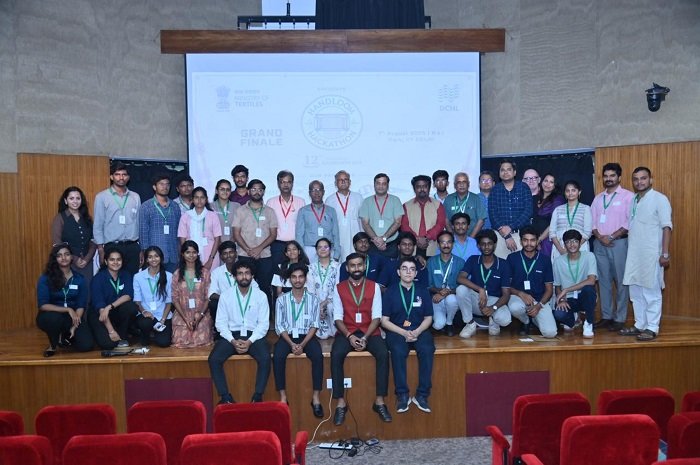
The Handloom Hackathon 2026, a nationwide innovation competition by the Office of the Development Commissioner for Handlooms under the Ministry of Textiles, concluded successfully with a Grand Finale at the Research and Innovation Park, IIT Delhi. The competition, conceptualised by ThinkStartup, attracted over 2,500 participants, with 280 finalists from the top 100 shortlisted teams across the country presenting technology-driven solutions to modernize and strengthen India’s vibrant handloom ecosystem.
 |
Handloom Hackathon 2026
The hackathon served as a pivotal national platform for innovators, researchers, faculty members, and handloom experts to develop practical solutions addressing critical challenges in loom modernization, design innovation, sustainability, market access, and weaver livelihoods. The shortlisted teams showcased breakthrough innovations aimed at improving productivity, preserving traditional craftsmanship, and enhancing the global competitiveness of India’s handloom sector.
Development Commissioner (Handlooms) Dr. M. Beena, IAS emphasized that India’s handloom heritage and modern technology are complementary forces. “We must combine innovation with traditional craftsmanship to improve the lives of weavers,” Dr. Beena stated, highlighting the inherent sustainability and circularity of the handloom sector. She also underscored the importance of technological innovations in loom processes, design development, and modern marketing strategies, while spotlighting the Indian Handmade Portal, an e-commerce platform enabling weavers to sell globally without intermediaries.
Winners Recognized Across Four Thematic Categories
The hackathon featured problem statements to modernize and revitalize India’s handloom industry across four key themes.
VIZHI – AI Powered Trend Forecasting App, developed by Madeshwaraboobalan V and Srinidhi B from IIHT Salem, emerged as the winner in the Weaver Livelihoods & Financial Inclusion category. The platform leverages artificial intelligence to forecast market trends, enabling weavers to anticipate demand patterns and make informed production decisions that directly impact income stability.
Sutradhar, created by Atharv Sanjeev Kumar and Gurkirat Singh from IIT Madras, won in the Market Access & Digital Integration category. Sutradhar bridges the gap between rural weavers and digital markets, enabling direct access to global buyers and eliminating supply chain intermediaries.
In the Sustainability & Environmental Impact category, Savinya, developed by Naveen Goyal, Mahak Goyal, Ritu Devi, from Savinya Studio, claimed the top position by integrating sustainability throughout the handloom production cycle and creating circular economy models that reduce environmental waste.
In the Innovation in Design & Operations category, the Weaver Mithra Back Support System was selected as the winning entry. The solution, by Sriram Vaggu, Adigoppula vishal from KLB IIHT Hyderabad, addresses occupational health challenges and enables longer, more productive working hours for weavers.
Strategic Vision and Institutional Partnerships
The hackathon reflects a broader commitment to integrating academia, industry, and government in advancing India’s handloom sector. Dr. Deepti Gupta, Head of the Department of Textile and Fibre Engineering at IIT Delhi, announced the proposed Centre of Excellence for Handloom Technology at IIT Delhi, expected to be inaugurated next week in collaboration with the Ministry of Textiles. This centre will integrate technology with handloom production, improving standardization and productivity while preserving the uniqueness of handcrafted textiles.
Sanjeeva Shivesh, Co-founder of ThinkStartup and Program Director of the Handloom Hackathon 2026 Organising Committee, congratulated the finalist teams and encouraged continued development of innovative solutions. “This hackathon is a milestone in creating meaningful social and economic impact for India’s weavers. The winning solutions exemplify how innovation can preserve heritage while driving progress. This spirit of empowering young innovators also aligns with ThinkStartup’s Youth Ideathon, which encourages school and college students to become creators and develop ideas that can solve real-world challenges and contribute to India’s progress.”
Voices from the Jury and Ecosystem Partners
Dr. Sanjay Gupta, Vice Chancellor, World University of Design, said, “Handloom is often viewed through the lens of heritage. The Handloom Hackathon reminded us that it is equally a source of innovation. As a jury member, I was encouraged to see young minds applying design thinking, emerging technologies and entrepreneurial imagination to one of India’s most enduring creative ecosystems. The future of handloom will not be secured by preserving the past alone, but by enabling the next generation to reinterpret it for contemporary markets and lifestyles. This initiative by the Ministry of Textiles is an important step in that direction.”
CV Raghu, President & Founder, General Counsel’s Association of India, said, “As India’s handloom sector modernizes, the innovations coming out of platforms like this hackathon will increasingly touch questions of design ownership, geographical indication and intellectual property. Building that legal and governance backbone alongside the technology is what will let weavers and young innovators capture the full value of what they create. It was heartening to see solutions that think about the weaver’s livelihood not just as a design problem, but as a rights and market-access problem too.”
Sanchit Govil, Co-founder, Lal10, said, “We’ve spent years building the bridge between rural artisans and digital markets, so it was exciting to see a new generation of innovators tackle that same problem from fresh angles. Sutradhar and the other market-access solutions at this hackathon are exactly the kind of thinking the sector needs, technology that removes intermediaries and puts more of the value directly in weavers’ hands. Initiatives like this hackathon are critical to accelerating that shift.”
Vanita Vasudeva, Startup Portfolio Management, FITT, IIT Delhi, said, “What stood out at this hackathon was how quickly finalist teams moved from problem statements to workable prototypes. That’s exactly the kind of founder mindset we look to nurture through incubation- taking a strong idea and giving it the structure, mentorship and market validation it needs to survive beyond the competition. With the right incubation support, several of these handloom-tech solutions have a genuine shot at becoming durable ventures.”
Path from Ideation to Market Viability
The Ministry of Textiles has committed to providing 1-year incubation support for investor-ready participants, positioning winning and promising solutions for real-world implementation. This initiative aims to create a modern, innovation-led image for brand Handloom while building a visible pathway from ideation to market viability, ensuring that breakthrough innovations translate into tangible benefits for India’s weaver communities.
The successful conclusion of Handloom Hackathon 2026 marks another pivotal step in the Ministry’s efforts to strengthen academia-industry collaboration and build a technology-enabled, sustainable, and globally competitive handloom ecosystem that supports the long-term growth and prosperity of India’s weavers.