

introduction
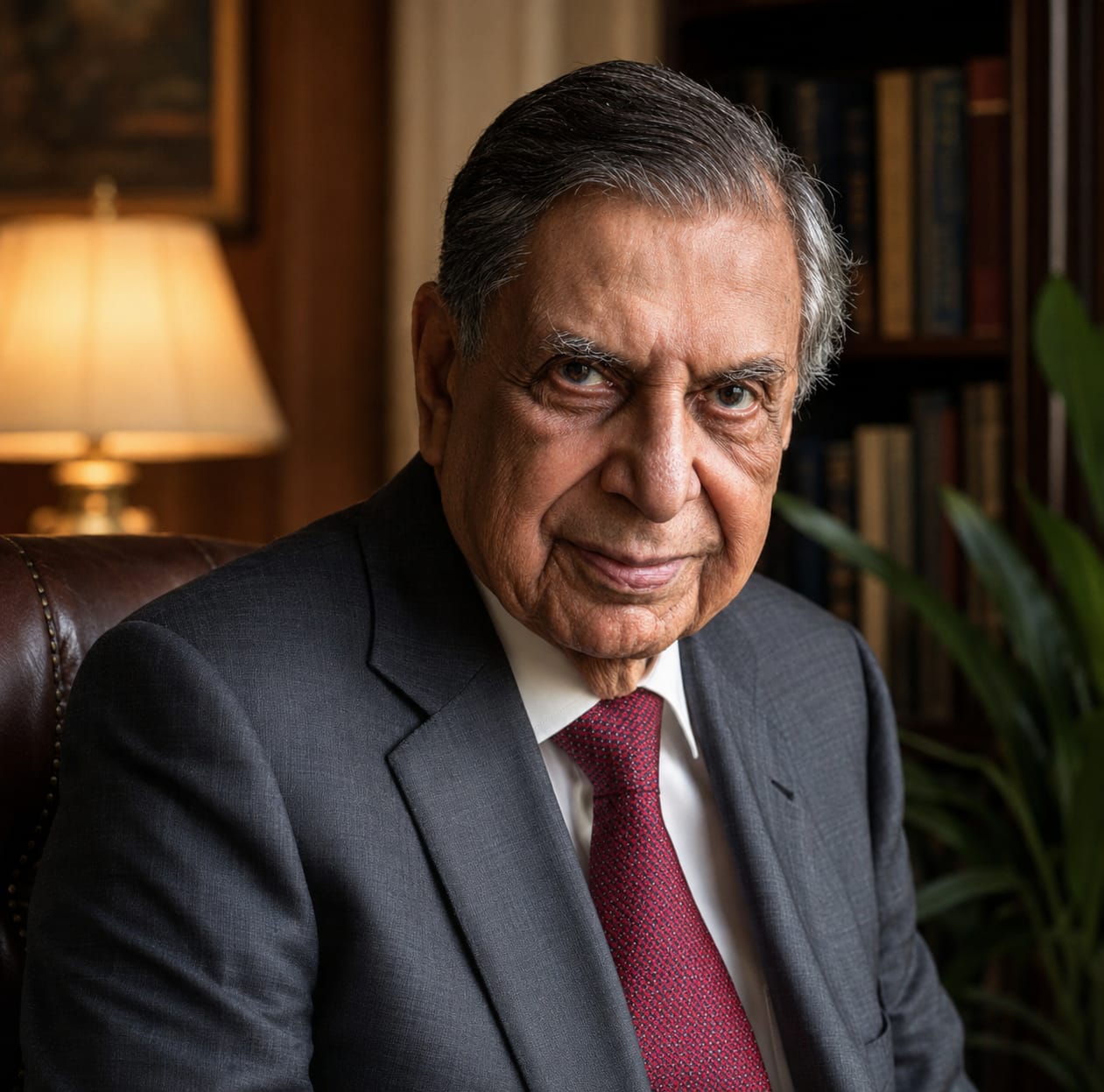
In the global landscape of business, individuals who successfully combine immense corporate growth with a deep, unwavering commitment to human welfare are rare. Ratan Naval Tata was one such rare leader. As the longtime chairman of the Tata Group—one of India’s oldest, largest, and most respected conglomerates—he transformed a domestically focused business house into a multi-billion-dollar international powerhouse. Yet, his legacy extends far beyond corporate balance sheets, mergers, and global acquisitions. He is widely remembered as a symbol of ethics, simplicity, and compassion, whose life demonstrated that business can be a powerful instrument for the greater good.
Early Life, Education, and Ground-Up Beginnings
Ratan Tata was born on December 28, 1937, in Bombay (now Mumbai) during the British Raj. He belonged to the prominent Tata family, a lineage rooted in the Parsi community and famous for pioneering India’s industrial infrastructure. He was the son of Naval Tata and Soonoo Commissariat. When he was young, his parents separated, and he was raised under the strict but loving guidance of his grandmother, Lady Navajbai Tata. This early environment instilled in him the foundational values of resilience, discipline, and public service.
Educational Pursuits and the Love for Architecture
For his schooling, Tata attended prestigious institutions in India, including the Campion School and Cathedral and John Connon School in Mumbai, as well as the Bishop Cotton School in Shimla. He completed his high school education at the Riverdale Country School in New York City in 1955.
Fascinated by design and structural engineering, he enrolled at Cornell University in Ithaca, New York. To honor his father’s initial wishes, he spent his first two years studying engineering before pivoting to his true passion. He graduated with a Bachelor of Architecture degree in 1962. His years in the United States left an indelible mark on his worldview, giving him a fondness for the West Coast lifestyle. He briefly worked for the architectural firm Jones & Emmons in Los Angeles and intended to settle there permanently.
Return to India and the Shop Floor
His plans changed when Lady Navajbai’s health began to decline, prompting his return to India in late 1962. Upon his return, he received a job offer from IBM. However, the legendary J.R.D. Tata, who was heading the Tata Group at the time, intervened, insisting that a family member could not remain in India working for a foreign tech competitor.
Instead of being handed an executive suite, Ratan Tata started at the lowest rungs of the ladder in 1962. He spent his early career working on the shop floor of Tata Steel (then Tisco) in Jamshedpur. He shoveled limestone, worked alongside blast furnace operators, and experienced the day-to-day struggles of blue-collar employees. This rigorous, hands-on apprenticeship ground him in humility and gave him a lifelong empathy for workers’ rights and operational challenges.
The Chairmanship: Globalizing an Indian Giant
In 1991, J.R.D. Tata stepped down and named Ratan Tata as his successor to lead Tata Sons, the holding company of the group. The appointment occurred at a pivotal historical moment: India was opening its economy to globalization through sweeping economic liberalizations.
Consolidating Power and Restructuring
Ratan Tata’s entry into leadership was met with intense institutional friction. Powerful, entrenched barons running individual Tata subsidiaries—such as Russi Mody at Tata Steel and Darbari Seth at Tata Chemicals—resisted central control. Displaying quiet determination, Tata systematically modernized the group. He consolidated ownership, enforced a mandatory retirement age policy to infuse younger talent into management, and aligned independent entities under a unified, cohesive corporate vision.
Landmark International Acquisitions
Under his visionary stewardship from 1991 to 2012, the Tata Group transitioned from an Indian-centric industrial house into an aggressive global player. He recognized that for the group to thrive in an open market, it needed global scale. This strategy led to a string of historic international acquisitions:
Tetley Tea (2000): Bought for $431.3 million, marking the first major overseas acquisition by an Indian company and making Tata Global Beverages a worldwide brand.
Daewoo Commercial Vehicles (2004): Acquired the truck-manufacturing arm of South Korea’s Daewoo Motors for $102 million, expanding their heavy vehicle footprint.
Corus Group (2007): In a massive $11.3 billion deal, Tata acquired the Anglo-Dutch steel giant Corus, dramatically increasing production capacity and global reach.
Jaguar Land Rover (2008): In perhaps his most celebrated move, Tata purchased the iconic, struggling British luxury brands Jaguar and Land Rover from Ford for $2.3 billion. Critics predicted financial disaster, but Tata turned the brands around, restoring their profitability and prestige.
By the time he stepped down as chairman in 2012, the conglomerate’s revenues had grown over 40 times, and profits had grown over 50 times, with more than 65% of total revenue generated from international operations.
Innovation, Failures, and Resilience
Ratan Tata strongly believed that innovation should serve a societal purpose. His leadership wasn’t just about scaling high-end luxury brands; it was also about designing solutions for the common citizen.
The Tata Indica and Tata Nano
In 1998, under his guidance, Tata Motors introduced the Tata Indica, India’s first indigenously designed passenger car. It proved to be a major success, laying the foundation for modern Indian automotive design.
A decade later, inspired by seeing a family of four balancing precariously on a scooter in the pouring rain, Tata set out to build the world’s most affordable car. The result was the Tata Nano, launched in 2009 for approximately ₹1 lakh ($2,500 at the time). Unfortunately, political challenges over the manufacturing plant in Singur forced a costly relocation to Sanand, Gujarat. Furthermore, marketing missteps that branded it as the “cheapest car” rather than an affordable, safe upgrade created a social stigma.
Though the Nano did not achieve commercial success and was eventually phased out, Tata handled the setback with characteristic dignity. He openly acknowledged the project’s shortcomings, treating the failure as a vital learning point on the path toward business resilience.
Strategic Philanthropy and Corporate Social Responsibility
While modern billionaires are often judged by their positions on global wealth indexes, Ratan Tata rarely ranked among the ultra-wealthy. This was a deliberate choice. Approximately 60% to 65% of the equity of Tata Sons is held by philanthropic trusts—predominantly the Sir Dorabji Tata Trust and Sir Ratan Tata Trust. Consequently, the vast majority of the profits generated by the conglomerate bypassed personal bank accounts and flowed directly into societal development.
Healthcare: The trusts poured massive funding into cancer care, establishing the Tata Medical Center in Kolkata and building a comprehensive network of affordable cancer care centers across underserved states like Assam.
Education and Institutions: Tata continued the family tradition of backing premier national research bodies, including the Indian Institute of Science (IISc), Tata Institute of Fundamental Research (TIFR), and Tata Institute of Social Sciences (TISS). Additionally, he set up a $28 million Tata Scholarship Fund at Cornell University to support underprivileged Indian undergraduates.
Crisis Management and Human Solidarity: During the tragic 2008 Mumbai terror attacks, the Taj Mahal Palace Hotel (a flagship Tata property) was targeted. Ratan Tata personally supervised relief operations, stood outside the burning hotel to support emergency services, and ensured that the family of every single victim—including hotel staff, security, and vendors outside the property—received lifetime financial compensation and emotional support.
Simplicity, Humility, and Passion for Animals
Beyond the corporate offices and global boardrooms, Ratan Tata won public admiration for his understated personal life. He remained unmarried, lived in a modest home, and frequently drove himself or sat in the front seat next to his driver. He maintained an active presence on social media late into his life, engaging thoughtfully with younger entrepreneurs and startup founders.
He was also a deeply passionate advocate for animal welfare, particularly stray dogs. He famously ordered that stray animals be allowed free shelter and care inside Bombay House, the global headquarters of the Tata Group. Under his personal vision, Tata Trusts recently opened India’s first state-of-the-art Small Animal Hospital in Mumbai, providing world-class medical facilities to pets and strays alike.
Awards, Later Life, and Passing
For his outstanding contributions to nation-building, trade, and corporate ethics, the Government of India honored him with two of its highest civilian awards:
Padma Bhushan (2000)
Padma Vibhushan (2008)
His international acclaim was equally widespread, earning him titles such as the Honorary Knight Grand Cross of the Order of the British Empire (2014) from the United Kingdom, the Commander of the Legion of Honour (2016) from France, and the Honorary Officer of the Order of Australia (2023).
Ratan Tata passed away on October 9, 2024, at the age of 86 in Mumbai. His death triggered a wave of mourning across the globe, with tributes pouring in from heads of state, corporate titans, and everyday citizens whose lives had been subtly improved by a Tata product or initiative.
Conclusion: An Enduring Blueprint for Leadership
Ratan Tata’s life serves as an enduring blueprint for the modern corporate world. He challenged the singular notion that a corporation’s only purpose is to maximize shareholder wealth, proving instead that a business can achieve massive global success while preserving its soul. Through global acquisitions, domestic innovations, quiet philanthropy, and an unassuming lifestyle, he established a legacy of empathy, integrity, and social responsibility that will inspire generations of leaders to come.