

Introduction
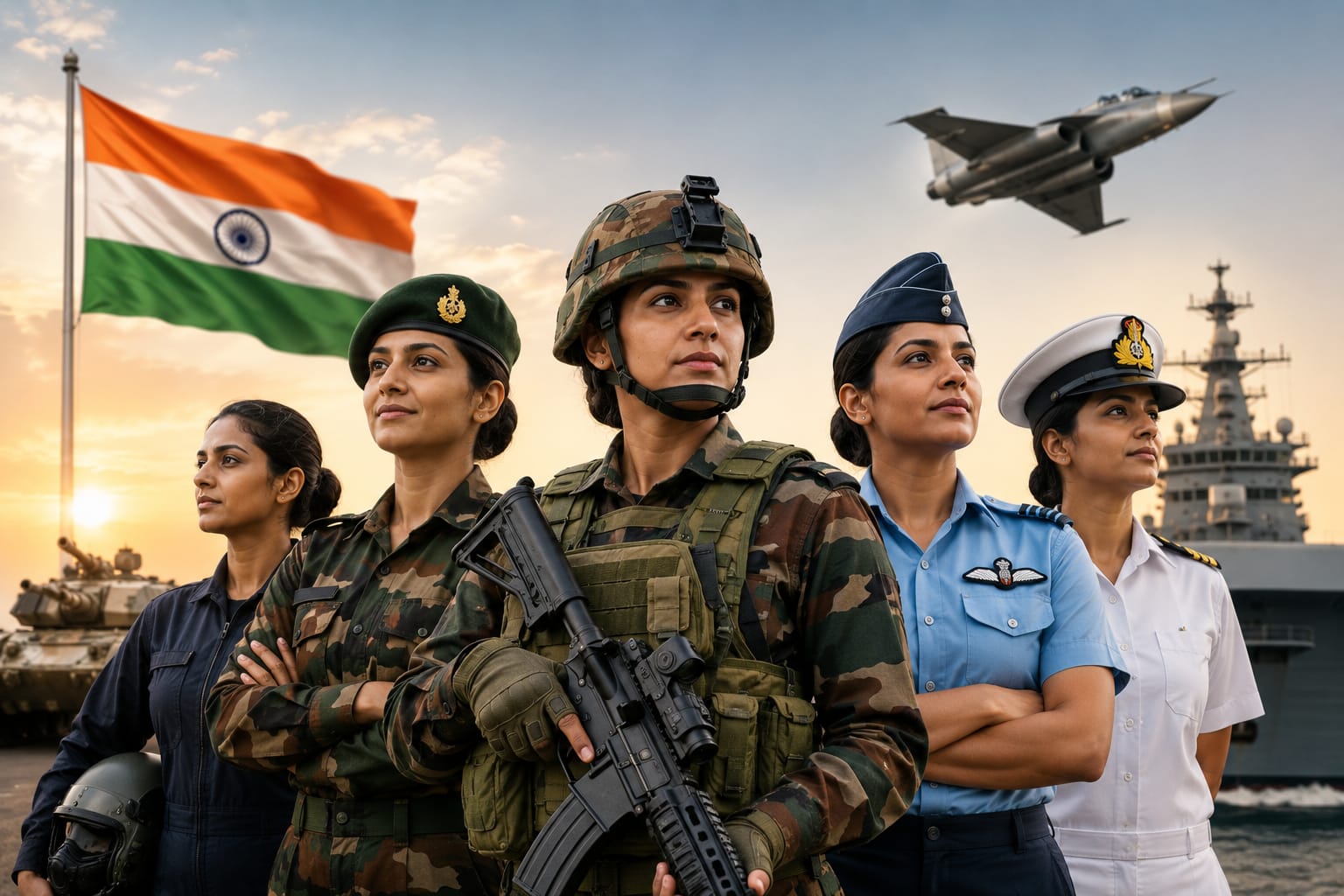
Women in the Indian Armed Forces represent courage, discipline, and patriotism. Their role has transformed significantly over the years. Earlier, women mainly served in medical and support services, but today they contribute to technical, operational, leadership, and strategic roles.
Women officers now serve proudly in the Indian Army, Indian Navy, and Indian Air Force. Defence reforms and changing social perspectives have created more opportunities for women to build successful careers in the military. Through entries like NDA, CDS, AFCAT, and technical branches, women are gaining equal opportunities to serve the nation.
Women in Indian Military Education and Training
The inclusion of women cadets in military training is one of the most important milestones in India’s defence history. Institutions like the Indian Military Academy (IMA) now welcome women officers through various entry routes.
Women cadets undergo the same challenging training as male cadets. Their training includes physical endurance, weapon handling, field exercises, leadership skills, and academic preparation.
This development proves that dedication, discipline, and ability define military excellence. The participation of women in military training has broken traditional barriers and strengthened the idea of equality in defence services.
Roles of Women Officers in Defence Forces
Women officers are contributing to different branches of India’s defence forces.
In the Indian Army, women serve in important areas such as signals, intelligence, engineering, logistics, education, and administrative services.
In the Indian Air Force, women officers work as fighter, transport, and helicopter pilots. They demonstrate exceptional skill, confidence, and technical expertise in aviation roles.
In the Indian Navy, women officers handle technical, operational, and shore-based responsibilities. Their growing participation reflects the increasing trust placed in their capabilities.
The expanding role of women shows that modern defence forces value talent, leadership, and commitment.
Women in Operation Sindoor and Leadership Roles
Women officers have made significant contributions to important military missions, including Operation Sindoor. Their involvement in official briefings and strategic communication highlighted their leadership and professionalism.
Officers like Colonel Sofiya Qureshi and Wing Commander Vyomika Singh have become inspiring examples of women’s achievements in defence services. Colonel Sofiya Qureshi has contributed to military communication and coordination, while Wing Commander Vyomika Singh has shown excellence as a helicopter pilot in the Indian Air Force.
Their achievements prove that women officers can successfully handle responsibilities at national and international levels.
Changing Concept of Military Leadership
The concept of leadership in the armed forces is evolving with the increasing participation of women. Earlier, people often connected military strength only with physical ability. Today, modern warfare depends on technology, intelligence, teamwork, and quick decision-making.
Women officers have demonstrated excellence in these areas. Their performance shows that effective leadership depends on skills, dedication, and decision-making abilities rather than gender.
Their contribution improves operational efficiency and supports better decision-making during complex situations.
Nari Shakti and Women’s Contribution to Defence
The concept of Nari Shakti has gained importance in India’s defence structure. Women officers bring valuable qualities such as adaptability, communication skills, patience, and teamwork.
These qualities strengthen leadership and improve coordination within military units. The inclusion of women creates a more balanced and effective defence system.
Women’s participation in the armed forces reflects India’s commitment toward equality and empowerment.
Challenges and Progress
Women in the armed forces have achieved remarkable progress, but some challenges still exist. These include social stereotypes, limited representation in certain roles, and the demanding nature of military service.
The government and defence forces continue to introduce reforms to overcome these challenges. Permanent commission opportunities, new recruitment schemes, and expansion into advanced fields have improved career options for women officers.
These reforms are creating a more inclusive environment in the military.
Future of Women in the Armed Forces
The future of women in India’s defence services is full of opportunities. Emerging fields such as cyber warfare, artificial intelligence, drone technology, and space defence are creating new career paths.
Modern warfare requires technological knowledge, strategic thinking, and innovation. Women officers are already proving their capabilities in these areas.
Their increasing participation will continue to strengthen India’s defence capabilities.