

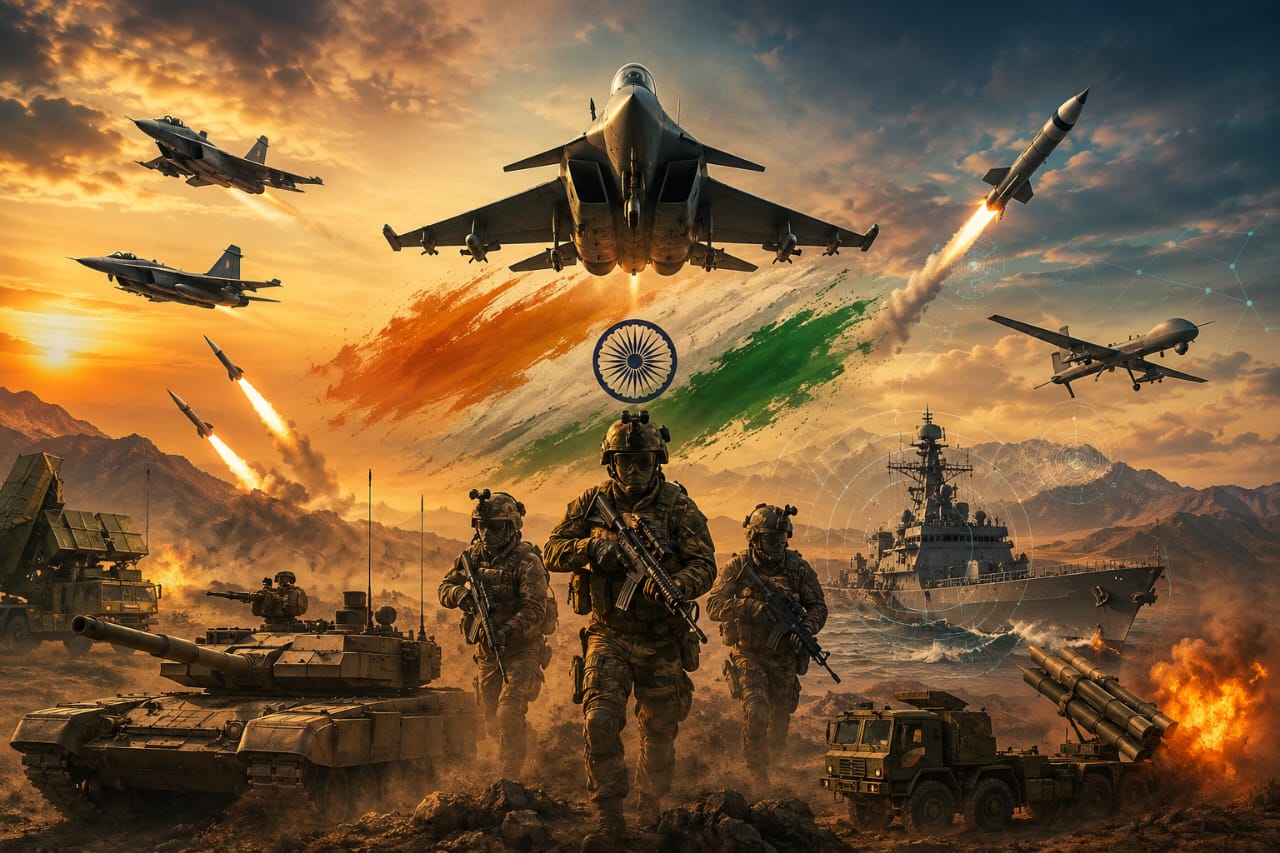
Introduction to Operation Sindoor
Operation Sindoor was a targeted operation against the threats of cross border terrorism in 2025. The mission goal was to:
Wipe out terror networks in enemy controlled areas.
For precise strikes with minimum collateral damage, make sure everything is in place.
Showcase India’s speedy response mechanism
Improve the sense of threat for future attacks
The campaign was different than the traditional one, where Sindoor was meant to be a technology-driven precision campaign rather than a long war.
India’s security and defence preparedness.
Integrated Defence Network (IACCS)
India’s air defence mainstay during the operation was:
Integrated Air Command and Control System (IACCS)
Key functions:
Real-time airspace monitoring
Putting radar stations throughout the country into a network.
Linking up missile batteries and fighter jets
The ability to identify and respond to threats quickly.
This was a system that made India one integrated battlefield network. Joint Tri-Services Coordination
During Operation Sindoor, the entire coordination was done amongst:
Ground readiness and artillery deployment by the Indian Army.Indian Army – Ground readiness, Artillery deployment
Personnel of Indian Air Force – precision airstrikes and interception of hostile aircraft.Indian Air Force – precision air strikes and interception of hostile aircraft.
Indian Navy – surveillance support and inputs for intelligence.
It represents the transition towards joint theatre command structure
Intelligence & Surveillance Support
The operation was highly reliant on:
Satellite reconnaissance systems
Drone-based surveillance
Human intelligence (HUMINT)
Signals intelligence (SIGINT)
The cyber units were also involved in:
Keeping track of enemy communications
Blocking misinformation campaigns
Identifying digital intrusion attempts:
Weapons and Missile Systems Used
Operation Sindoor displayed the Indian mix of indigenous and state-of-the-art imported guided and non-guided missiles.
Air-Launched Cruise Missiles
A missile designed to strike the enemy’s head.Missile for head attack.
Precision strike weapon that can be fired over a distance.
For deep penetration targets, this design is suitable.
High accuracy and stealth function.
Designed to eliminate high-calibre terror infrastructure.
Precision Strike Systems
A HAMMER is a guided bomb system.
Modular air-to-ground weapon
Very accurate in hilly area
Action against bunkers and fortified camps
Indigenous Missile Power
BrahMos Supersonic Cruise Missile
One of the world’s fastest cruise missiles
Run around the plane at Mach 3 or higher
Very accurate and elusive
It symbolizes India’s strategic strike power.
Air Defence Systems
Akash Missile System
Medium-range surface-to-air missile
Aerodynamically protects aircraft and drones.
The S-400 System is a type of strategic deployment areas . S-400 System is a class of strategic deployment areas.
Long-range air defence shield
Able to track multiple air targets
Counter-Drone Systems
Detects and neutralizes the threat of UAVs
Munitions – Loitering Munitions (Kamikaze Drones)
Real time surveillance and strike capability.
~90% accuracy at a distance of up to 700 meters from a moving object
Safety to human pilots is improved.
Systems Development and Simulation
Indian Air Force Operations
Key aircraft used:
Rafale is a precision strike mission.
Su-35 – air-to-air missile system.Su-38 – anti-submarine warfare.
Aircrafts known as Electronic Warfare aircraft are able to jam enemy radar system.
Indian Army Support
Howitzers for quick deployment.Howitzers that are ultra-light.
Precision artillery shells
Teams to watch the target for corrections for travel ahead.
Network-Centric Warfare Approach
Digital systems were used to link all the forces to facilitate:
Instant target sharing
Real-time battlefield updates
Faster strike coordination
Reduced operational delays
This was a move from the old-fashioned warfare to the modern way of conducting warfare based on data.
Air Defence Effectiveness
Perhaps the best part of Operation Sindoor was the multi-layered air defence success in India.
Achievements included:
Early warning of airborne attacks at a distance
Drones and missile attacks are intercepted.Missile and drone defense.
The protection of important strategic structures.
The operation showed a strong multi-layer defence system. Gallantry Awards and Recognition
Operation Sindoor brought the concept of bravery to light in all the services.
Vir Chakra
Given for outstanding bravery in fighting.
Awarded to any fighter pilot and front line officers engaged in strike missions.
Yudh Seva Medal
Standards for recognizing distinguished operational leadership:Distinguished operational leadership is recognized through the following:
Awarded for excellence in planning and execution.
Sarvottam Yudh Seva Medal
The highest wartime service award
Given to commanders in high command for strategic leadership.
Service Medals
The Sena Medal is awarded to Indian Army personnel.The Sena Medal is given to the Indian Army.
Navy personnel are given the Nao Sena Medal.The Nao Sena Medal is awarded to the Navy personnel.
Vayu Sena Medal – Indian Air Force personnel:
BSF Gallantry Awards
The award is given to the Border Security Force personnel.
Exhibited acts of heroism in border operations in situations of extreme danger
Awardee Summary
The Operation Sindoor case was said to have resulted in the awarding of over 100 gallantry and distinguished service awards spread across the various services, highlighting the size and scope of the operation.
Strategic Lessons from Operation Sindoor
Precision Over Volume
India focused on:
Targeted destruction
Avoiding civilian harm
Intelligence-based strikes
Multi-Domain Warfare
The operation integrated:
Air operations
Ground forces
Cyber defence
Electronic warfare
Indigenous Defence Systems
Indigenous Defence Systems –
BrahMos
Akash
Established India’s growing capability to produce defense.
Intelligence-Driven Warfare
Success depended on:
Satellite imagery
Drone surveillance
Real-time signal intelligence
The future security preparedness of India is our eighth topic.The eighth topic is Future security preparedness of India.
India is now making its strength:
Hypersonic missile development
Artificial intelligence-based surveillance
Swarm defence systems for drones
Cyber warfare command structures
Unified theatre commands
These are aimed at automating India’s defence system, making it more integrated and quick response.