
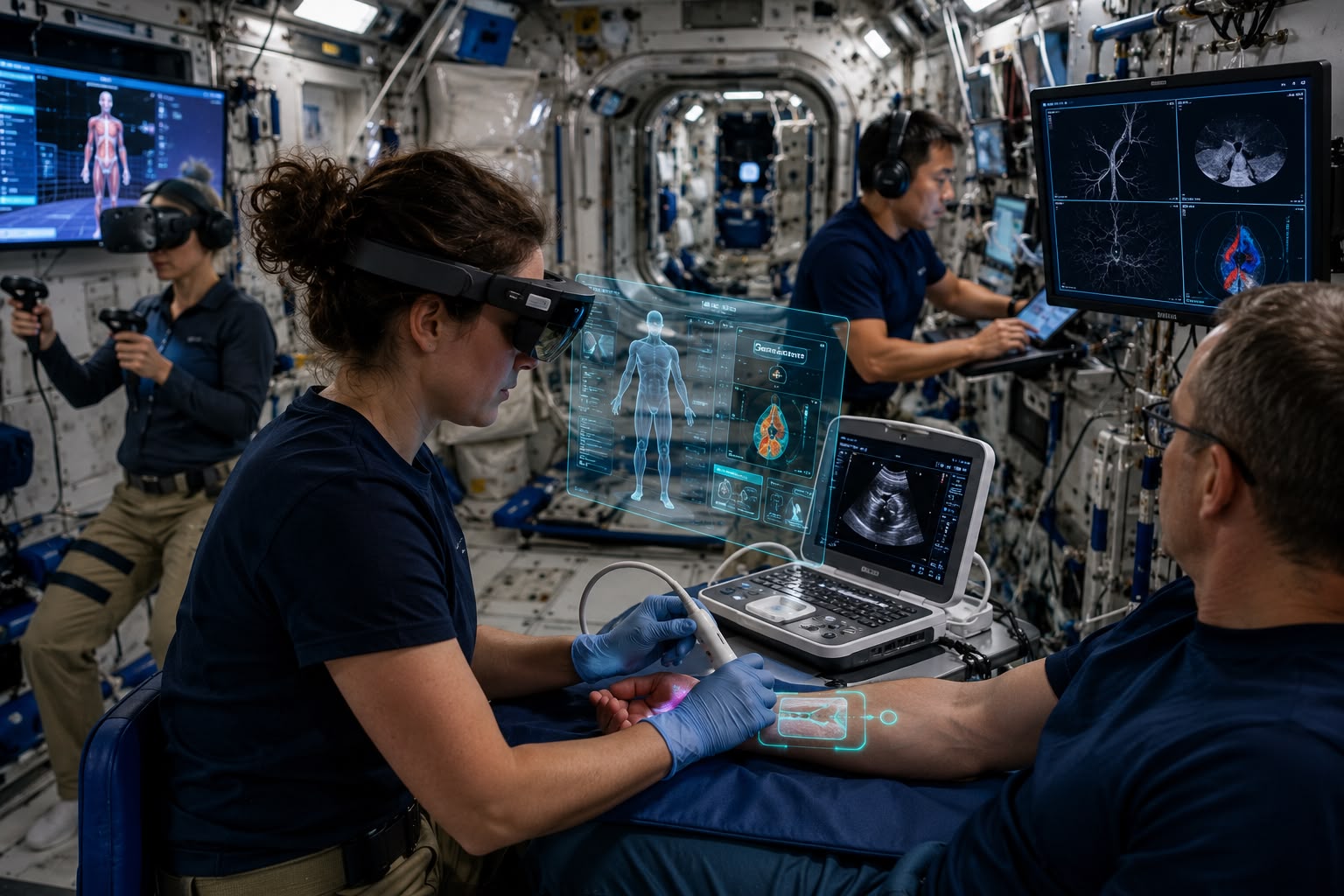
Astronauts aboard the International Space Station are using advanced augmented reality (AR), virtual reality (VR), artificial intelligence (AI), and medical imaging technologies to conduct groundbreaking healthcare research that could transform medical care in space and on Earth. The latest studies are part of ongoing efforts to prepare crews for future deep-space missions, where immediate assistance from mission control may not always be available.
As part of Expedition 74, researchers are testing the EchoFinder-2 ultrasound system, an innovative medical technology designed to help astronauts perform diagnostic examinations with minimal guidance from Earth. The system combines AR-based visual instructions with AI-assisted diagnostics, enabling crew members to conduct complex medical scans even without extensive medical training.
Using AR interfaces, astronauts can receive step-by-step visual guidance while operating ultrasound equipment. The technology helps them locate and scan veins, blood vessels, and internal organs, providing real-time feedback that improves accuracy and efficiency. By integrating AI capabilities, the system can also assist in interpreting scan results and identifying potential health concerns.
The research addresses one of the key challenges of long-duration spaceflight: ensuring astronauts can manage medical issues independently. Future missions to the Moon under the Artemis Program and eventual journeys to Mars will involve significant communication delays with Earth, making autonomous healthcare capabilities increasingly important. Technologies such as EchoFinder-2 could allow crews to diagnose and monitor health conditions without requiring constant support from medical experts on the ground.
Beyond space exploration, the study highlights the expanding role of immersive technologies in modern healthcare. AR and VR systems are already being used in medical training, surgical planning, rehabilitation programs, and remote consultations. By adapting these tools for the unique challenges of spaceflight, researchers hope to create solutions that can also improve healthcare access in remote or underserved regions on Earth.
The project represents a collaborative effort involving NASA, European Space Agency, and a network of international research partners. Together, they are advancing the field of space medicine by developing technologies that support astronaut health while expanding scientific understanding of human physiology in microgravity environments.
Scientists believe the knowledge gained from these experiments could have far-reaching benefits. Remote diagnostic systems, AI-assisted medical imaging, and AR-guided healthcare tools developed for space missions may eventually enhance patient care on Earth, particularly in areas with limited access to specialists or advanced medical facilities.
As human space exploration moves farther from Earth, innovations such as EchoFinder-2 demonstrate how emerging technologies can help bridge healthcare challenges in extreme environments. At the same time, they offer promising opportunities to strengthen medical services for communities around the world, illustrating the dual benefits of space research and technological advancement.