

Introduction
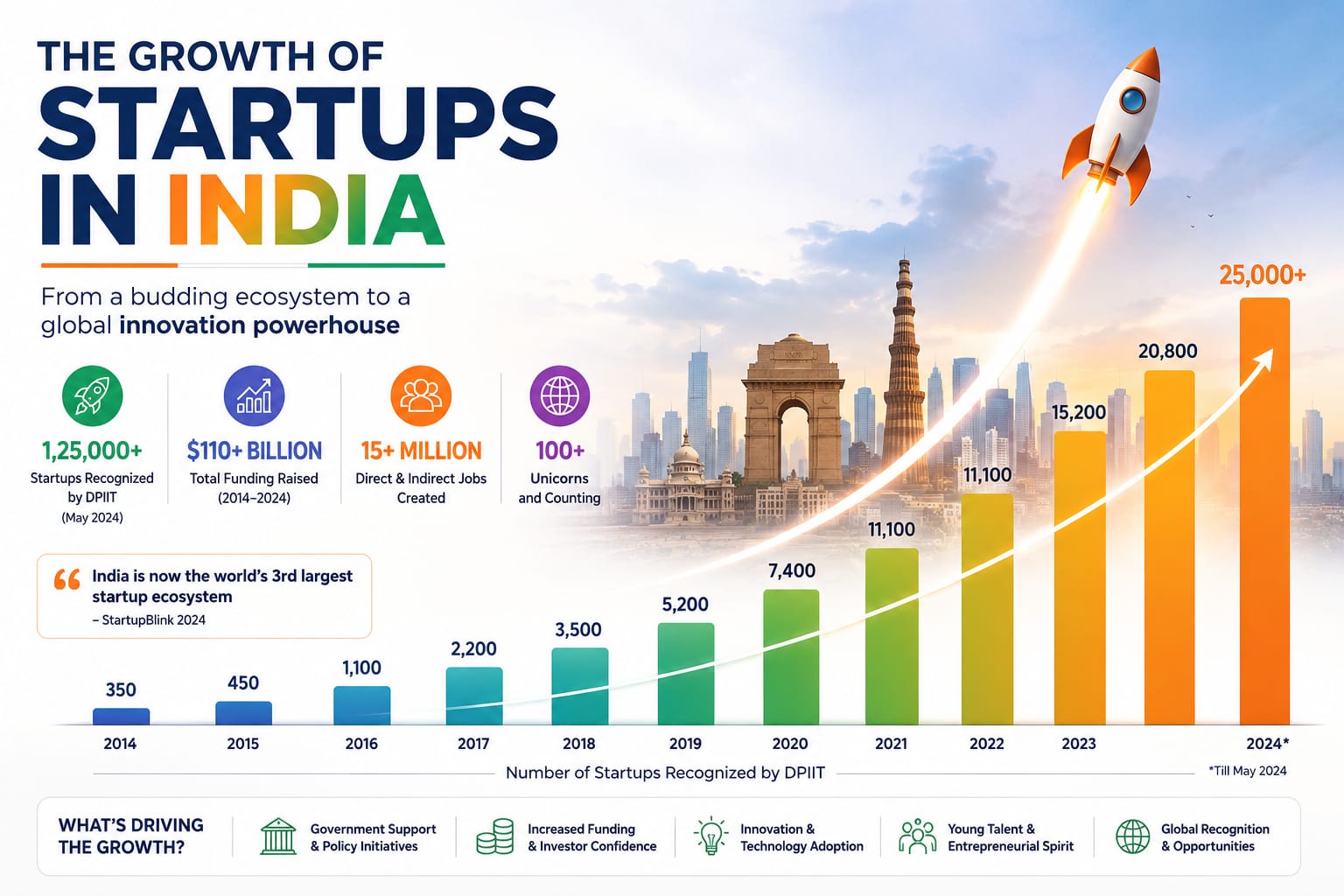
India has become one of the fastest growing start-up ecosystems in the world. In the past ten years, thousands of innovative companies have been established in areas including technology, healthcare, education, finance, agriculture and ecommerce. Though the origins might have been in garages and college dorm rooms, Indian startups have been turning the economy upside down and providing new opportunities for millions of people—from small ideas to unis that are valued at billions of dollars.
Several key factors such as enhanced internet penetration, digital payments, government support, venture capital funds and a large young population with the zeal to innovate have contributed to the growth of startups in India. In today’s times, India has been identified as one of the leading hubs of startups in the world, next to the USA and China.
What Is a Startup?
A startup is a young company that is founded to address a particular problem by using innovative products or services. Startups unlike other traditional businesses are focused on fast growth, scalability, and making use of technology to reach large number of customers.
The following are some of the key drivers of startup growth in India:
1. Digital Revolution
The penetration of cheap smartphones and internet has brought millions of Indians into digital world. This has led to an enormous amount of customer base for online businesses and fast scaling of startups.
2. Government Support
The initiatives of Digital India, Make in India, and Startup India have been instrumental in promoting entrepreneurship by providing tax allowances, streamlined processes for registration, and financial assistance.
3. Availability of Funding
Indian startups are getting more and more VC (Venture Capital) investors, angel investors, and private equity firms funding them. Entrepreneurs can use this access to capital to create products, to recruit talent and to grow their businesses.
4.Young and Skilled Workforce
India is home to one of the world’s biggest youth professional workforce. Many of the graduates are opting for entrepreneurship over jobs, adding fresh ideas and technological skills in the startup ecosystem.
The role of start-ups in the Indian economy
5.Job Creation
Start-ups create jobs in many industries. These employ software developers, marketers, designers, salespersons and support personnel, playing a significant role in job creation.
6.Innovation
Indian start-ups are addressing the challenges in the real world with innovative solutions. Fintech firms have enhanced digital payments, edtech have created more opportunities to access learning, and health-tech startups have enabled access to health services, to mention a few.
7.Boost to Digital Economy
With the emergence of startups, India has been moving towards a digital economy. Online shopping, e-banking.
8.Global Recognition
Numerous Indian startups are now going to compete with their products and services overseas and also attracting the global investors. This further boosts the image of India as a hub of innovation and entrepreneurship.
Challenges Faced by Indian Startups
While the startups in India have seen so much growth, there are a number of challenges that they have to face:
1. Funding Difficulties
Successful startups can attract investment, but many startups are too early to receive the attention of investors.
2. Intense Competition
The start-up environment is very competitive, and it is hard for new businesses to gain their foothold in the market.
3. Regulatory Compliance
There are detailed legal and tax and compliance matters that start-up companies will have to deal with.
4. Talent Retention
Finding and keeping qualified staff is not always easy, particularly for smaller startups with budgets that can’t accommodate highly qualified workers.
5. Profitability Pressure
Many startups go for quick expansion but do not make a profit in the long run.
Emerging Startup Sectors in India
There are several sectors that have a strong growth potential:
Artificial Intelligence (AI)
Fintech
Health-tech
Edtech
Agri-tech
Clean Energy
E-commerce
Improving logistics and delivery services. Enhancing logistics and delivery services.
The industries that are expected to get considerable investments in the coming years are all these.
The upcoming trends in Startups in India
Indian startups are poised to have a bright future. With rising levels of digital adoption, expanding consumer demand and government support, even more opportunities are anticipated. Experts feel that by the end of this decade, India may turn into one of the biggest startup ecosystems in the world.
Smaller cities and towns also are emerging as important startup centers. New businesses are being created in Tier-2 and Tier-3 cities, catering to local needs to bring the startup revolution beyond the big cities.
Conclusion
Startups are a big change in India’s economy. Startups are generating employment opportunities, fostering innovation, enhancing the service offerings and shaping India’s digital future. The challenges of funding, competition and profitability still exist, but the overall ecosystem is growing stronger.
The Indian startups can be a global leader in various industries with the proper support, investment, and entrepreneurial touch. The startup revolution is not only changing the way businesses operate but also shaping the future of India’s economy.