

Introduction
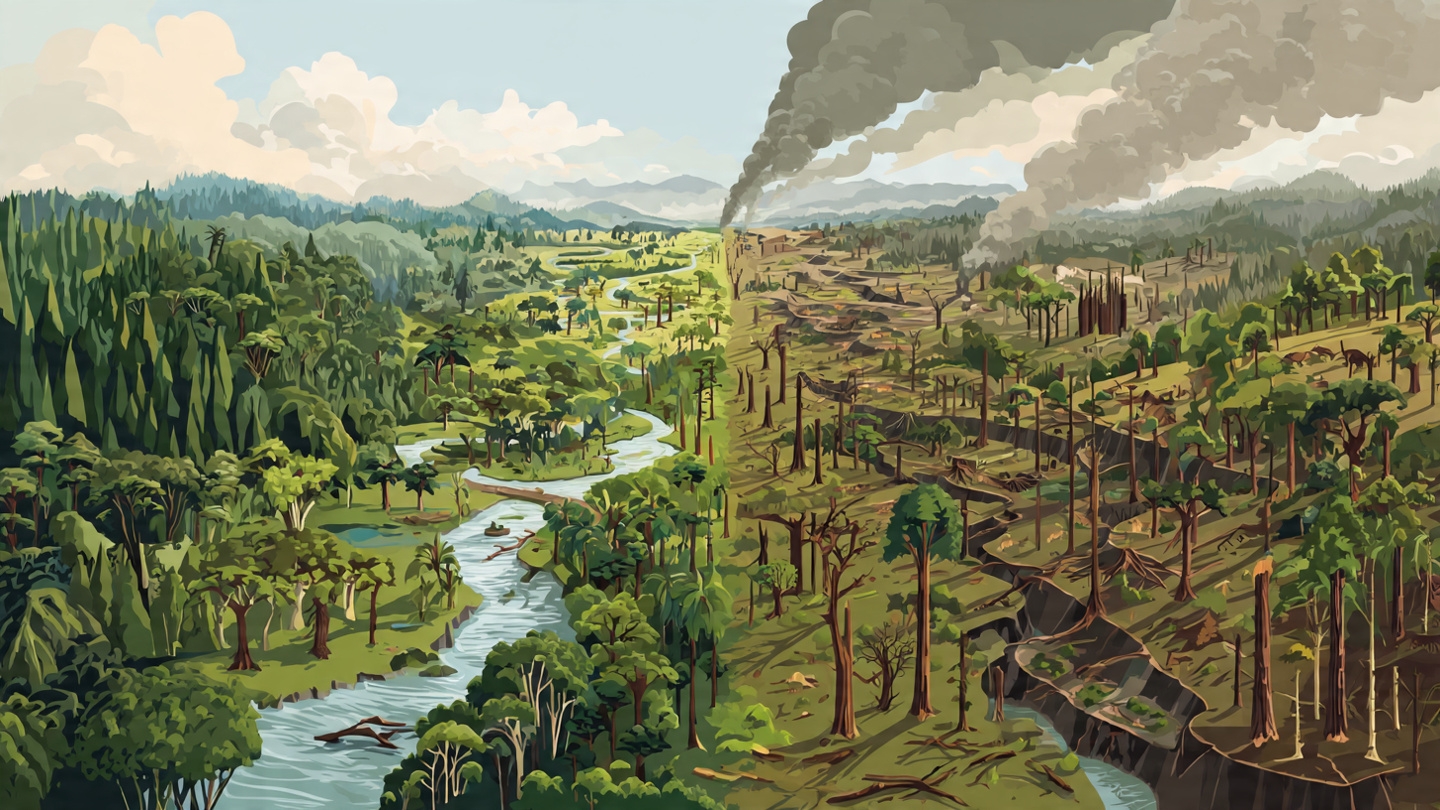
Forests cover 31% of the Earths land.. We lose around 10 million hectares of forest every year. This is an area big as South Korea. Deforestation is when we cut down trees to make room for farms, ranches, mining, roads or cities. While clearing land has helped our economy grow for centuries the scale and speed of it today are like nothing we’ve ever seen before. The effects of deforestation go beyond the trees. They affect our climate, the variety of life on Earth our economies and our health. Understanding what we lose when forests disappear is the step to finding a balance between development and survival.
What Drives Deforestation
1. Agriculture: Most deforestation in the tropics is for crops like soy, palm oil and cocoa and for raising cattle. This accounts for 80% of tropical deforestation. Small farmers also add to the problem in areas where the population is growing fast.
2. Logging: When we cut down trees for wood, paper or fuel it removes trees that store a lot of carbon.
3. Infrastructure & Mining: Building roads breaks up habitats. Makes it easier to access remote forests. Mining for gold, iron and bauxite destroys vegetation. Pollutes rivers.
4. Fires: Often set on purpose to land fires can get out of control especially in dry years like during El Niño.
5. Urbanization: As cities grow and people in developing countries collect firewood forests on the edges of cities get cut down.
Environmental Consequences
1. Climate Change Acceleration
Trees are like carbon sinks. A single mature tree in the tropics can store 22 kg of CO₂ per year. When forests burn or rot that carbon goes into the air. Deforestation causes around 10-12% of all greenhouse gas emissions. This is more than all the cars, trucks and planes combined. With trees there’s less water vapor released into the air, which affects rainfall patterns. The Amazon for example produces 50-80% of its rain. If we lose the forest we lose the rain. That leads to a drier climate that makes it harder for forests to grow back.
2. Biodiversity Collapse
Forests are home to 80% of all land species. Borneo lost 50% of its habitat between 1999 and 2015. Unique animals like Madagascars lemurs, Amazon jaguars and many insects, fungi and plants face extinction when their homes are destroyed. It’s not about the cute animals. Pollinators, soil microbes and predators keep ecosystems healthy. When one part of the ecosystem breaks crops fail, pests. Diseases spread.
3. Disrupted Water Cycles
Forest canopies catch rainfall and tree roots keep soil in place. Without them rain hits the ground causing erosion, landslides and rivers to fill with sediment. Watersheds that supply cities like São Paulo, Jakarta and Mumbai depend on forests upstream. Deforestation reduces water flow during seasons and increases flooding making the water supply unpredictable.
4. Soil Degradation
Leaf litter builds soil. Remove the trees and heavy rains wash away the nutrients within a years. The land becomes barren forcing farmers to clear forest. This cycle of cutting and burning is a reason why 30% of the worlds farmland is now degraded.
Economic and Social Consequences
1. Lost Livelihoods and Indigenous Rights
Over 1.6 billion people depend on forests for food, medicine and income. Indigenous communities in the Amazon, Congo Basin and Southeast Asia protect forests. Their land rights are often not secure. When forests disappear, cultures, languages and traditional knowledge are lost. Conflicts over land have increased as logging and large-scale farming expand.
2. Health Impacts
Deforestation is linked to the spread of diseases from animals to humans. As people move into wildlife habitats viruses like Ebola and malaria spread easily. Smoke from forest fires in Indonesia and Brazil causes problems across entire regions. The 2015 Southeast Asian haze event led to over 100,000 deaths.
3. Economic Costs
The World Bank estimates that the services forests provide are worth $125-$140 trillion per year. This includes flood control, carbon storage, water purification and tourism. When forests disappear these benefits vanish. Countries that invest in reforestation see returns. Costa Rica reversed deforestation through payments for ecosystem services. Now promotes ecotourism.
4. Climate Feedback Loops
Deforestation creates cycles. Less forest means rain, which stresses remaining trees making them vulnerable to fire. Fires release carbon warming the planet, which dries forests further. Scientists warn that parts of the Amazon are nearing a “tipping point” where it could turn from a rainforest to a savanna.
Global Hotspots
– Amazon Basin: Lost 17% since 1970 for cattle and soy.
– Congo Basin: The largest rainforest, threatened by mining and charcoal.
– Southeast Asia: Palm oil and pulpwood drove 80% of deforestation in Indonesia and Malaysia from 2001-2019.
These three regions store over 50% of the Earths carbon. Regulate rainfall across continents.
Path Forward
1. Sustainable Supply Chains: Certification schemes like FSC for timber and RSPO for palm oil push companies to avoid products linked to deforestation.
2. Policy & Enforcement: Brazil reduced deforestation by 80% from 2004-2012 through satellite monitoring and law enforcement. Strong governance is crucial.
3. Reforestation & Agroforestry: Planting trees isn’t enough; protecting existing forests is 7-9 times more effective for carbon. Integrating trees into farms boosts yields and stores carbon.
4. Consumer Choices: Reducing beef consumption choosing paper and supporting brands with zero-deforestation pledges shift market demand.
5. Finance: REDD+ programs pay developing nations to keep forests standing. Carbon markets and biodiversity credits are emerging tools.
Conclusion
Deforestation is not an environmental issue. It’s a climate issue, a health issue, an economic issue and a human rights issue. The effects of deforestation cut into systems that took millennia to evolve. Yet the trend isn’t irreversible. We have satellite data, indigenous knowledge, market mechanisms and policy tools that didn’t exist 30 years ago. The cost of inaction is counted in degrees of warming, extinct species and unstable communities. The cost of action is investment, in a future. Forests don’t need us. We absolutely need them. Protecting what remains and restoring what we’ve lost is one of the most effective levers we have for planetary stability.