

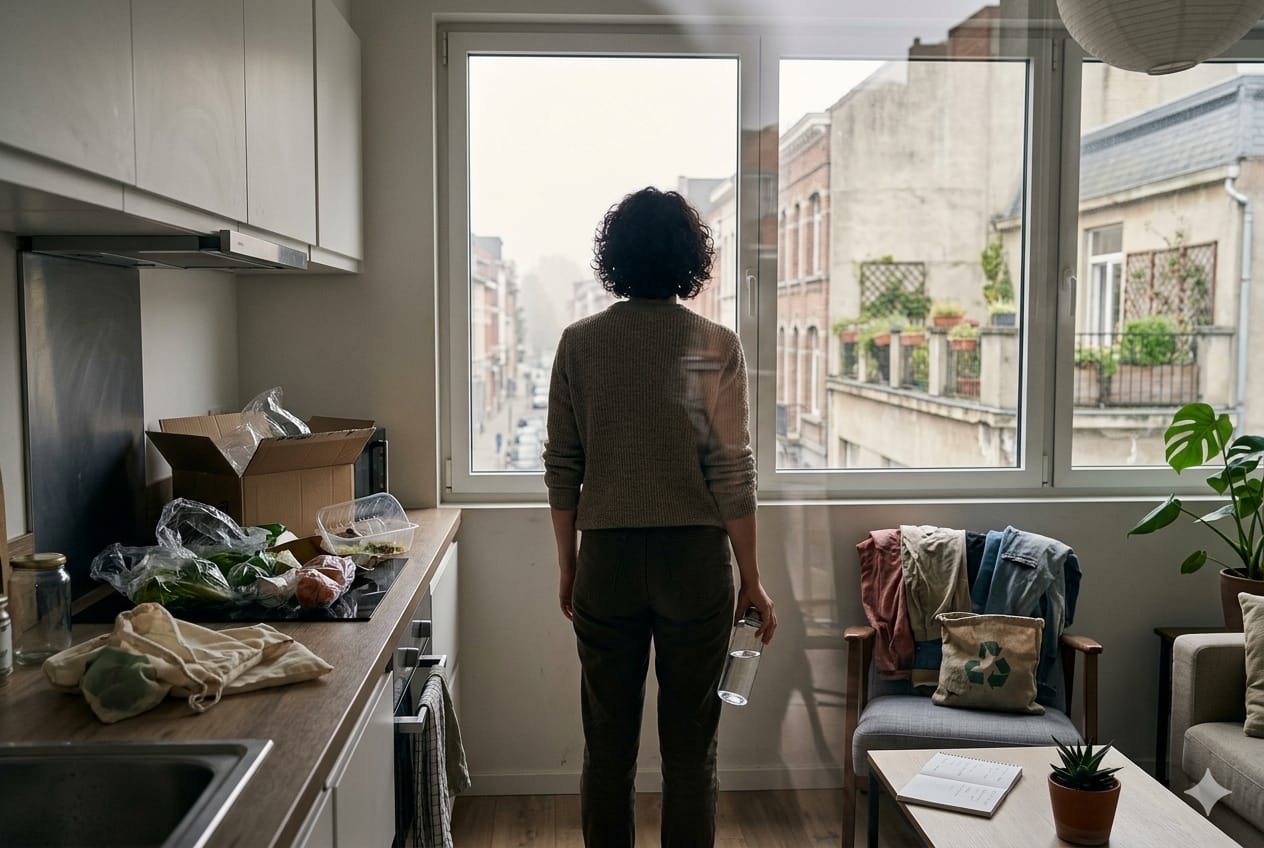
I’ll be honest with you. Some mornings I go outside, I feel the difference in the air, see the sky that has this weird “film” that I don’t know what it is and some kind of fear sets in. Not the kind of hysterical frenzy that you see in movies, but a subtle feeling that something is not right, and most of us continue to live our daily lives as if nothing is.
The world is facing an environmental crisis. I feel like we’ve been overly gentle in stating that out loud.
Living Ordinary Life, Paying an Extraordinary Price
What bothers me the most is that the bad guys aren’t just in the boardrooms. This is being done by ordinary life – how I shop, eat, travel, consume. It’s not easy to sit with.
I’m part of the problem every time I pick up a plastic-wrapped vegetable at the supermarket, or leave a tap running a few seconds too long or order something online because it’s so convenient and arrives in three layers of packaging. I know that. I think most of us know it in the back of our mind: It’s just that we don’t want to pay attention to it.
The typical household creates more trash than ever before in history. We consume more, use less and dump it quicker. Without the industry we would not keep buying and this is a staggering percentage of pollution of water and carbon emissions that the fashion industry contributes to the world. Clothes that are sold at a low price, used twice, then thrown out at the end of the season. I’ve done it. You’ve likely done it as well.
Small Choices, Real Consequences
I would tell myself that it doesn’t really matter when I do simple things at home: until governments and corporations change, nothing I do matters. And although I still feel there needs to be a systemic change, I’ve taken that stance off myself and I’m no longer using that as an excuse to stay inactive.
So here’s the truth: our daily choices aren’t separate from the bigger system. They are the part of the system. Companies produce what we consume. Policies follow public behavior. There are enough people to change a culture when there are enough people to change a culture.
It’s obvious when you’re drinking from a reusable water bottle. Now, when this is multiplied out by millions of people, it is billions of plastic bottles not made, not shipped, not stored in a landfill for five hundred years. Little decisions, transformed into habits, and then into norms, have an impact.
I began to pay more attention to the foods I ate — not all the time, and not all the time. Reducing how much meat is consumed by reducing the amount of meat eaten several days per week. When I can, buying locally-produced produce. Saving more by planning meals. All of this was done without any sacrifice. It simply needed a little more will. And honestly? It was helpful in reducing the helplessness.
It is a privilege to be “Later,”
There is one thing I have learned, it’s not the same luxury for everyone to say “we’ll deal with it later”. Sea level rise is already displacing people living in coastal areas. Rainfall is erratic and this causes farmers to lose their crops. Kids living in polluted cities are born with weak lungs.
For them, there is no “later.” The crisis isn’t about to happen, it has already happened.
If I consider sustainability in that context, sustainability becomes more of a personal issue than just an abstract environmental one. It transforms to a matter of right and wrong. Who is allowed to live decently on this earth, and who’s left to suffer from choices made by others to which they had no say.
It changed my attitude towards this. It’s not simply a matter of recycling or carbon footprint. It’s about recognizing that my convenience comes at a price — someone somewhere is paying the price.
Diary of the Freshman’s Heart and Soul,
I don’t think we have enough time. Not in some distant future – in a real way! A this-decade, decisions-matter-right-now approach.
I also think that most people when they really understand what’s at stake, want to do better. We are not indifferent, we are overloaded, distracted, and sometimes even deceived about how grave the position is.
Awareness is not sufficient without action, it is only guilt with a fancy word. So I try to act. Deliberately but not perfectly, not consistently.
Buy less. Waste less. If possible, select alternate options. Talk about it. Normalize caring of course. Hold companies who sell you goods or services to the same account and demand leaders, whether they are elected or appointed, to do their part.
There will be no need to pity the environment. It requires our decisions, our choices, our decisions, our choices, our decisions.
It’s not too late. But each day that passes, we come closer to surrender and less towards patience.