

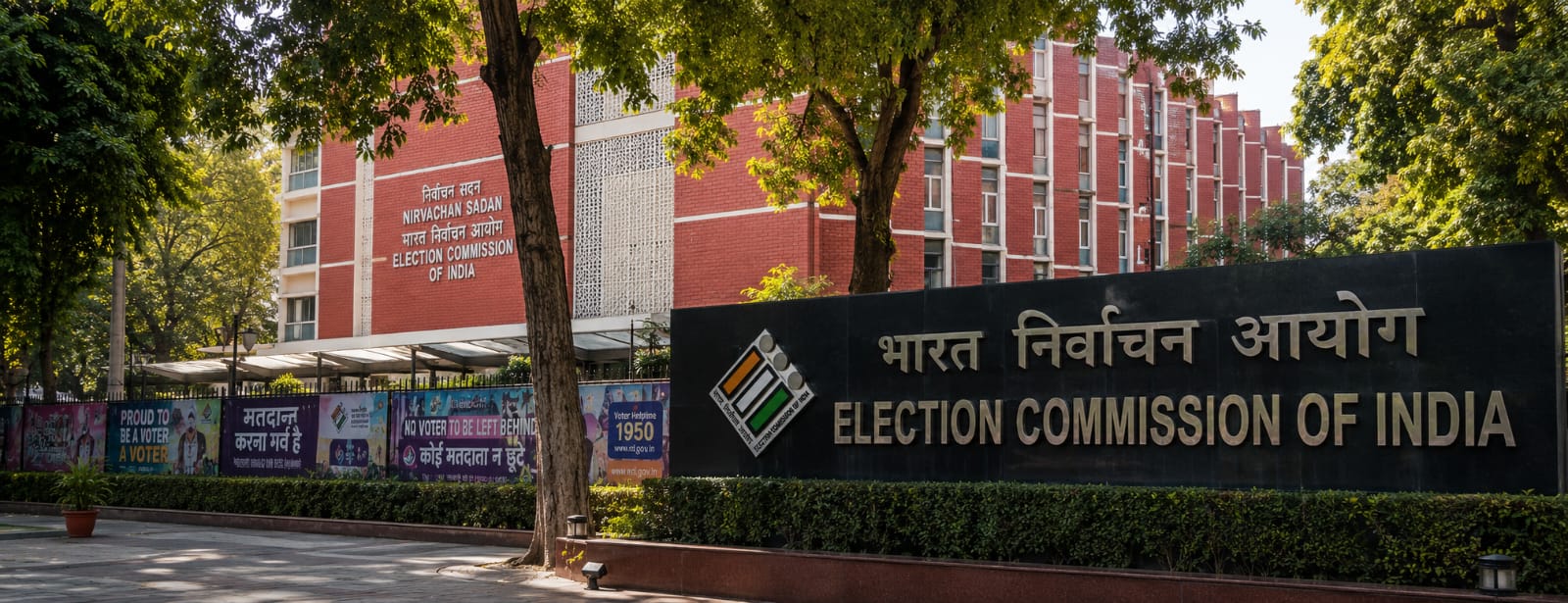
The Election Commission of India
Guardian of the World’s Largest Democracy
The Election Commission of India (ECI) stands as one of the most vital institutions in the country’s democratic framework. Tasked with the monumental responsibility of conducting free, fair, and transparent elections across a nation of more than a billion people, the ECI has, for over seven decades, been the backbone of India’s electoral process. Its independence, authority, and credibility have made it a model election management body studied and admired across the world.
Constitutional Foundation
The ECI derives its powers from Article 324 of the Constitution of India, which vests in it the “superintendence, direction, and control” of elections to Parliament, state legislatures, and the offices of the President and Vice President. Established on January 25, 1950 — a day now celebrated annually as National Voters’ Day — the Commission was created to ensure that India’s electoral machinery would function independently of executive interference, a safeguard considered essential for a young democracy of immense scale and diversity.
For nearly forty years, the ECI functioned as a single-member body. In 1989, it was expanded to include two additional Election Commissioners, transforming it into a multi-member body in which decisions are taken collectively by majority opinion, with the Chief Election Commissioner (CEC) holding no power to override the other two members.
Composition and Appointment
Today, the Commission comprises the Chief Election Commissioner and two Election Commissioners. The appointment process was significantly altered by the Chief Election Commissioner and Other Election Commissioners (Appointment, Conditions of Service and Term of Office) Act, 2023, which formalized a selection committee headed by the Prime Minister, including the Leader of the Opposition in the Lok Sabha and a Union Cabinet Minister nominated by the Prime Minister. The President of India formally appoints commissioners on this committee’s recommendation.
The senior-most member is designated CEC, who can serve for up to six years or until the age of sixty-five, whichever comes first. Currently, Gyanesh Kumar, a 1988-batch IAS officer of the Kerala cadre, holds the office of Chief Election Commissioner, having assumed charge in February 2025.
To insulate the Commission from political pressure, commissioners enjoy security of tenure similar to judges, and the CEC can only be removed through a parliamentary impeachment process requiring a two-thirds majority — the same rigorous standard applied to Supreme Court judges.
Powers and Functions
The ECI’s responsibilities are vast and multifaceted. It prepares and periodically revises electoral rolls, ensuring that every eligible citizen is registered to vote while weeding out duplicate or fraudulent entries. It determines the schedule and conduct of elections, decides on the delimitation of constituencies in coordination with the Delimitation Commission, and grants recognition to political parties along with allotting their electoral symbols.
Perhaps most visibly, the Commission enforces the Model Code of Conduct, a set of guidelines governing the behavior of political parties and candidates during election campaigns, covering everything from the content of speeches to the use of government resources for campaigning. The ECI also regulates campaign expenditure, monitors the use of money and muscle power in elections, and has the authority to countermand or postpone elections in constituencies where the process is compromised by violence, malpractice, or natural calamities.
The scale at which the Commission operates is staggering. During the 2024 Lok Sabha elections, the ECI managed an electorate exceeding 960 million voters, deployed over a million polling stations, and coordinated more than five million polling personnel — making it, for the duration of the exercise, the largest electoral undertaking on the planet.
A Legacy of Strengthening Democracy
The institutional weight of the ECI grew considerably during the tenure of T.N. Seshan as CEC from 1990 to 1996. Seshan is widely credited with enforcing the Commission’s powers assertively, cracking down on electoral malpractices, and establishing the ECI as a body genuinely capable of disciplining even powerful political actors. His tenure marked a turning point after which the Commission came to be seen not merely as an administrative body but as an active guardian of electoral integrity.
Since then, the ECI has introduced numerous reforms to modernize India’s elections, including the widespread adoption of Electronic Voting Machines (EVMs), the Voter Verifiable Paper Audit Trail (VVPAT) system for transparency, and various digital platforms for voter registration and information dissemination.
Challenges and Criticism
Despite its achievements, the Commission has not been free from controversy. In recent years, opposition parties have raised concerns over the accuracy of electoral rolls, allegations of duplicate or invalid voter entries, and the Commission’s responsiveness to such complaints. Questions have also periodically been raised about the appointment process for commissioners and the extent of true independence from the executive, particularly given the role of the ruling government in nominating members to the selection committee.
Special Intensive Revision exercises of electoral rolls in certain states have similarly drawn both support and criticism, reflecting the ongoing tension between administrative efficiency and political sensitivity that surrounds any body responsible for who gets to vote.
Conclusion
The Election Commission of India remains a cornerstone of the country’s democratic architecture, entrusted with translating the constitutional promise of universal suffrage into electoral reality across a vast and diverse nation. Its ability to conduct elections of unprecedented scale with relative order and legitimacy has earned it global recognition, including India’s assumption of leadership roles in international democracy-promotion bodies.
Yet, like any institution central to democratic life, its continued credibility depends on sustained independence, transparency, and responsiveness to legitimate public concern — qualities that will determine whether it continues to be regarded as the trusted custodian of the world’s largest democratic exercise.