

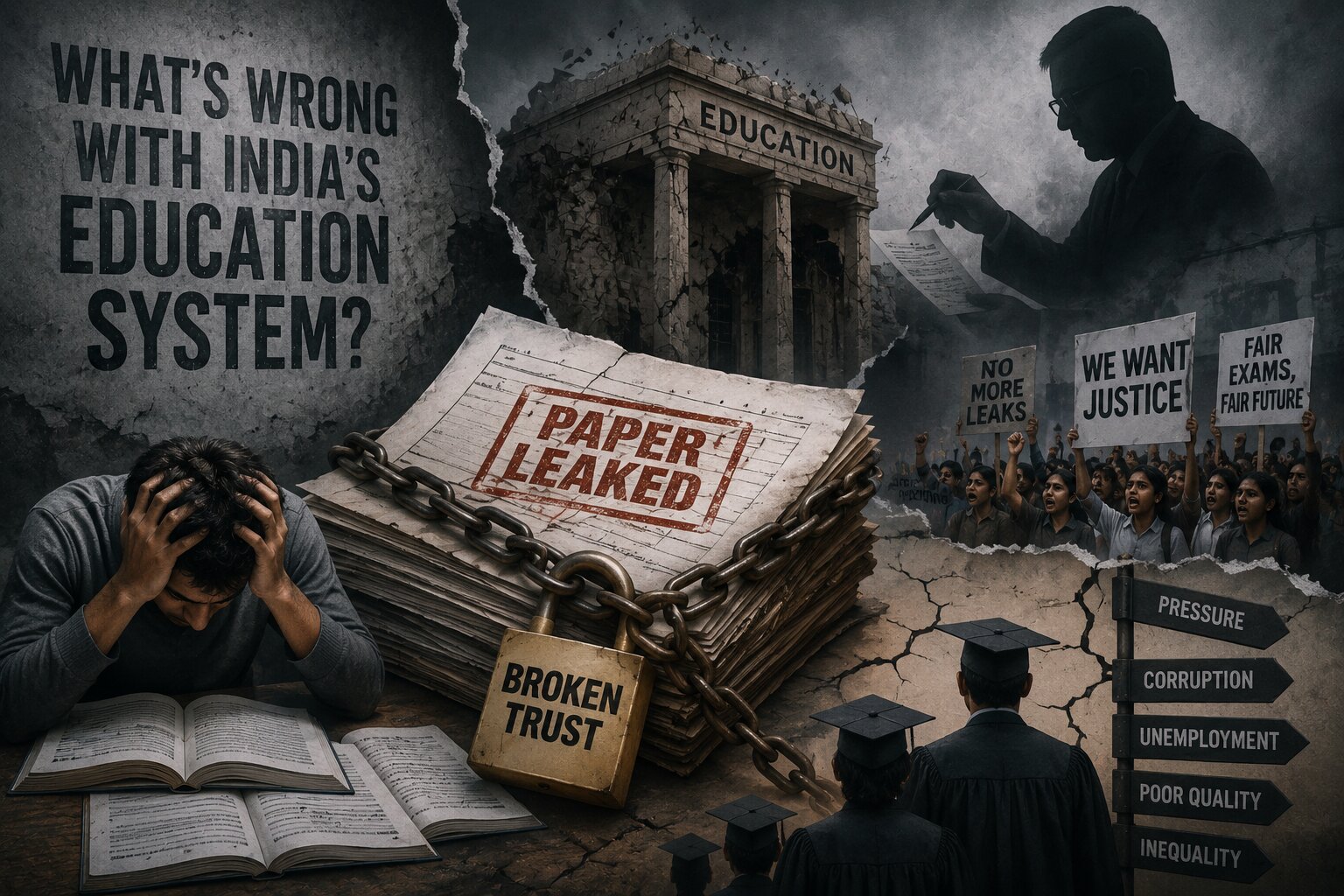
Education has always been regarded as the key to success in India. All the students work hard to get admission in the reputed colleges and become a successful career. But in the last few years, there has been an increasing awareness of something important that needs to be addressed: is the Indian education system doing its job to educate students or is it putting unnecessary pressure on them and inducing some level of uncertainty?
The system is criticised for its continued emphasis on marks and exams. Students may end up in a cycle of preparation, coaching classes and competition from the school board exams to national level entrance exams and tests. Success often is defined in terms of scores, not creativity, critical thinking, or practical skills.
It came to a head after recent exam leak scandals. Competitive examination papers allegedly leaked, especially in the high-stakes exams like NEET, has angered students, parents and teachers all over the country. These exams are years of effort, investment and sacrifice for many aspirants. When asked questions about the fairness of the process students feel disappointed and betrayed.
Not only do exam leaks impact on the results, but they also have a negative impact on trust. A student who has been preparing for years for a test expects a level playing field. If there are any irregularities reported, people lose faith in the system. Several students have voiced frustration about the cancellations of exams and investigations, along with the re-testing and uncertainty.
The increasing pressure on young learners is another worry. The tough competition for admission to college and professional courses can cause stress and anxiety. Students will be expected to do very well in a setting where a single exam may decide their fate.
There are positive signs of change, but there can be no doubt of the difficulties. The National Education Policy (NEP) 2020 aims to foster skill learning, flexibility, and all-round development. Gradual adoption of hands-on learning, technology-integrated classrooms and vocational training programmes in educational institutions.
Reforms, however, are not sufficient. The system should also be transparent, fair and accountable in the conduct of examinations. Improving security, monitoring and quick action against malpractice is necessary to regain trust in the system.
India’s education system is one of the most ambitious and large in the world. But, its real achievement will come not in the volume of exams taken and marks given, but in the number of children it reaches and the marks it gains. It will be judged on its capacity to provide an equitable setting for students to learn, develop and reach their potential in a free from fear and uncertainty environment.