

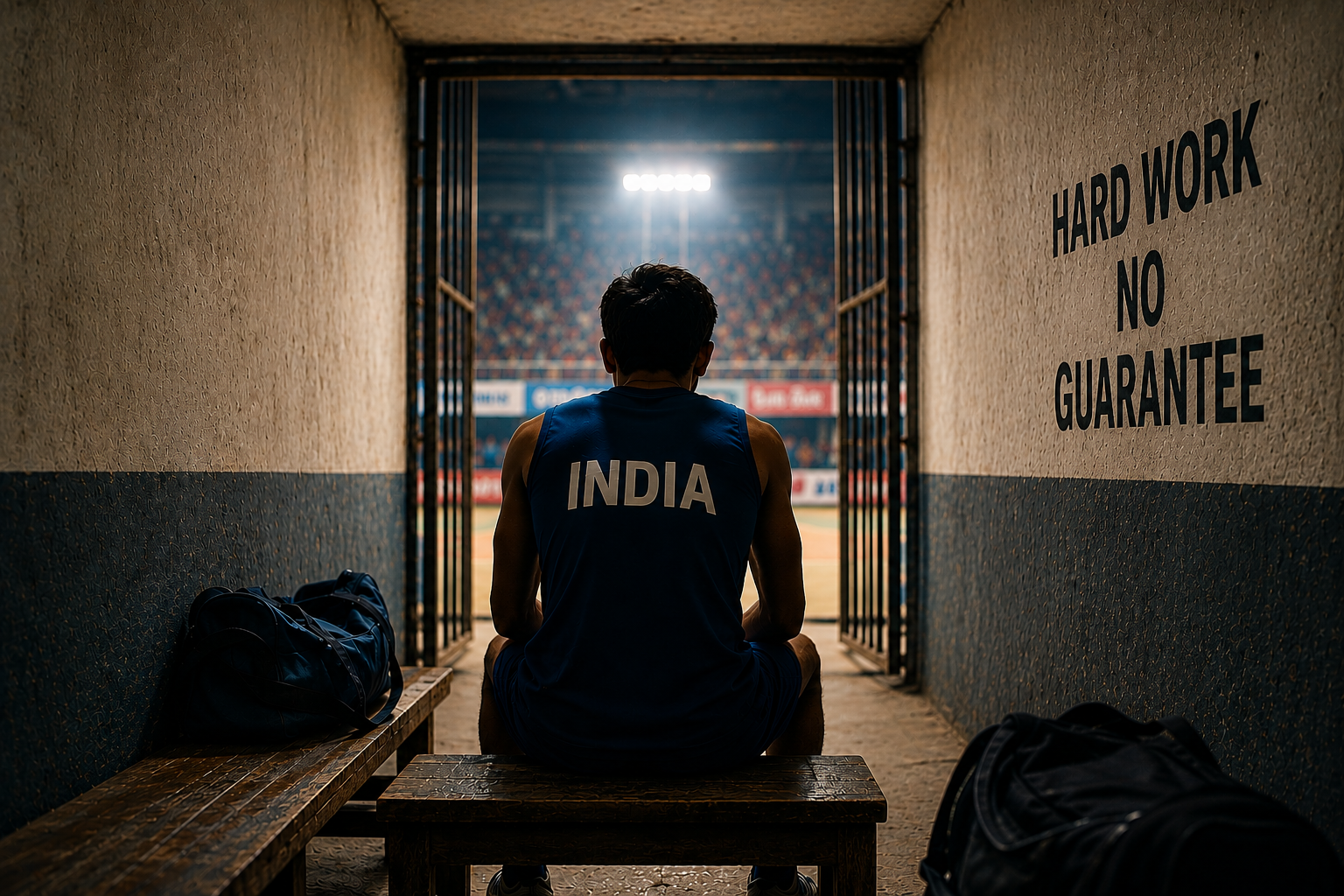
What happens to the athlete who outplays everyone in the trials but never makes the team? In most countries, that is a scandal. In India, it is a Tuesday. I have been in that room, and I have watched it happen more times than I can count. But the selection table is just where the story ends, the real problem starts much earlier, the moment a young athlete walks through their first academy gate.
You Pay to Play
Whether You Know It or Not That moment comes with a fee receipt. Private academies charge anywhere from ₹20,000 to several lakhs a year, and that is before nutrition, physios, or decent equipment enter the picture. Most Indian families simply cannot sustain that bill, which means the sport quietly filters out entire economic brackets before a single trial is held. The coaches who invest in athletes without counting the cost are the best people this sport has produced but they are rare, and nothing in the current structure rewards them for it. Meanwhile, a fourteen-year-old from Jharkhand with twice the hunger and half the resources has nobody to advocate for them in the right rooms. No union reaches that far. No federation sends a scout. That talent disappears, and the sport never knows what it lost.
Nationals: Where Politics Wears a Jersey
If that kid somehow survives and scrapes together the fees, finds a good coach, earns their shot, this is where the next wall appears. Selection in India’s team disciplines too often comes down to proximity to selectors, regional allegiances, and in some cases, money changing hands. I have personally watched a more deserving athlete sit at home while someone with the right contact made the squad. Not once but multiple times, across multiple sports. No transparent criteria exist before trials. No audit follows after. Your options are to accept the outcome or leave the sport entirely and far too many talented people have chosen the second option. The encouraging reality is that this costs almost nothing to fix. Published selection criteria and independent oversight are standard practice in countries that take sport seriously. One honest policy decision would restore faith in the process and keep the right people in the game.
The Leagues Are Brilliant
The Foundation Is Not. The IPL alone crosses ₹10,000 crore in annual revenue. The ISL, PKL, and PBL add to a franchise sports economy built in under two decades with millions of fans, thousands of jobs, commercial energy that the world watches with genuine envy. India pulled this off remarkably fast. The uncomfortable question is where that money stops. The athletes who feed these leagues’ pipelines, who trained for years to make the product worth watching – routinely finish their careers without contracts, without insurance, and without a safety net. The business is thriving while the people at the base of it are left largely on their own. That gap is not an argument against the leagues. It is an argument for demanding they do more with what they clearly have.
The Bigger Economic Opportunity India Is Missing
A broken grassroots structure is not just a sporting failure, it is an economic one. Coaching, sports science, athlete management, content, infrastructure, an entire career ecosystem sits underdeveloped because talent exits too early and trust in the process is too low. Germany, Australia, and the UK built self-sustaining sports economies by investing in exactly this layer. India has the market, the passion, and the commercial proof that sport works here at scale. The missing piece is structural honesty. Tie a portion of league revenues to grassroots reinvestment, make selection transparent, and give unrepresented athletes a real voice and India does not just produce more champions. It builds one of the largest sports industries on the planet.
The Bottom Line
The villain here is not commerce, and it is not the leagues. It is the distance between what Indian sport earns and what it returns to the people who make it worth watching, the overlooked athletes, the underpaid coaches, and the kids from small towns who never got a fair shot. The ceiling for Indian sport is genuinely sky-high. Everything needed to reach it already exists. The only thing left is the will to make the machine honest. I have played inside it long enough to know it is broken in specific, fixable ways. And that, honestly, is reason enough to stay hopeful.