

Introduction
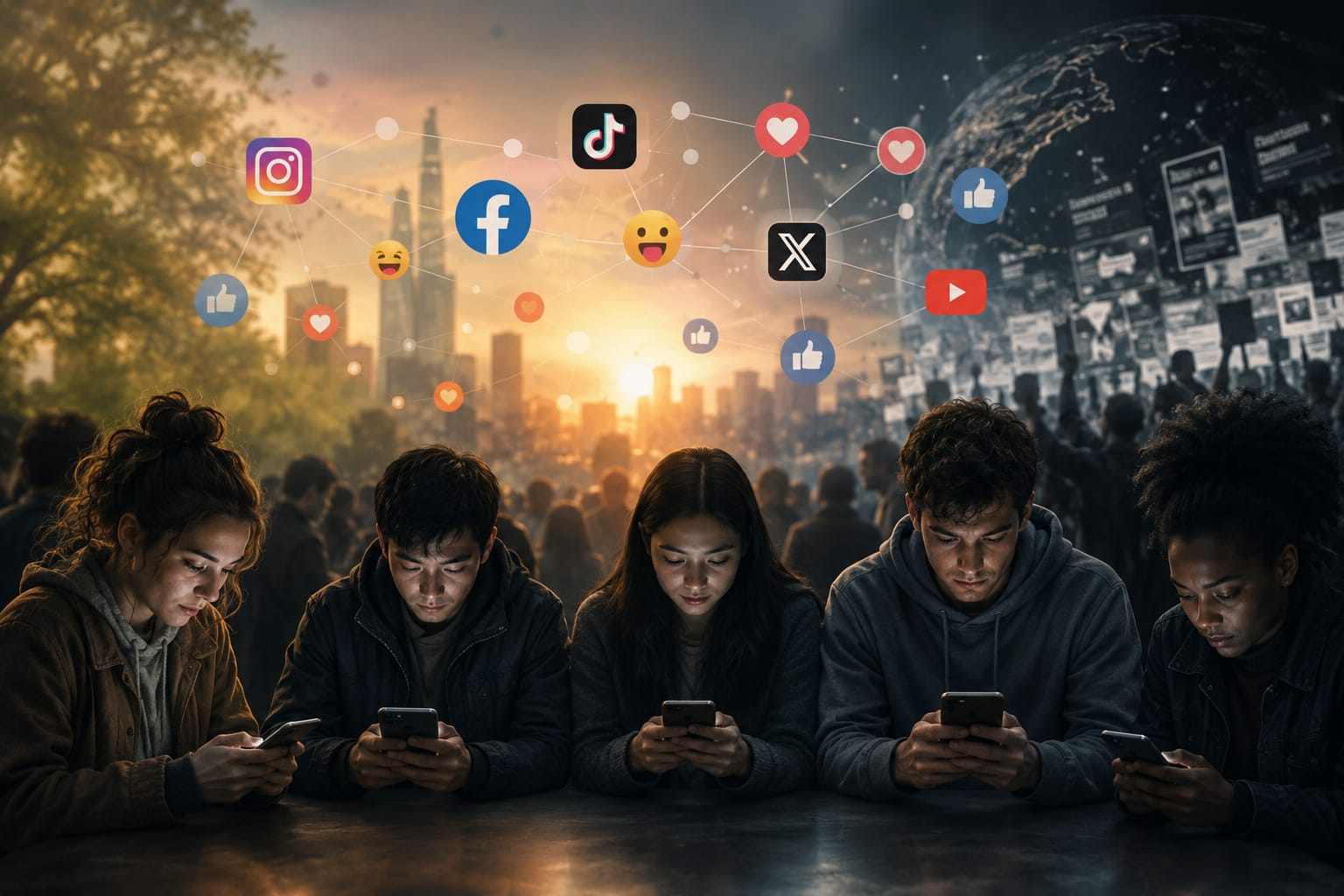
In little more than two decades, social media has transformed from a novelty into the connective tissue of modern life. Platforms like Instagram, TikTok, X (formerly Twitter), and Facebook now host the conversations, controversies, and cultural moments that define our era. More than three billion people scroll, post, like, and share every single day. The question is no longer whether social media has changed society — it clearly has — but whether that change is, on balance, something we should celebrate or fear.
The Case for Connection
At its best, social media has done something remarkable: it has collapsed distance. A teenager in rural Kenya can learn to code from a YouTube channel run by a developer in Toronto. A rare disease patient in a small town can find a global community of people who understand exactly what they are going through.
Activists in authoritarian states have used encrypted social platforms to organize, document abuses, and reach an international audience that would otherwise never have heard their voices. The Arab Spring, for all its complicated aftermath, demonstrated that ordinary people armed with smartphones and Twitter accounts could shake governments that had stood for decades.
Social media has also democratized creativity and entrepreneurship in ways that were unimaginable a generation ago.
A home cook can build an audience of millions without a television deal. An independent musician can release music directly to fans without a record label. A small business owner in a mid-sized city can target customers with a precision that once belonged only to corporations with massive advertising budgets. The barriers to being seen and heard have never been lower.
For many people, especially those who are geographically isolated, neurodivergent, or part of minority communities, social media is not a distraction from real life — it is real life. It is where friendships form, identities are explored, and belonging is found.
The Hidden Costs
Yet the same architecture that enables connection also engineers compulsion. Social media platforms are not neutral public squares. They are products designed by engineers whose key performance metrics — daily active users, time on app, engagement rates — are best served by keeping people hooked. The tools they use to do this are powerful: algorithmically curated feeds that prioritize outrage and novelty, variable reward loops borrowed from slot machine design, and social validation metrics (likes, shares, follower counts) that tap directly into the brain’s dopamine system.
The consequences are becoming harder to ignore. Research has consistently linked heavy social media use among adolescents — particularly girls — to rising rates of anxiety, depression, and body image disorders. The phenomenon is not subtle. Between 2012 and 2018, rates of teen depression in the United States surged in near-perfect correlation with the widespread adoption of smartphones and social apps. Jonathan Haidt and Jean Twenge, among others, have argued that this is not coincidence. Young people are spending formative hours in environments optimized to make them feel inadequate, envious, and perpetually behind.
The damage extends beyond mental health. Social media has become a primary vector for misinformation. False stories travel faster and further than corrections, a dynamic documented by MIT researchers who found that false news was 70 percent more likely to be retweeted than true news. During elections, public health crises, and moments of social unrest, this matters enormously. The COVID-19 pandemic illustrated how a parallel “infodemic” of false cures, conspiracy theories, and politicized science could complicate a genuine public health response and cost lives.
The Polarization Problem
Perhaps most corrosive is what social media has done to public discourse. Algorithms reward emotional intensity, not accuracy or nuance. The content that spreads most reliably is content that triggers strong reactions — and strong reactions are most reliably triggered by content that confirms our existing beliefs and vilifies those who hold different ones.
The result is an epistemic fragmentation in which people across the political spectrum increasingly inhabit separate information universes, with different facts, different heroes, and different villains.
This is not purely a technology story — political polarization has deep structural and economic roots. But social media has turbocharged it. It has made it easier to self-sort into ideological bubbles, harder to encounter good-faith disagreement, and far more rewarding to perform outrage for an approving audience than to engage seriously with complexity. The discourse that results is often less like a conversation and more like two audiences simultaneously booing different stages.
What Comes Next
The uncomfortable truth is that social media’s benefits and harms are not cleanly separable. The same openness that lets a young person discover their identity also exposes them to harassment and predatory content. The same virality that amplifies marginalized voices amplifies extremist ones. The same platforms that connected the world have helped fracture it.
Meaningful reform will require action on multiple fronts.
Regulators in the European Union have begun treating algorithmic accountability as a legal matter rather than a voluntary corporate commitment. Researchers are calling for platforms to share data that would allow independent study of social media’s effects. Educators are integrating media literacy into curricula. And a growing number of individuals are experimenting with intentional use — time limits, curated feeds, deliberate digital detox — as a form of personal resistance against attention capture.
Social media is, at its core, a mirror. It reflects human creativity, generosity, and curiosity, but also tribalism, vanity, and cruelty — and then amplifies all of it at scale. The technology itself is not destiny. How we choose to design it, regulate it, and use it will determine whether the feed becomes a tool of genuine human flourishing or a permanent drain on our collective attention, mental health, and democratic life. That choice, unlike so much of what appears in our feeds, is still ours to make.