

INTRODUCTION
The Digital Classroom: How Online Education Is Reshaping Learning
Not long ago, a quality education meant sitting in a physical classroom, commuting to campus, and arranging your entire life around a fixed schedule. That model served generations reasonably well — but it also excluded millions of people. Today, online education is dismantling those barriers one course at a time, and the shift is arguably one of the most consequential changes in how human beings share and acquire knowledge.
A World Without Walls
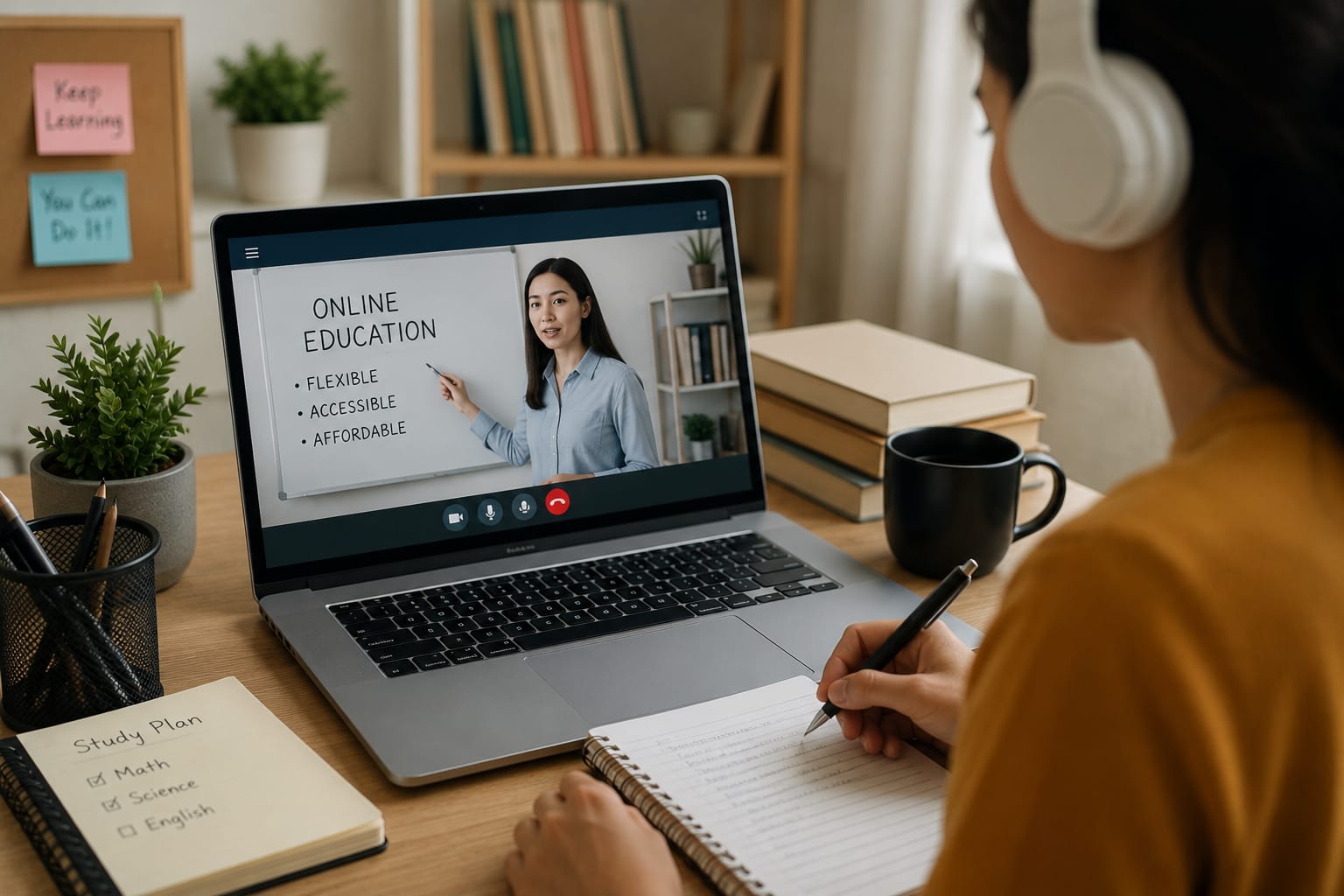
The most obvious advantage of online education is accessibility. A single mother working two jobs can earn a degree during the hours her children sleep. A farmer in rural Kenya can study computer programming from MIT. A retired engineer in his seventies can finally take those philosophy courses he always meant to explore. Geography, socioeconomic status, and physical disability — barriers that once felt permanent — are increasingly negotiable in a world of broadband and digital courseware.Platforms like Coursera, edX, Khan Academy, and Udemy have collectively enrolled hundreds of millions of learners. Universities that once served a few thousand students on a single campus now reach learners across every continent. This democratization of knowledge is not a minor convenience — it is a civilizational shift. When access to education expands, so does human potential on a global scale.
Flexibility as a Feature
Traditional education was designed around industrial-era constraints: fixed class times, synchronized pacing, a single teacher addressing thirty students at once. Online education is not simply the old model digitized — it is structurally different in ways that benefit learners.
Asynchronous learning allows students to engage with material on their own schedule. Someone who processes information more slowly is not left behind; someone who grasps a concept quickly does not sit idle waiting for the group to catch up. Video lectures can be paused, rewound, and reviewed. This is not a luxury — for many learners, especially those for whom English is a second language or those managing learning differences, it is the difference between understanding and confusion.
Self-paced courses also give learners the ability to stack credentials incrementally. Rather than committing to a multi-year program before testing the waters, a person can complete a short course, confirm their interest, and then build from there. This modular approach suits a workforce that increasingly values specific, demonstrable skills over broad, generalized credentials.
The Quality Question
Critics of online education often raise the issue of quality, and it is a fair challenge. A credential from a prestigious university earned entirely online carries different social weight than one earned in residence — at least for now. Some disciplines genuinely suffer in the absence of physical presence: studio arts, surgical training, hands-on laboratory science, and clinical psychology all require in-person practice that screens cannot replicate.
Furthermore, online courses have notoriously high dropout rates. The flexibility that makes digital learning attractive also makes it easy to deprioritize. Without the social pressure of a classroom, the physical act of showing up, and the face-to-face relationship with instructors, many learners struggle to stay motivated over weeks and months.
These are real problems, not illusions. But they are also problems that the industry is actively working to solve. Adaptive learning platforms use data and artificial intelligence to personalize content, identify when a student is struggling, and intervene before disengagement becomes dropout. Cohort-based courses restore the social dimension of learning by grouping students together with synchronized schedules, live discussions, and peer accountability. Hybrid models — blending online content with periodic in-person sessions — are becoming increasingly common, capturing the best of both formats.
Employers and the Shifting Credential Landscape
For decades, the university degree functioned as a signal: a proxy for intelligence, discipline, and baseline competence. Employers used it as a filter precisely because they had no better tool. Online education, especially the proliferation of micro-credentials, boot camps, and professional certificates, is forcing a renegotiation of that social contract.
Major employers, including Google, Apple, and IBM, have publicly removed four-year degree requirements from many job postings, stating instead that they will evaluate candidates on skills and demonstrated ability. This is significant. When the gatekeepers of economic opportunity begin to care less about the institution and more about the capability, the case for affordable, skills-focused online learning becomes dramatically stronger.
That said, the credential landscape is still fragmented and confusing. Not all certificates carry equal weight, and learners must be careful consumers, researching whether a specific certification is recognized and respected in their target industry before investing time and money.
The Social and Emotional Dimension
Learning is not only cognitive — it is social. The friendships formed in a dormitory, the debates sparked in a seminar room, the informal mentorship of a professor who notices a struggling student and takes time to intervene: these elements of traditional education are difficult to replicate online. For younger students especially, the campus experience serves developmental functions that go far beyond content delivery.
Online education has not yet found a satisfying answer to this. Virtual study groups, discussion forums, and live video sessions help, but they are not perfect substitutes. The honest position is that online learning excels at knowledge transfer and skill-building, while the residential campus experience excels at personal formation, socialization, and the cultivation of a professional network.
Looking Forward
The future of education is almost certainly neither purely online nor purely physical — it is a thoughtful integration of both. The pandemic demonstrated, painfully, what happens when institutions pivot to online learning without preparation or design. It also demonstrated that more learning can happen remotely than most people previously believed.
What emerges from this era of experimentation will likely be an education system more responsive to individual needs, more globally connected, and more focused on outcomes than on tradition. Online education will not replace the university — but it is fundamentally changing what the university must be in order to justify its existence and its cost.
The digital classroom is not a lesser version of the real thing. It is a different thing — with its own strengths, its own weaknesses, and its own extraordinary promise.