

Introduction
Data is one of the most valuable assets for businesses in today’s digital economy. Every business interaction, online transaction, and every customer interaction generate valuable information which can be used to make informed decisions. With the help of data analytics, organizations can gather, analyze and process this information to make sense of the trends, improve performance and provide a competitive edge. Data analytics allows companies to gain insights into customer behavior, improve their operations, and adapt to market trends quickly and efficiently.
Data Analytics definition?
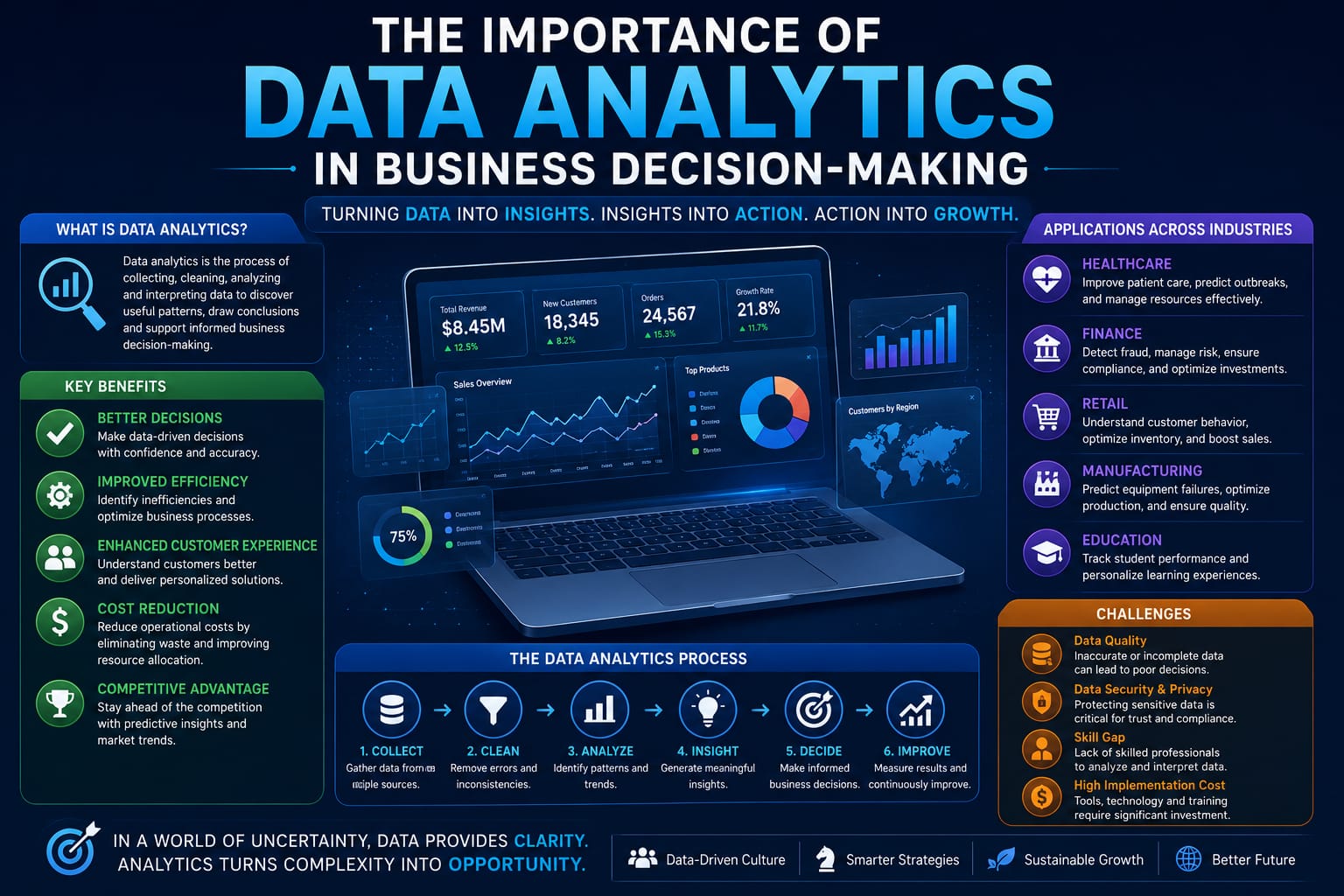
Data analytics involves data collection, data organization, data analysis, and data interpretation to achieve meaningful results. It involves the use of statistical techniques, machine learning algorithms, and business intelligence tools to transform raw data into actionable information. Data analytics allows businesses to see patterns, make predictions and make decisions that are based on facts, not assumptions.
Data Analytics offers several benefits. Data Analytics has some advantages.
Better decision-making is among the major advantages of data analytics. Business leaders can use the actual data to make timely and accurate decisions that can be beneficial for the growth of the organization. Rather than a hunch, companies can use data-driven insights to reduce risk and maximize opportunity.
Data analytics also enhances customer satisfaction. Understanding the preferences, purchasing habits, and feedback of customers allows businesses to tailor their offerings to individual needs, enhancing the likelihood of meeting customer demands and driving sales.Analysing customer preferences, purchasing behavior, and feedback enables businesses to make tailored products, services, and marketing strategies that improves the chances of satisfying client demands and creating sales. This individualized strategy boosts customer relationships and enhanced customer loyalty.
This also offers a significant operational efficiency benefit. Performance data can be used to identify inefficiencies, optimize workflows, cut down on operational costs, and boost productivity for organizations. The ability to predict issues and solutions before they even arise is another benefit of predictive analytics that can help a business.
Applications Across Industries
Data analytics is playing an increasingly significant role in industries across the globe. Hospitals use information to enhance patient care, analyze data to better diagnose patients, plan and design patient care, and prevent disease. Financial institutions leverage analytics in various ways, including for fraud detection, financial risk analysis, and customer service enhancement. Retail companies study customers’ buying habits to make the most of their sales.
For manufacturing firms, they can track equipment performance and forecast maintenance needs, minimizing downtime and enhancing productivity. Data analytics is used to track student progress, tailor learning and enhance learning outcomes in educational institutions.
Data Analytics is not without its challenges. There are challenges to Data Analytics.
Although the use of data analytics has a lot of benefits, there are also various challenges for implementing data analytics. Data sources may have a lot of data and be complex, making data integration a challenge. Keeping data high quality and ensuring the accuracy of data is also vital when doing analysis.
Ensuring data privacy and cybersecurity are still a big concern, especially when dealing with sensitive customer data. Compliance with data protection rules and robust security protocols are essential for businesses to protect sensitive information. Also, organizations need experts who can analyze the data and derive valuable business insights.
Future of Data Analytics
Data analytics has also been closely intertwined with the evolving technologies like Artificial Intelligence (AI), Machine Learning (ML), and Cloud Computing. These technologies empower companies to analyze the huge amount of data quickly and accurately. Business intelligence and strategic planning will continue to be enhanced by real-time analytics, predictive modeling and automated reporting.
The digital transformation is gaining pace, and those companies that invest their resources in advanced analytics will reap the benefits and be better set up to innovate, enhance customer experiences and stay ahead of the curve in the global marketplace.
Conclusion
Data analysis is a key part of business strategies today. This capability of converting raw data into meaningful insights helps organizations make better decisions, optimize their operations, and provide outstanding customer experiences. Despite the difficulties of data security and implementing the system, businesses that embrace data analytics can see sustainable growth and long-term success. As the world becomes more data-centric, analytics is not just an advantage but a must-have for businesses to stay competitive and future-ready.