

Introduction
Artificial Intelligence (AI) has transformed from a vision for the future to a technology that impacts nearly every facet of the current life. Whether it’s in healthcare, education, finance, or transportation, AI is reshaping industries by streamlining processes, optimizing decision-making, and providing personalized experiences. With its widespread use of AI-powered solutions, knowledge of its impact is crucial for both businesses and individuals.
AI in Healthcare
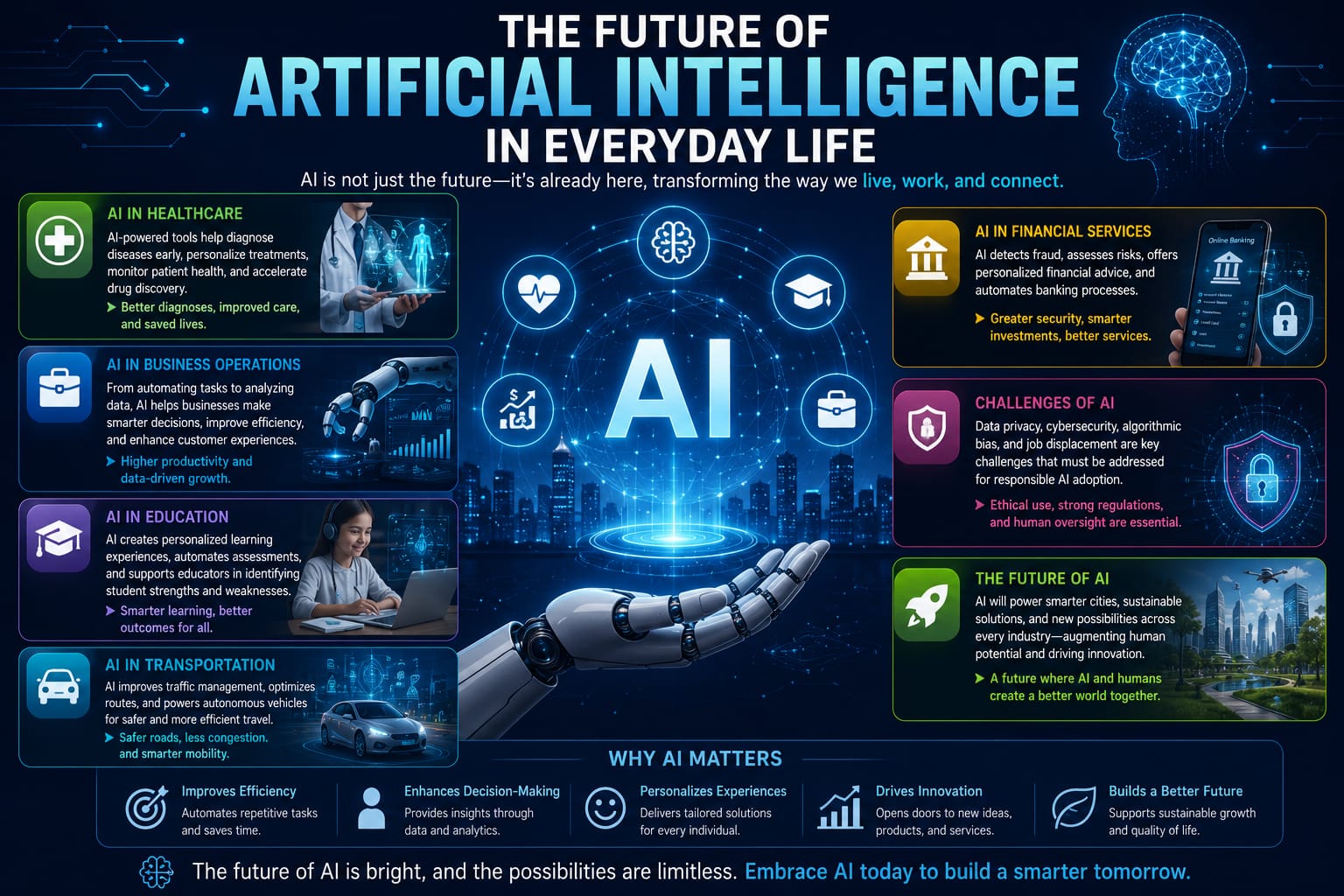
Artificial intelligence is a major asset to the healthcare industry. Diagnostic systems using AI can interpret medical images, identify potential diseases early, and help doctors make precise diagnoses. Predictive analytics also provides hospitals with insights into potential health risks, enhanced patient care, and better resource management. These benefits help to achieve improved health outcomes and lower operational expenses.
Business Operations with AI.
AI is transforming industries with its ability to enhance productivity and customer satisfaction. AI-powered chatbots offer real-time customer service, and machine learning algorithms process customer data to route it to personalized suggestions. AI is also applied in organizations for market forecasting, inventory management, and process automation, promoting quicker decision-making and improved operational effectiveness.
The education in
AI in Education
Destry is revolutionized by artificial intelligence, which enables personalized learning experiences. Smart learning platforms customize learning material to the individual student’s learning speed and performance. AI-driven assessment tools instantaneously offer feedback, enabling teachers to fine-tune teaching methods and enhance student learning. Moreover, the administration of the school, which includes attendance tracking and appointment scheduling, can be automated, permitting teachers to spend more time on student development.
AI in Transportation
AI is reshaping the transportation landscape to solve complex challenges and boost efficiency.AI is rapidly revolutionizing the transportation industry, offering solutions to complex challenges and enhancing efficiency. AI technologies are enhancing traffic management, optimizing delivery routes, and aiding in the creation of self-driving vehicles. The advanced driver-assistance systems increase road safety by the reduction of human errors and better navigation. Such innovations help to make transportation systems safer, faster and more efficient.
AI in Financial Services
Financial institutions are turning to AI to bolster their security measures and enhance customer service. Real-time fraud detection is powered by machine learning, and AI systems help with credit risk assessment and investment analysis. In addition, automation streamlines everyday banking tasks like customer authentication, loan application processing, and financial reporting, resulting in increased efficiency and customer satisfaction.
Challenges of Artificial Intelligence
However, there are a number of drawbacks to AI that must be taken into account. With the proliferation of AI systems, data privacy and cybersecurity are still significant concerns. Ethical considerations such as algorithmic bias and transparency must also be addressed to ensure responsible development of AI. Governments, businesses and technology providers should collaborate to create regulations that encourage fairness and accountability.
The Future of AI
The future of AI is defined by ongoing innovations and responsible usage. With the development of AI technology, it can be used to assist in developing smarter cities, sustainable development, better healthcare, and higher productivity in the workplace. AI is not meant to replace human intelligence but rather work alongside humans to eliminate repetitive tasks and allow professionals to concentrate on more creative and strategic work.
Conclusion
Artificial Intelligence is changing the lives and working ways of people. It has potential applications in healthcare, education, business, transportation, and finance, showing its ability to contribute to innovation and economic growth. While there are ethical, privacy, and work force adaptation concerns, the potential long-term benefits of responsible AI usage are immense. In a world that is increasingly shaped by technology, the opportunities presented by AI are vast. Technological advancements, combined with ethical considerations, can help organizations and individuals harness the power of AI and contribute to a more efficient, connected, and sustainable future.