

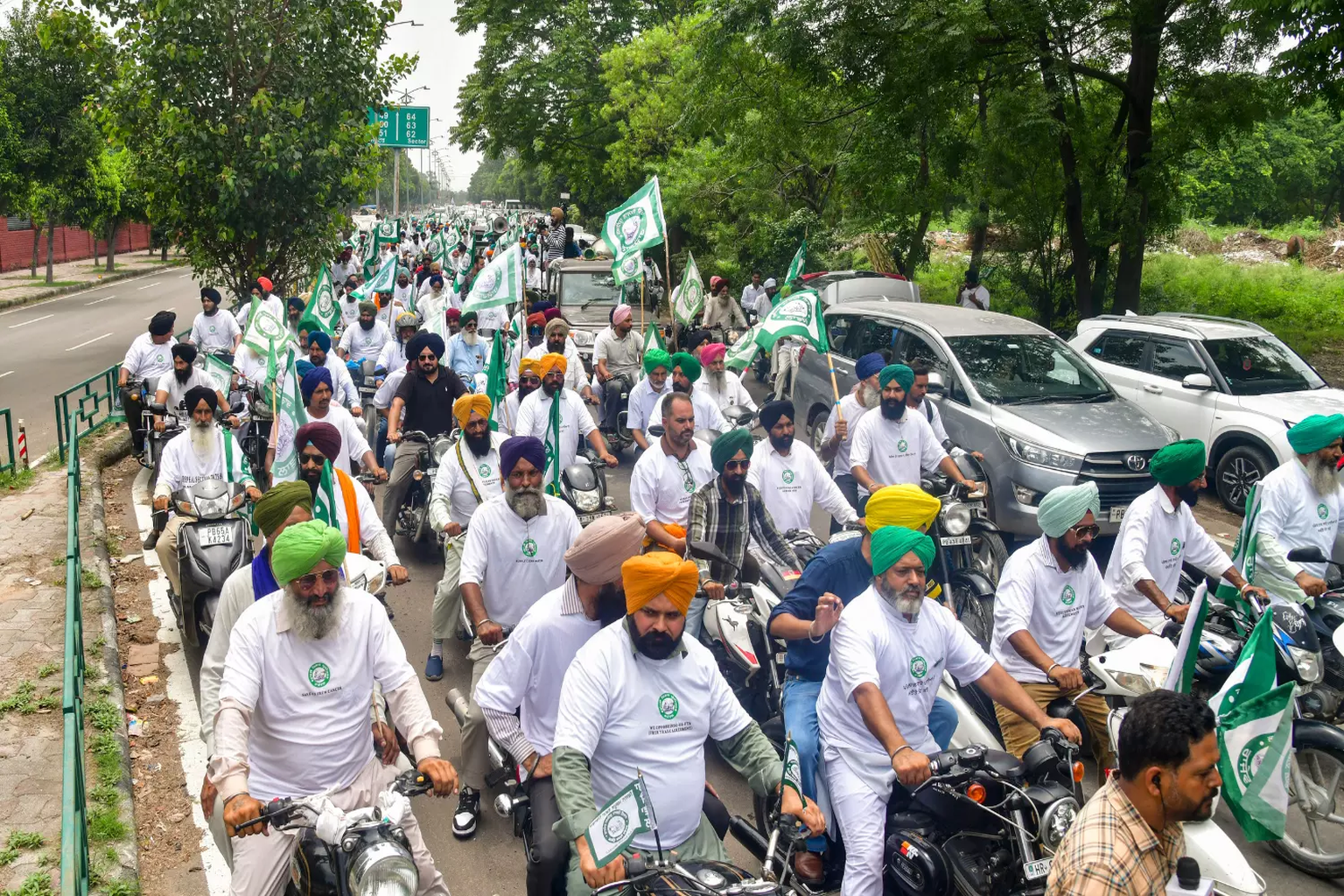
Punjab witnessed a fresh wave of farmer protests as hundreds of farmers staged a motorcycle march to oppose the proposed India-US trade agreement. The demonstration, organised by several farmer unions, reflected growing concerns that the deal could negatively affect Indian agriculture, particularly small and marginal farmers who form the backbone of Punjab’s rural economy.
The protesters carried union flags, raised slogans, and rode through major roads in different districts, urging the Central Government to safeguard farmers’ interests during ongoing trade negotiations. Farmer leaders said any agreement that opens India’s agricultural markets without adequate protections could put domestic producers at a disadvantage.
Farmers Raise Concerns Over Agricultural Imports
Farmer organisations fear that an India-US trade deal could lead to increased imports of agricultural products at lower prices. They argue that Indian farmers, who already struggle with rising input costs, uncertain weather, and fluctuating market prices, would find it difficult to compete with heavily mechanised and subsidised agricultural systems abroad.
According to protest leaders, products such as maize, pulses, dairy items, and edible oils could face greater competition if import duties are reduced. They believe such a move may affect farm incomes and increase financial pressure on rural households.
The unions also expressed concern that trade negotiations should not compromise India’s food security or weaken the country’s minimum support mechanisms that provide income stability to farmers.
Motorcycle March Draws Large Participation
The motorcycle rally attracted participants from several districts across Punjab. Farmers rode in organised groups while displaying banners highlighting their demands. The march remained largely peaceful, with volunteers managing traffic and ensuring discipline during the demonstration.
Farmer leaders addressed gatherings at different locations, calling on the Central Government to maintain transparency in trade discussions. They said agricultural stakeholders should be consulted before any major agreement is finalised.
Many participants described the rally as a symbolic reminder that trade policies have direct consequences for millions of farming families across the country.
Trade Deal Sparks Wider Debate
India and the United States have been exploring ways to strengthen economic and trade relations through discussions covering multiple sectors. While supporters believe a comprehensive trade agreement could boost exports, attract investment, and create new business opportunities, concerns remain within the agricultural community.
Experts note that international trade agreements often require balancing economic growth with the protection of sensitive domestic sectors. Agriculture remains one of the most politically and economically significant sectors in India, employing a large share of the country’s workforce.
For Punjab, where farming contributes significantly to the state’s economy, any policy affecting agricultural markets attracts close attention from both farmers and policymakers.
Government Yet to Announce Final Agreement
The Central Government has not announced a final India-US trade agreement. Officials have repeatedly stated that India’s national interests, including those of farmers, will remain a priority during negotiations.
Government representatives have also maintained that trade discussions aim to improve market access for Indian goods while protecting vulnerable sectors. However, farmer unions continue to seek written assurances that agricultural products and farmer welfare schemes will not be adversely affected.
Several agricultural economists have suggested that transparent consultations with farmer organisations could help address concerns and reduce uncertainty surrounding the negotiations.
Punjab’s History of Farmer Mobilisation
Punjab has a long history of organised farmer movements. The state played a leading role during the nationwide protests against the three farm laws, which were eventually repealed in 2021 after months of demonstrations.
Since then, farmer unions have remained active on issues related to minimum support prices (MSP), crop procurement, debt relief, water management, and agricultural policy reforms.
The latest motorcycle march reflects the continuing influence of these organisations and their ability to mobilise farmers around policy issues that they believe could affect rural livelihoods.
Experts Call for Balanced Trade Policies
Trade experts say international agreements can create opportunities for exporters while also posing challenges for sectors facing stronger global competition. They argue that carefully designed safeguards, phased implementation, and targeted support measures can help protect domestic farmers.
Agricultural economists also recommend increasing investment in modern farming techniques, storage facilities, food processing, and export infrastructure. Such measures could improve the competitiveness of Indian agriculture in international markets without compromising farmer welfare.
Many experts believe that successful trade policy should combine economic growth with strong protections for vulnerable communities.
Conclusion
The motorcycle march in Punjab highlights the concerns many farmers have about the proposed India-US trade agreement. While the government views trade negotiations as an opportunity to strengthen economic ties and expand exports, farmer organisations fear the agreement could expose Indian agriculture to greater competition and financial risks.
As negotiations continue, the challenge for policymakers will be balancing international trade ambitions with the need to protect millions of farming families. Transparent dialogue, stakeholder consultations, and appropriate safeguards are likely to remain essential in ensuring that any future agreement supports both economic growth and agricultural sustainability.