


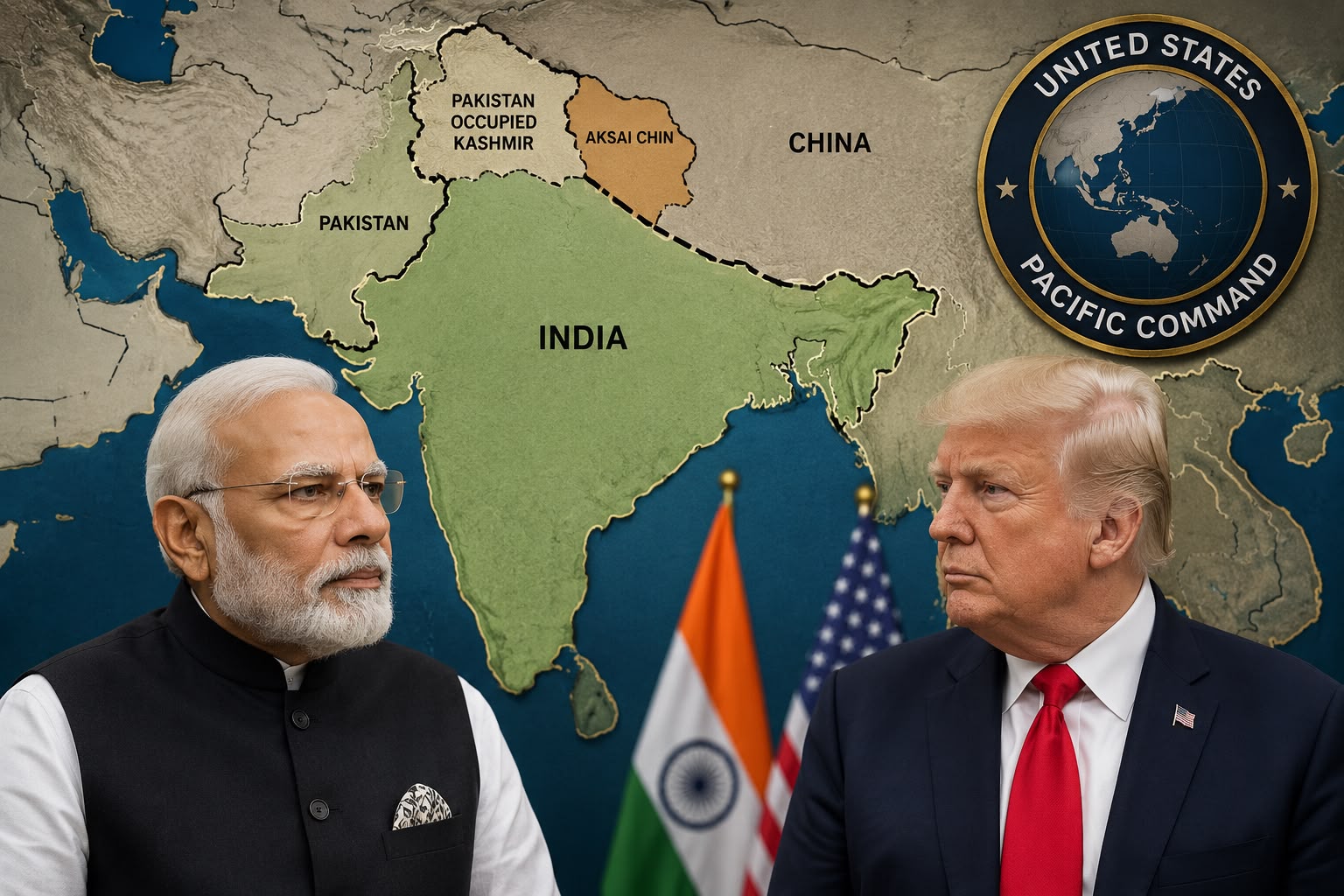
A map released by the United States military has sparked controversy in India after it allegedly depicted the country’s territorial boundaries inaccurately, leaving out portions of Jammu and Kashmir from the map of India. The development has attracted significant attention ahead of a scheduled meeting between Prime Minister Narendra Modi and US President Donald Trump, adding a diplomatic dimension to the issue.
The controversy emerged after the US Department of Defense reportedly renamed its “Indo-Pacific Command” as the “Pacific Command” and released a map illustrating the command’s area of responsibility. Critics have pointed out that the map does not appear to show the entire Union Territory of Jammu and Kashmir as part of India. In particular, Pakistan-occupied Kashmir (PoK) has reportedly been depicted outside India’s boundaries, drawing objections from observers and strategic affairs experts.
According to reports, the map portrays most of India in a single light-green colour but separates certain northern and western regions, including PoK and Aksai Chin, from the main Indian landmass. A black line running across the region is understood to represent the division between different US military command jurisdictions. However, the depiction has triggered concerns because of the sensitive nature of territorial issues involving India, Pakistan, and China.
The timing of the controversy has further amplified its significance. The map surfaced just before an anticipated meeting between PM Modi and President Trump during ongoing international diplomatic engagements. Political observers note that territorial representations involving India are closely scrutinised, particularly when they originate from major international partners.
India has consistently maintained that the entire former princely state of Jammu and Kashmir, including Pakistan-occupied Kashmir, is an integral part of the country. New Delhi also claims Aksai Chin, a region currently administered by China but regarded by India as part of the Union Territory of Ladakh. These territorial disputes remain among the most sensitive geopolitical issues in South Asia.
Strategic analysts and former diplomats have often argued that inaccurate representations of India’s boundaries in official documents or maps can create diplomatic friction and invite public criticism. Such incidents have previously led to requests for corrections or clarifications from foreign governments and organisations.
The issue also highlights the broader importance of maps in international diplomacy. Cartographic representations are often viewed not merely as geographic illustrations but as reflections of political and territorial positions. As a result, any perceived deviation from a country’s official stance can quickly become a matter of diplomatic concern.
As of now, there has been no widely reported official clarification from either Washington or New Delhi regarding the map controversy. However, the development comes at a time when India-US relations continue to deepen across defence, trade, technology, and strategic cooperation, making the dispute particularly noteworthy.