

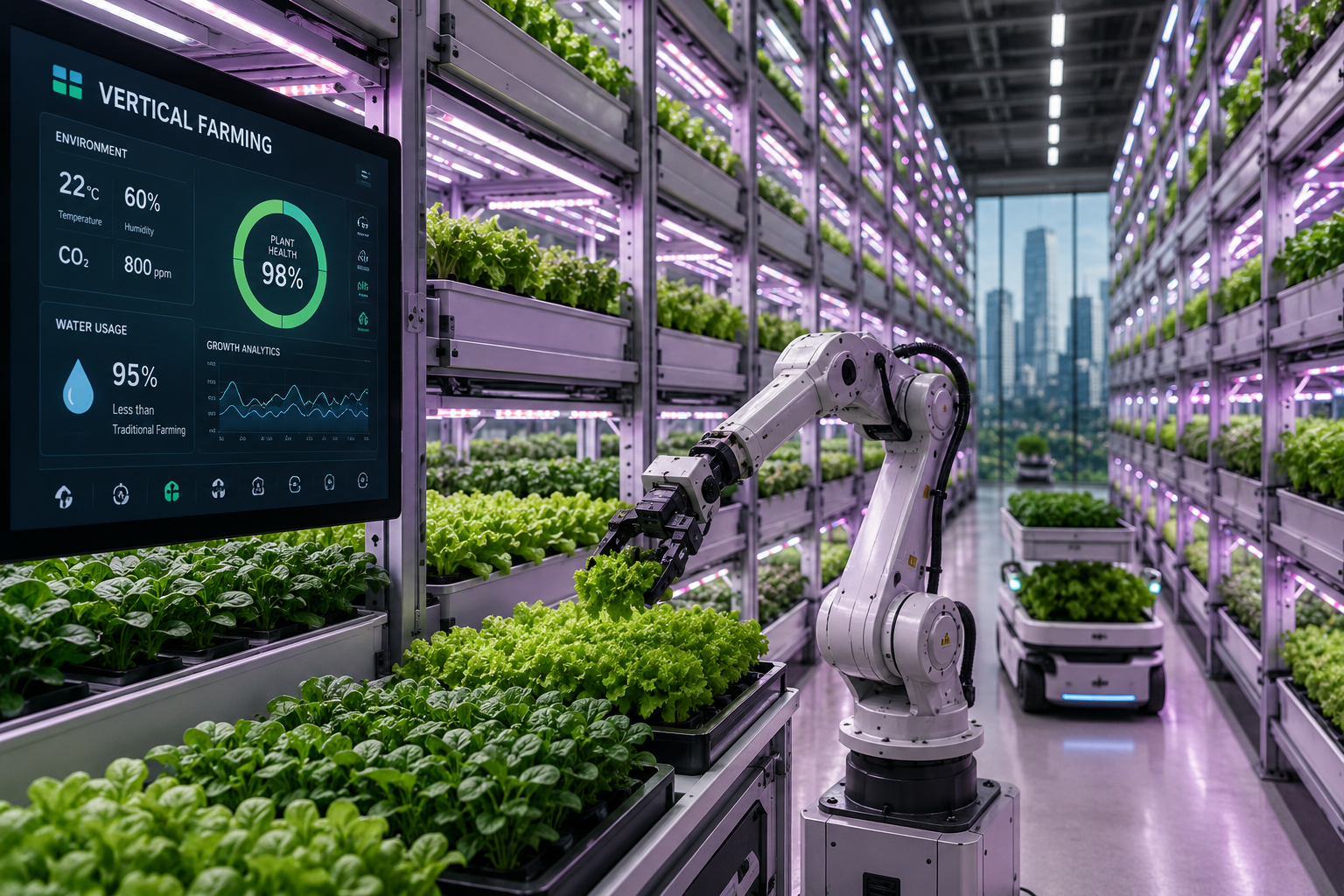
Vertical farming, with advanced technologies like LED lights, hydroponics, climate control systems and artificial intelligence, is transforming food production. It provides an environmentally friendly approach to farming and an alternative to traditional farming practices.
In recent years, climate change, unpredictable weather, and growing food requirements have challenged traditional farming practices. However, vertical farming is showing promise for the future, as it can help meet the increasing demand for food and reduce the environmental impact of farming.
What is vertical farming anyway?
Vertical farming is a method of growing plants in different layers in a controlled space like a shipping carton, warehouse, or specially built space. These farms can produce plants without the need for sunlight and soil, instead they include artificial lights and water systems that are filled with nutrients.
Hydroponic and aeroponic technologies help to supply crops with the necessary nutrients without the need for farmland. The temperature, humidity and light are closely monitored to ensure optimal growth conditions all year round.
This way, farmers are able to cultivate fresh vegetables even through the seasons.
The rise of vertical farming is due to several factors. Here are some of the reasons why vertical farming is gaining popularity.
The population of the world will soon be more than 9 billion, requiring more food and less available farm space in the coming decades.
In most of the world, people living in urban regions eat the majority of food and frequently rely on the food being brought from the countryside from far away. Vertical farming can help to grow fresh vegetables closer to consumers, which helps reduce transportation costs and carbon emissions.
The consumers also get better quality produce with extended shelf life as they are brought to supermarkets within hours of harvesting.
Environmental Benefits
Vertical farming offers a number of benefits to the environment.
Uses Less Water
In conventional farming a vast amount of water is used. In vertical farms, water is recycled using closed-loop systems and consumes up to 90–95% less water than in conventional farming.
Requires Less Land
Crops are not spread out like on a farm, but rather they are growing upward, and a small building can yield as much as several acres of farmland.
Reduces Pesticide Use
In the interior, insects and diseases are not a problem, thus chemical pesticides are not needed or required in large quantities.
Lower Carbon Footprint
Local production reduces transport times, and consequently fuel usage and greenhouse gas emissions.
What is the Technology behind vertical farms? What is the technology behind vertical farms?
Technology is the key enabler in vertical farming.
AI technology tracks and regulates plant growth and optimizes the plant’s light, nutrients, humidity, and temperature to produce maximum yield.
Data is continuously gathered about the health of the crop, and automation is used to control irrigation and harvest with minimal human input.
Additionally, numerous facilities are implementing renewable energy solutions, including solar panels, to lower their operating expenses and enhance sustainability.
Water scarcity in urban areas is now a critical issue. Water scarcity has become a real problem in urban areas.
Although vertical farming has a number of advantages, there are also a number of hurdles to it.
The investment needed to establish indoor farms is much more than traditional farming. The cost of equipment like LED lighting, climate control, and automation can add up.
Energy use is still a worry, particularly in areas with elevated electricity prices.
Moreover, not all crops can be grown in a vertical farming system. Vegetables, herbs and strawberries are suitable, and large cereal crops such as wheat and rice are not yet suitable for indoor cultivation.
Supporting sustainable agriculture in cities. Future of urban agriculture.
Vertical farming is expected to be a key component for future generations’ food.
With the increased affordability of technology, vertical farming is projected to grow in schools, supermarkets, restaurants and residential buildings.
Conclusion
Vertical farming is a significant change in agricultural innovations.