


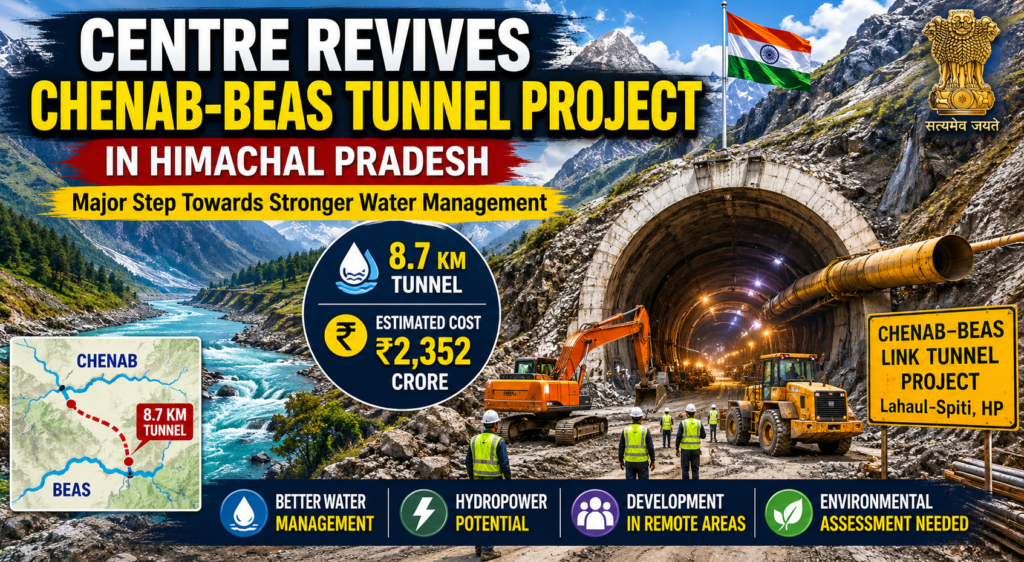
The Chenab–Beas Link Tunnel Project in Himachal Pradesh has reportedly been discussed in policy and planning circles as part of India’s broader focus on long-term water resource management and inter-basin river transfer concepts. However, the project remains at a conceptual stage and has not been officially approved for execution.
Proposed Idea and Objective
The proposal refers to the possibility of constructing a tunnel in the Himalayan region of Himachal Pradesh, potentially in the Lahaul–Spiti area, to transfer water from the Chenab River basin to the Beas River system.
The main objective of such a concept is to optimise seasonal water distribution by redirecting surplus river flows from one basin to another, especially toward regions with higher agricultural and domestic water requirements.
Potential Purpose of the Project
If such a project were to be implemented in the future, it could potentially contribute to:
- Improved irrigation facilities
- Enhanced agricultural productivity
- Better water availability in parts of Himachal Pradesh, Punjab, and nearby northern regions
- More efficient utilisation of Himalayan river waters
It is also viewed in the broader context of addressing regional water imbalance and improving water resource management in northern India.
Estimated Cost (Indicative)
Earlier proposal-level discussions have suggested a possible cost in the range of thousands of crores. However, no officially sanctioned or updated budget has been released, and any cost figures available in the public domain should be considered indicative only.
Additional Infrastructure Considerations
Experts and infrastructure planners note that inter-basin transfer projects, if designed and executed, may also offer additional benefits such as:
- Limited hydropower generation potential
- Improved infrastructure development in remote mountainous regions
- Better integration of water systems across basins
However, these benefits remain theoretical at the proposal stage.
Environmental and Geological Concerns
At the same time, the proposal has raised important environmental and geological concerns. The Himalayan region is ecologically sensitive and geologically fragile, and large-scale tunnelling projects may involve risks such as:
- Land instability and landslides
- Ecological disruption
- Long-term environmental impact on river systems
Because of these factors, experts consistently emphasise the need for detailed environmental impact assessments, geological studies, and transparent feasibility analysis before any further progress.
Current Status of the Project
At present, the Chenab–Beas Link Tunnel Project remains a conceptual idea within broader water resource planning discussions in India. It has not received formal approval, and no construction activity has been initiated.