

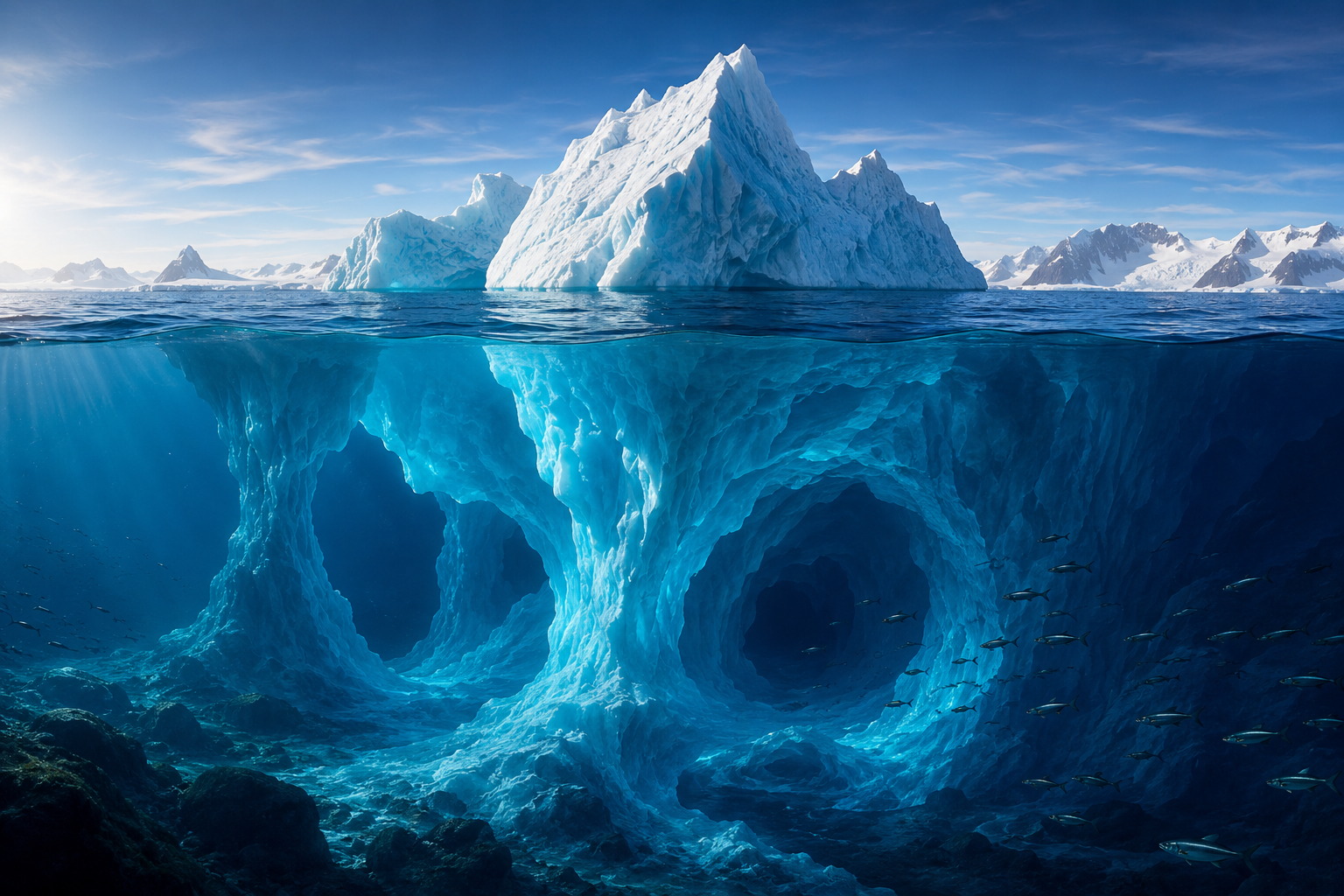
When people hear the word iceberg they usually think of a block of ice floating in the ocean. What you see above the water looks really big.. The truth is actually more interesting. 90% Of an iceberg is hidden underwater, which is what scientists call the “bottom iceberg”. A mysterious world that not many people get to see.
This hidden part is not just bigger than the part you can see. It is also weirder, darker. Has lots of secrets that keep surprising researchers. Let’s go beneath the surface and explore the bottom of ocean icebergs.
The Part Nobody Sees
There is a reason we say, “tip of the iceberg”. What you see above the water is a small part of the whole iceberg.
The part underwater can go down hundreds of feet below the ocean’s surface. Imagine seeing a hill and finding out that there is a whole mountain hidden underneath. That is how icebergs work.
Because ice is lighter than water, about 10% of the iceberg stays above the surface and the rest stays underwater. This hidden part often decides how the iceberg moves, turns and survives in the ocean.
A Frozen Cave System Underwater
One thing people do not often talk about is that the bottoms of icebergs are not big blocks of ice.
Ocean currents keep melting parts of the iceberg. Over time this creates tunnels, arches, caves and weird shapes underwater. Some of these caves are big enough for boats to fit inside.
Scientists using robots have found structures that look like they are from another world. The walls can glow blue. The shapes can look like big cathedrals carved by nature.
Many people do not realize that some of the beautiful parts of an iceberg are completely invisible from above.
A Home for Life Forms
At first the underside of an iceberg might seem like it has no life.. Surprisingly it can support whole ecosystems.
Tiny plants often grow on the ice surface underwater. These tiny organisms become food for marine animals.. Then bigger animals eat them.
The bottom of an iceberg can be like a floating island of life in a part of the ocean.
Researchers have even found tiny life forms living in these icy environments. Some scientists think that studying these organisms can help us understand how life can survive in places like other planets.
Icebergs Can Flip Without Warning
One of the dangerous secrets of iceberg bottoms is that they can be unstable.
As the iceberg melts and changes shape underwater its balance can suddenly shift. When this happens, the iceberg might roll over. Flip completely.
This process releases a lot of energy. Creates big waves. Ships and researchers have to be careful around icebergs because even a looking iceberg can suddenly become dangerous.
The hidden underwater part is often the reason for these movements.
The Water Around Them Is Different
Not many people know that melting icebergs can change the ocean around them.
Freshwater from the melting ice mixes with seawater creating unique conditions. This affects the water temperature the way nutrients are spread and even how marine life behaves.
In some areas melting icebergs help bring nutrients to the ocean surface. These nutrients help plankton grow, which supports food chains.
In a way the hidden bottom of an iceberg can affect life beyond its immediate surroundings.
Ancient Ice Trapped in Time
Some icebergs have old ice.
The ice might have formed thousands of years ago when snow fell and compressed into glaciers. When chunks break off and become icebergs they carry records of the Earth’s climate.
Scientists drill into the ice. Look at the air bubbles trapped inside. These bubbles have samples of old atmospheres, which give us clues about the environment a long time ago.
Every iceberg is like a frozen time capsule floating in the ocean.
Strange Colors Beneath the Surface
Most people think icebergs are white. Underwater they can have amazing shades of blue, green and turquoise.
The deeper and denser the ice gets the more it absorbs light and reflects blue light. Some icebergs even look green because of minerals and other things trapped in the ice.
Divers often say that the underwater parts look like scenes from science fiction.
The Titanic Learned This Lesson the Hard Way
The story of the Titanic taught us a lesson about iceberg bottoms.
The part of the iceberg that you could see was a small clue to its real size. Most of the ice was hidden below the surface.
This is why icebergs are hard to judge from a distance. What looks okay above the water might have a frozen structure below.
Today ships use advanced technology to track and avoid icebergs.
Could There Be Secrets Waiting?
Scientists keep exploring iceberg bottoms using drones, sonar systems and remote-operated vehicles.. There is still a lot we do not know.
Many iceberg formations have not been studied closely. Some are, in polar regions where it is hard to explore.
Researchers think there might be ecosystems, geological interactions and environmental processes connected to these hidden ice giants.
The deeper we look the more questions we have.
Final Thoughts
The bottom iceberg of the ocean reminds us that nature often hides its secrets beneath the surface. What we see floating above the water is a small part of a much bigger reality.
Beneath every iceberg lies a world of frozen caves old climate records, weird colors, hidden ecosystems and powerful forces that shape the ocean around them.
Time you see a picture of an iceberg remember: the most fascinating part is probably the part nobody can see. It is a frozen kingdom hidden beneath the waves still keeping many of its secrets locked away in the deep.