

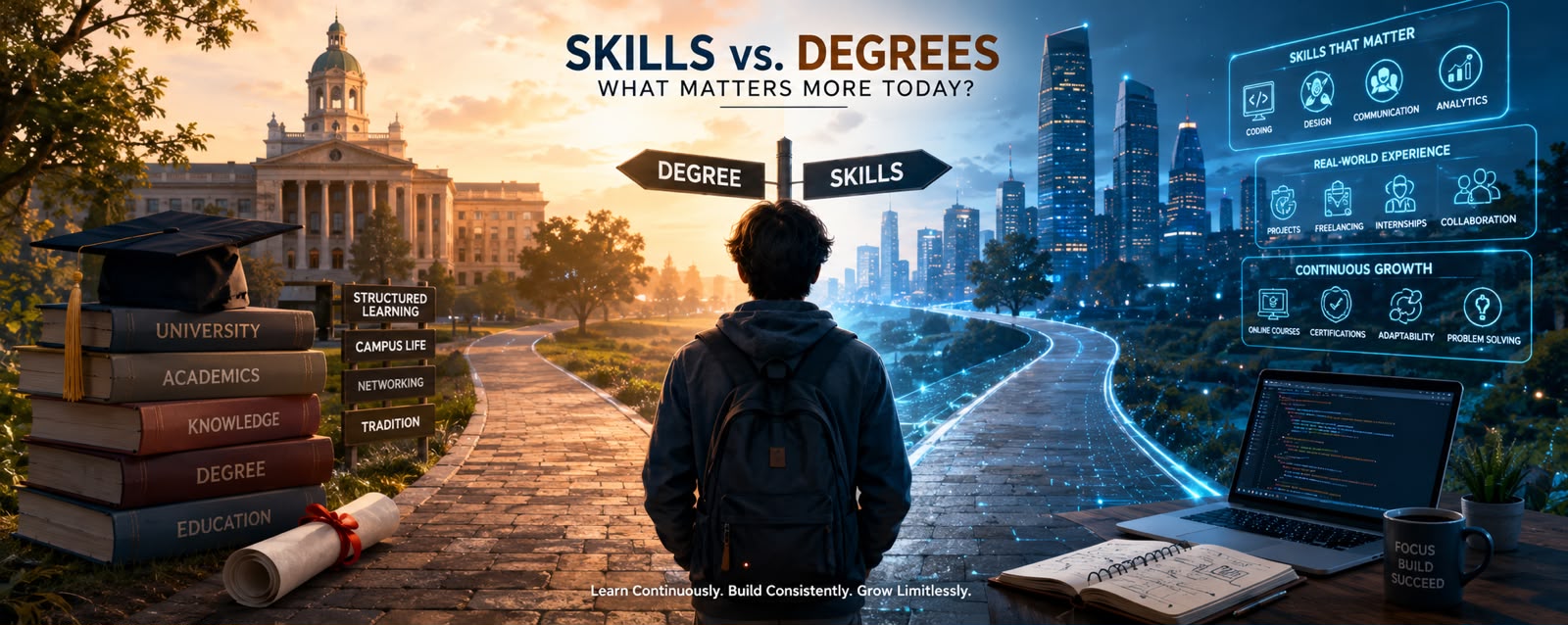
Skills vs. Degrees: What Matters More Today?
For decades, a university degree was considered the golden ticket — the surest path to a stable career, a respectable income, and professional credibility. Parents pushed for it. Employers demanded it. Society celebrated it. But something has shifted. In boardrooms, startup garages, and government offices alike, a quiet but powerful debate has taken hold: does a degree still matter as much as what you can actually do?
The answer, like most important ones, is complicated. But the evidence increasingly tilts toward skills — and the trend shows no signs of reversing.
The Case for Degrees
Let’s be fair. A university degree is not worthless — far from it. In certain professions, it remains non-negotiable. You cannot practise medicine without a medical degree. You cannot argue cases in court without a law degree. Engineering, architecture, and pharmacy all require formal, accredited training for good reason: public safety depends on it.
Beyond the professions, degrees carry signal value. They tell an employer that a candidate can commit to a multi-year programme, manage deadlines, absorb complex information, and operate within institutional structures. For employers hiring at scale — particularly large corporations processing thousands of applications — a degree acts as a convenient filter, whether or not it directly predicts job performance.
There is also the matter of networks. Universities expose students to peers, mentors, and alumni who can open doors for decades. The friend you meet in a seminar at 19 might be your co-founder at 35. That social capital is real, and it does not appear on any certificate.
The Shifting Landscape
Yet the ground has moved. Several forces are dismantling the degree’s monopoly on professional credibility.
Technology has democratised learning. Platforms like Coursera, Udemy, LinkedIn Learning, and YouTube have made world-class instruction available to anyone with an internet connection and the discipline to use it. A self-taught developer in Lagos or a self-trained data analyst in Manila can now build portfolios that rival — and often surpass — those of graduates from mid-tier universities.
Employers are updating their criteria. In 2021, IBM, Google, Apple, and dozens of other major companies publicly removed degree requirements from large swathes of their job listings. They were not making a philosophical statement — they were responding to talent shortages and the reality that degree filters were excluding highly capable candidates. IBM’s Chief Human Resources Officer noted that nearly half of their US job openings no longer require a four-year degree.
The cost-benefit calculus has changed. In many countries, the cost of a university education has ballooned while graduate salaries have stagnated in key sectors. Students are graduating with significant debt, often into roles that did not require their specific qualification in the first place. When a three-month coding bootcamp can lead to a starting salary comparable to — or better than — a four-year humanities degree, the arithmetic becomes hard to ignore.
What Skills Actually Signal
Skills, particularly demonstrable ones, have a directness that degrees cannot always match. A GitHub repository shows what a programmer has built. A design portfolio shows what a visual thinker has created. A published article, a completed consulting project, a product with real users — these are evidence, not proxies.
The rise of the portfolio economy reflects this shift. In creative industries, technology, marketing, and increasingly in finance and management, what you have done carries more weight than where you studied. Interviewers in fast-moving industries are more likely to ask a candidate to complete a take-home task or a live problem-solving exercise than to linger on their GPA.
Skills also have a freshness advantage. Technology moves faster than curriculum cycles. By the time a university department agrees on a new module, adapts it, pilots it, and rolls it out, the industry may have moved on. A professional who commits to continuous learning — picking up skills in machine learning, prompt engineering, or financial modelling as the market demands — can stay relevant in a way that a static credential cannot guarantee.
The Honest Middle Ground
The smarter question, perhaps, is not “skills or degree” but “skills with or without a degree.”
In an ideal world, a degree provides foundational knowledge, critical thinking habits, and structured exposure to a field — while skills fill the gap between theory and practice. The danger is when degrees become a substitute for skills rather than a complement to them: when graduates arrive in workplaces armed with credentials but unable to perform the actual job from day one.
Equally, skills without broader intellectual grounding can be brittle. A programmer who only knows how to code, but cannot communicate, reason about ethics, or understand organisational dynamics, will hit ceilings quickly. Depth of knowledge, the kind universities ideally cultivate, still matters.
The Verdict
Today, skills matter more in the daily reality of most workplaces. They determine what you can contribute, how fast you can grow, and whether you get hired in an increasingly competitive, project-based economy. Degrees matter most at the entry gates of highly regulated professions, and as a signal in traditional hiring pipelines — though even that signal is weakening.
The most employable person of this decade is not necessarily the one with the most prestigious diploma. It is the one who never stopped learning, who has the receipts to prove what they can do, and who understands that in a world of perpetual change, the ability to acquire new skills may be the most valuable skill of all.