

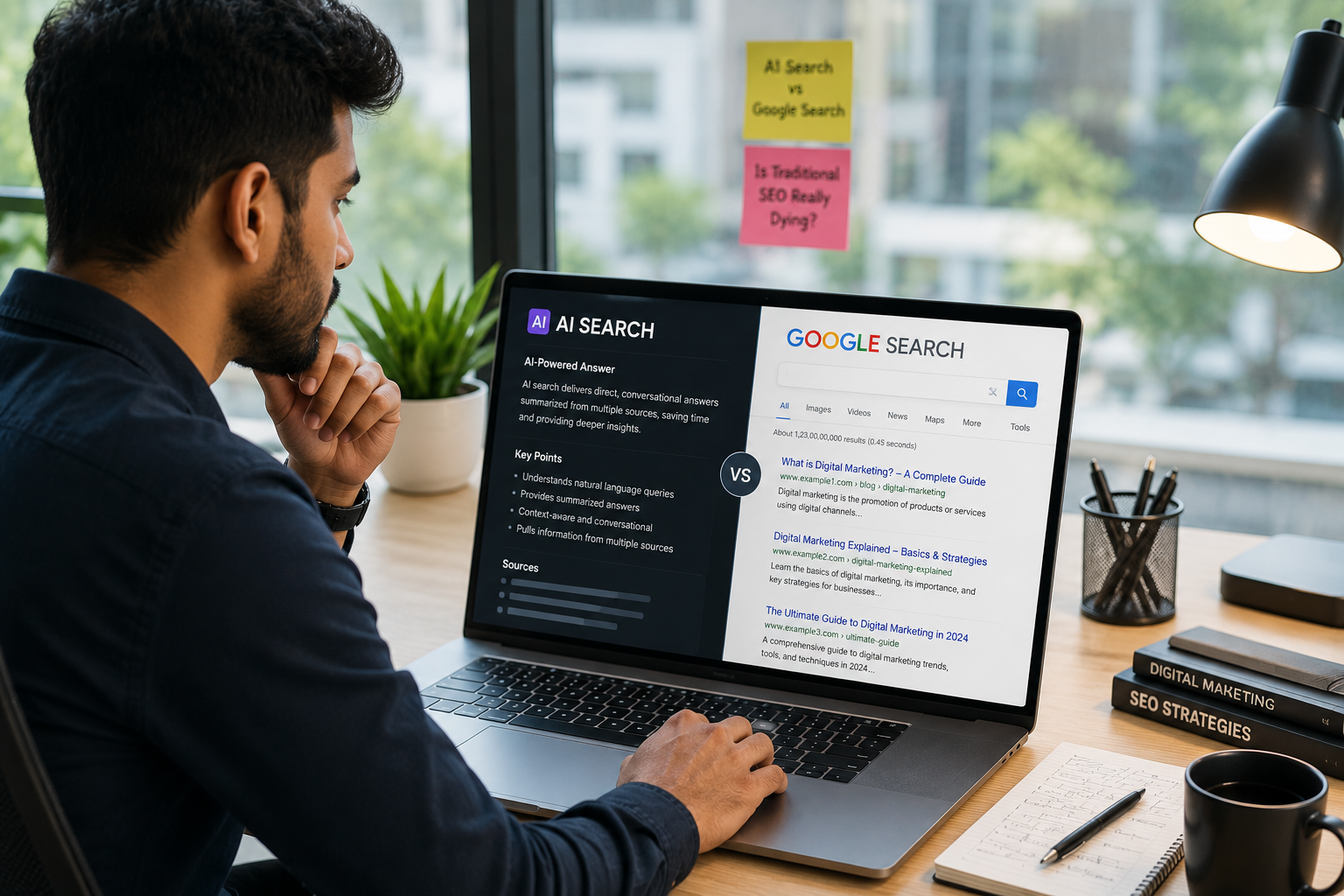
Introduction
Every few years, something shakes the digital marketing world hard enough that seasoned professionals stop and ask: does everything we know still apply? The last time that happened at this scale was the arrival of mobile search. Today, AI powered search tools are engineering that same disruption: quietly, quickly, and with far less warning than any Google algorithm update. Platforms like ChatGPT, Perplexity AI, and Google’s own AI Overviews are changing how people look for answers on the internet. And at the centre of this shift is a question that every brand, content creator, and digital marketer is wrestling with right now: is traditional Search Engine Optimisation becoming obsolete? The honest answer, as with most things in this industry, is more nuanced than a simple yes or no.
40% 8.5B 60%
OF GEN Z USERS SEARCHES HANDLED BY OF GOOGLE SEARCHES
PREFER AI TOOLS GOOGLE EVERY SINGLE NOW END WITHOUT
OVER SEARCH ENGINES DAY GLOBALLY A CLICK TO ANY
FOR INFORMATION WEBSITE
The Evolution of Online Search
Search did not always look the way it does today. In the early days of the internet, finding information online meant navigating through web directories curated by actual human editors. Then came keyword-based search engines that matched your query to pages containing those exact words. Google changed everything in the late 1990s by introducing PageRank, an algorithm that evaluated a page’s authority based on how many other credible sites linked to it. The emphasis shifted from stuffing web pages with keywords to building genuine content and earning backlinks.
Over the following two decades, Google’s algorithm grew increasingly sophisticated: penalising thin content, rewarding expertise, and placing greater value on user experience signals like page speed and mobile responsiveness. Search Engine Optimisation evolved alongside these changes, becoming a blend of technical know-how, content strategy, and digital PR. But the underlying model remained consistent: a user types a query, the engine returns a list of ranked links, and the user chooses where to go next. That model is now being challenged at its foundation.
What Is AI Search?
“AI search is not simply a smarter version of the search engine you already know. It represents a fundamentally different approach to answering questions. Rather than returning a list of links and leaving interpretation to the user”
AI- powered search engines synthesise information from multiple sources and deliver a direct, conversational response. Tools like Perplexity AI, ChatGPT Search, and Microsoft Copilot do not just find content: they read, process, and summarise it before presenting conclusions.
AI search doesn’t just retrieve information: it interprets your intent, synthesises sources, and hands you a conclusion. That’s a fundamentally different contract with the user.
The technology powering this shift is Generative AI: large language models trained on vast datasets that allow them to understand context, infer meaning, and generate human-like responses. When a user asks an AI search tool a complex question, the engine doesn’t simply scan for keyword matches. It tries to understand what the user actually needs, drawing from its training data as well as live web results in some implementations. The result is often faster and more direct: though not always more accurate, a limitation worth noting.
How Google Search Works Today
Google remains the undisputed giant of online search, processing over 8.5 billion queries every day. But the Google Search of 2026 looks markedly different from what it was five years ago. The introduction of AI Overviews Google’s generative AI summaries that appear at the top of many search result pages signals that even the world’s most dominant traditional search engine has begun incorporating AI-generated answers into its interface.
Beneath the surface, Google still relies on its foundational architecture: crawling, indexing, and ranking pages according to hundreds of signals. Core Web Vitals, E-E-A-T (Experience), Expertise, Authoritativeness, and Trustworthiness), search intent alignment, and content depth all continue to influence where a page ranks. The difference is that these rankings now sometimes sit below an AI-generated answer block meaning a page can rank at position one and still receive significantly fewer clicks than it would have two years ago.
This phenomenon, often called the “zero-click search,” has accelerated sharply. Industry data suggests that approximately 60 percent of Google searches now end without the user clicking through to any external website at all. For businesses relying on organic traffic, that statistic demands serious attention.
Is Traditional SEO Really Dying?
Here is the part where panic tends to set in and where clarity matters most. Traditional SEO is not dying. It is undergoing the most significant transformation it has experienced since Google first began rewarding quality content over keyword density. The skills at the core of effective Search Engine Optimisation understanding search intent, producing authoritative content, building credibility through backlinks, and optimising for user experience are not becoming irrelevant. They are becoming more important, and more demanding.
What is dying, however, is the version of SEO that was purely mechanical: gaming meta descriptions, churning out thin content at scale, or optimising for ranking position alone as the definitive success metric. AI-powered search engines are extraordinarily good at recognising shallow, formulaic content and bypassing it entirely. The bar for what constitutes genuinely useful, original, and trustworthy content has risen considerably.
There is also a structural reality to acknowledge. Google is not surrendering search. Even with AI Overviews eating into click through rates for informational queries, commercial searches where users are looking to buy, compare, or decide — still drive clicks. Local search, navigational queries, and high-specificity research tasks remain areas where link-based results continue to perform well. The death of SEO has been predicted many times before. It has not arrived yet, and it is unlikely to in any wholesale sense.
How Businesses and Content Creators Should Adapt
The strategic question is not whether to abandon SEO it is how to evolve it. The brands and content teams that will thrive in this environment are those treating AI search and traditional search not as competing priorities, but as two dimensions of a unified content strategy.
1. Prioritise depth over volume
One comprehensive, authoritative piece now outperforms ten shallow articles. AI engines source their answers from trusted, well-structured content.
2. Optimise for search intent
Understand not just what users are typing, but why. Content that directly addresses the underlying need earns citations from AI tools and ranks in traditional results.
3. Build E-E-A-T signals
Demonstrate real-world experience and expertise. Author bios, original research, and credible backlinks signal authority to both AI systems and Google’s algorithms.
4. Diversify traffic sources
Email lists, social platforms, podcasts, and community channels reduce dependency on organic search alone critical as zero-click rates rise.
5. Structure content for AI parsing
Use clear headings, concise answers near the top of sections, and structured data markup. AI engines reward content that is easy to extract and cite.
6. Track brand mentions, not just rankings
Being cited by AI search tools matters as much as page-one placement. Monitor where and how your brand appears in AI- generated answers.
The Future of Search and Digital Marketing
The trajectory points toward a hybrid search landscape one in which traditional search engines increasingly incorporate generative AI capabilities, and AI-native platforms progressively integrate real-time web data. Google is not standing still. Its continued investment in AI Overviews and the Search Generative Experience signals that the company is determined to evolve, not cede ground to challengers.
For digital marketing professionals, the future of SEO is less about chasing algorithm updates and more about building genuine authority in a specific subject area. Content that has been produced through real expertise, reflects authentic perspectives, and serves a clearly defined audience will always have a place in search regardless of which engine is delivering the results. Generative AI cannot easily replicate lived experience, original data, or nuanced professional insight. Those are the assets worth investing in.
Equally, the discipline of digital marketing must widen its scope. Visibility in AI-generated answers sometimes called Answer Engine Optimisation or AEO is emerging as a distinct practice alongside traditional SEO. Brands that understand how to position their content as trustworthy, citable sources for AI systems will gain a meaningful competitive edge in the years ahead.
The Verdict: Evolution, Not Extinction
The search landscape is genuinely changing faster, and more fundamentally, than at any point in the last two decades. AI-powered search has introduced a new set of rules, and those who ignore them will find their organic traffic eroding without understanding why. But the marketers sounding the death knell for traditional SEO are overcorrecting.
What this moment actually calls for is a clear-eyed reassessment. The principles that have always made content valuable accuracy, clarity, depth, and genuine usefulness matter more today than they ever have. The delivery mechanisms are changing. The underlying truth is not.
The future belongs to those who stop chasing rankings and start building authority. !at has always been what great SEO was really about the tools are just catching up.