

Introduction
India is a country rich in culture, history, and diversity. One of the most beautiful parts of this heritage is its traditional arts and crafts. For centuries, Indian artisans have created handmade items that reflect the customs, beliefs, and creativity of different regions. These arts and crafts are not only beautiful but also represent India’s cultural identity and artistic excellence.
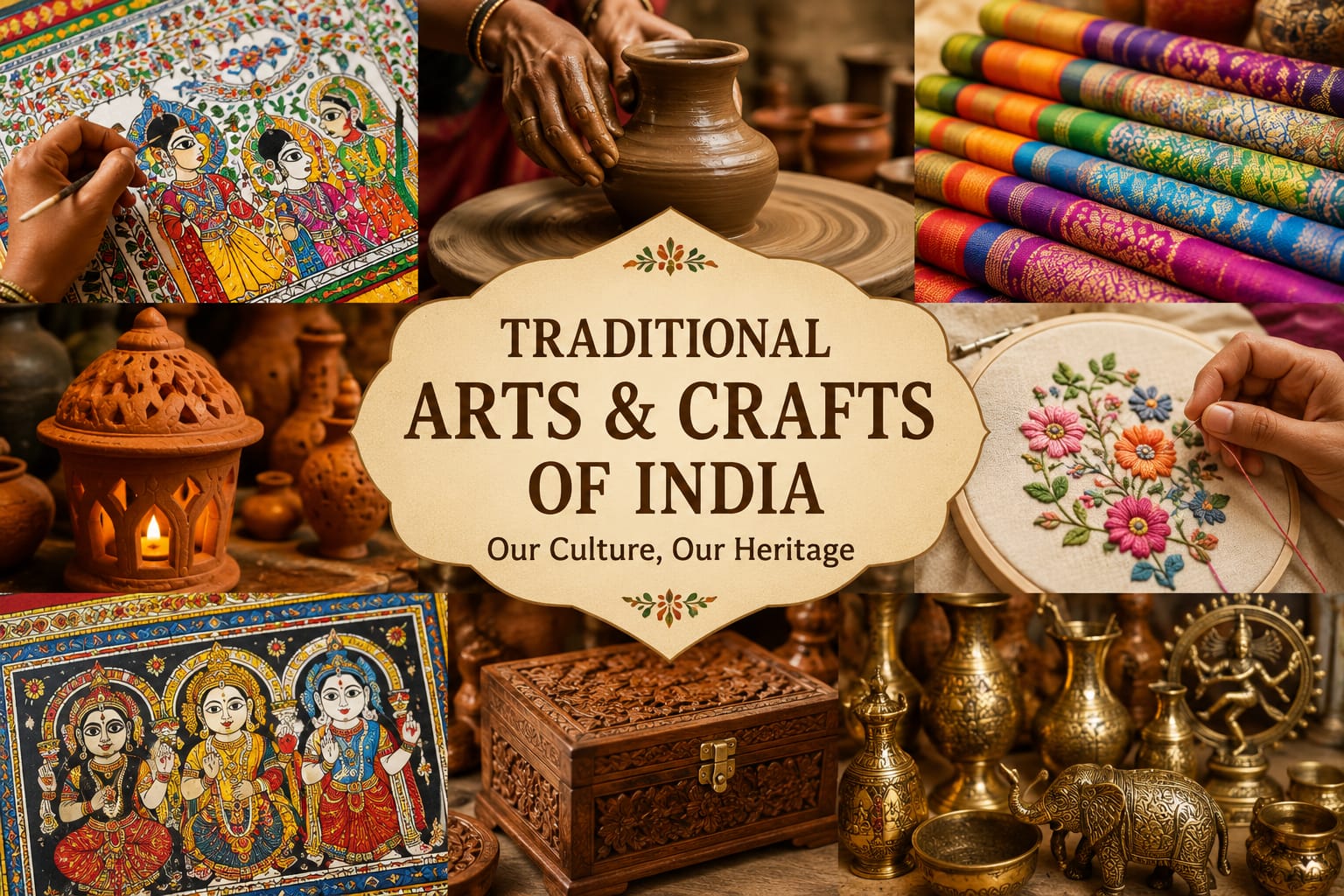
From colorful paintings and handwoven textiles to pottery, embroidery, woodwork, and metal crafts, every state in India has its own unique art forms. These traditional crafts tell stories of the past, reflect local traditions, and showcase the skills of talented craftsmen and women. Even today, they remain an important part of Indian culture and lifestyle.
A Treasure of Indian Handicrafts
Traditional Indian arts and crafts have passed from one generation to another for many years. Many of these crafts began in villages and royal courts, where artists made both useful and decorative items for daily life, religious rituals, and festivals. They used local materials such as clay, cotton, silk, wood, metal, bamboo, and natural colors.
The beauty of Indian handicrafts lies in their fine details, uniqueness, and cultural meaning. Unlike machine-made products, handmade items carry the personal touch of the artisan. Every design, pattern, and color has a story behind it. In addition, these crafts not only preserve tradition but also provide income to thousands of families across the country.
Famous Traditional Art Forms of India
India has a wide variety of traditional art forms, and each one is linked to a particular region and community.
Madhubani Painting
Madhubani art comes from Bihar and is one of the most popular folk art forms in India. It is known for its bright colors, detailed patterns, and themes inspired by nature, mythology, and everyday life. Traditionally, women painted the walls of their homes during festivals and special occasions. Today, artists also create Madhubani paintings on paper, cloth, and canvas.
Warli Art
Warli art belongs to the tribal communities of Maharashtra. It is simple in style but deeply meaningful. Usually, artists use white paint on a mud-colored background. They create human figures, animals, and scenes of farming, village life, and celebrations using circles, triangles, and lines. As a result, Warli art beautifully reflects the close bond between human life and nature.
Pattachitra
Pattachitra is a traditional painting style from Odisha and West Bengal. It is famous for its detailed work and mythological themes, especially stories of Lord Jagannath, Krishna, and other Hindu deities. Artists usually paint it on cloth or dried palm leaves. Moreover, people admire this art form for its rich colors, decorative style, and fine lines.
Traditional Crafts of Different Regions
India’s crafts are as diverse as its culture. Every region has its own special craft that reflects local traditions and available resources.
Handloom Weaving
Handloom weaving has a strong tradition in India. Some of the most famous examples include Banarasi silk from Uttar Pradesh, Kanjeevaram silk from Tamil Nadu, Pashmina shawls from Kashmir, and Chanderi fabric from Madhya Pradesh. These textiles are known for their beauty, quality, and traditional designs. Handwoven sarees and shawls are not just pieces of clothing; instead, they are a symbol of India’s cultural pride.
Pottery and Terracotta
Pottery is one of the oldest crafts in India. Artisans across the country make clay pots, lamps, decorative pieces, and terracotta sculptures. Terracotta art is especially popular in West Bengal, Rajasthan, and Gujarat. These handmade items look simple and natural, and they remain closely connected to village life and traditional customs.
Embroidery and Textile Crafts
Indian embroidery is admired across the world. Different states have their own embroidery styles, such as Phulkari from Punjab, Chikankari from Lucknow, Kantha from West Bengal, and mirror work from Gujarat and Rajasthan. These crafts add beauty to clothes, dupattas, bags, and home décor items. At the same time, they show the patience, creativity, and skill of Indian women artisans.
Wood and Metal Crafts
Wood carving and metalwork also form an important part of Indian craftsmanship. Kashmir is famous for walnut wood carving, while Saharanpur in Uttar Pradesh is known for wooden furniture and decorative items. Similarly, brass and bronze crafts from Rajasthan, Tamil Nadu, and Kerala are highly valued for their artistic beauty and traditional designs.
Cultural and Economic Importance
Traditional arts and crafts are not only a part of India’s culture but also a major source of livelihood for millions of artisans. In many rural areas, families depend on craftwork to earn a living. By selling handmade products in local markets, exhibitions, and online platforms, artisans support their families and keep their traditional skills alive.
In addition, these crafts play an important role in tourism. Visitors from India and abroad often buy handmade paintings, textiles, pottery, and decorative items because they represent the true spirit of Indian culture. Therefore, Indian handicrafts have become popular worldwide for their beauty, originality, and cultural value.
Challenges Faced by Traditional Crafts
Although Indian arts and crafts are rich and valuable, traditional artisans face many challenges today. Machine-made goods are often cheaper and more easily available, so the demand for handmade products has decreased. As a result, many young people from artisan families move to other jobs because craftwork does not always provide a stable income.
Another challenge is the lack of awareness and support. Some traditional art forms are slowly disappearing because people do not promote them enough. Therefore, it is important to support local artisans, buy handmade products, and encourage the younger generation to learn these valuable skills.
Preserving India’s Artistic Heritage
Traditional arts and crafts are an important part of India’s identity. They connect us to our roots and remind us of the creativity and wisdom of earlier generations. Preserving them means preserving a part of India’s soul. Governments, cultural organizations, and art lovers all have an important role to play in supporting artisans and promoting handmade crafts.
Today, exhibitions, fairs, online platforms, and government schemes are helping traditional artists reach a larger audience. If people continue to value handmade work and understand its cultural importance, these beautiful art forms can survive and grow in the modern world.
Conclusion
Traditional arts and crafts of India reflect the country’s rich heritage, creativity, and diversity. They are not just beautiful objects; rather, they are living traditions that carry stories, beliefs, and skills from one generation to the next. From paintings and weaving to embroidery, pottery, and woodwork, every craft has its own charm and significance.
In a fast-changing world, these traditional art forms remind us of the value of handmade work and the importance of preserving culture. By respecting and supporting Indian artisans, we can help keep this priceless heritage alive for future generations.