

INTRODUCTION
The Impact of the Constitution on Religion, Gender, and Society in India
A Secular Framework for a Plural Nation
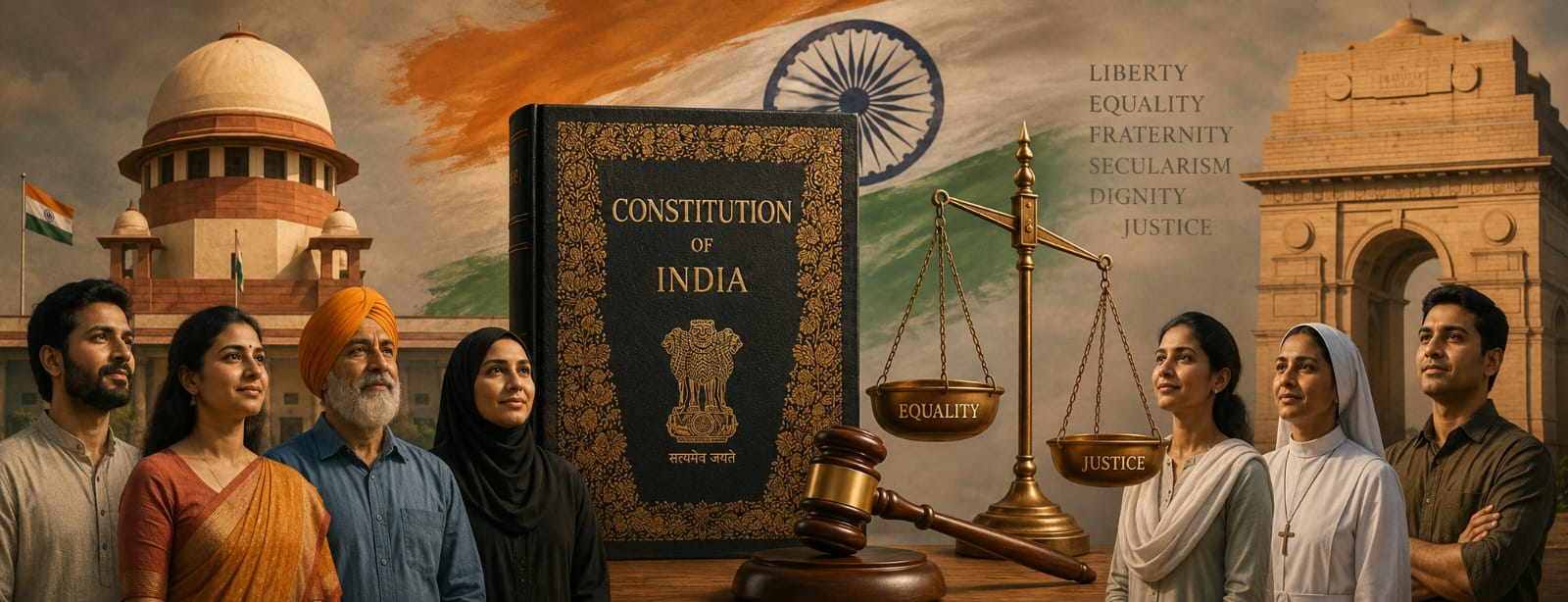
The Constitution of India was framed with the explicit aim of governing one of the world’s most religiously and socially diverse populations under a single set of guarantees. Articles 25 to 28 grant every citizen the freedom to profess, practice, and propagate religion, while the state itself is constitutionally secular, neither favoring nor persecuting any faith. This framework has shaped the experience of Hindus, Muslims, Christians, and other communities, as well as men and women, in distinct and sometimes contested ways.
The Constitution of India was framed with the explicit aim of governing one of the world’s most religiously and socially diverse populations under a single set of guarantees. Articles 25 to 28 grant every citizen the freedom to profess, practice, and propagate religion, while the state itself is constitutionally secular, neither favoring nor persecuting any faith. This framework has shaped the experience of Hindus, Muslims, Christians, and other communities, as well as men and women, in distinct and sometimes contested ways.
Impact on Hindus
For the majority Hindu population, the Constitution enabled significant internal social reform. Article 17’s abolition of untouchability directly targeted caste-based discrimination embedded in Hindu social practice, and subsequent legislation such as the Hindu Marriage Act and the Hindu Succession Act, passed under the Constitution’s reformist mandate, modernized personal law regarding marriage, divorce, and inheritance, eventually granting daughters equal inheritance rights through later amendments. Reservation policies for Scheduled Castes and Scheduled Tribes, most of whom are Hindu, have expanded access to education, government jobs, and political representation for historically marginalized groups. At the same time, these reservation policies remain genuinely contested: supporters view them as essential correctives for centuries of discrimination, while critics argue they have, in some instances, entrenched caste identity in politics or disadvantaged other economically weaker groups, a debate the courts and legislature continue to revisit.
Impact on Muslims
The Constitution guaranteed Muslims, India’s largest minority, religious freedom and the right to maintain personal laws governing marriage, divorce, and inheritance separately from the Hindu Code reforms. Article 30 additionally protects the right of minorities to establish and administer their own educational institutions, a provision that has allowed madrasas and Muslim-run colleges to flourish. However, this separate treatment of personal law has also fueled an enduring national debate over a Uniform Civil Code: proponents argue a common code would advance gender equality and national integration, while many Muslim organizations and other minority groups view it as a potential threat to religious autonomy. The Supreme Court’s 2017 judgment declaring instant “triple talaq” unconstitutional,
later codified into law in 2019, was framed by supporters as protecting Muslim women’s rights, while some religious bodies criticized it as an intrusion into personal law. More recently, the Citizenship Amendment Act of 2019, which offers an expedited path to citizenship for persecuted religious minorities from neighboring countries but excludes Muslims from its provisions, has been defended by the government as a humanitarian measure for persecuted minorities, while critics, including many in the Muslim community, view it as discriminatory and inconsistent with the Constitution’s secular character — a dispute that remains before the courts.
Impact on Christians
India’s Christian minority has similarly benefited from Article 30’s protections, which underpin a vast network of missionary-run schools, colleges, and hospitals that have historically extended education and healthcare into underserved regions. Christians have also exercised constitutional protections to practice and propagate their faith. Yet this right has come into tension with anti-conversion laws enacted by several state governments, which require prior notification or government approval before religious conversion. Supporters of these laws argue they prevent coercive or fraudulent conversions, while Christian organizations and human rights groups contend they create bureaucratic hurdles and a chilling effect on the constitutionally guaranteed right to propagate one’s faith.
Impact on Women
Constitutional guarantees of equality under Articles 14 and 15, along with Article 15(3)’s explicit allowance for affirmative provisions favoring women, have underpinned decades of legal reform: the criminalization of dowry and domestic violence, maternity benefit protections, and the landmark 73rd and 74th constitutional amendments reserving one-third of seats for women in local self-government bodies, which brought over a million women into grassroots political life. The triple talaq ban, discussed above, extended similar protective intent to Muslim women specifically. Despite these advances, critics note that personal laws across several religious communities still retain gender disparities in matters of inheritance, marriage, and divorce that broader constitutional equality has not fully overridden, and that implementation gaps leave many legal protections weakly enforced in practice, particularly in rural areas.
Impact on Men and Society Broadly
Men generally experience the Constitution’s equality guarantees without the same historical disadvantages addressed by affirmative provisions, though this has generated its own debate: some men’s rights advocates argue that certain protective laws, originally designed to address gender-based violence, are occasionally misused, a concern that courts have addressed through procedural safeguards over time. More broadly, the Constitution’s secular and pluralistic design has allowed India to sustain functioning democracy across enormous religious diversity, but communal tensions, periodic violence, and political polarization around religious identity have persisted despite — and sometimes in tension with — the document’s founding ideals.
Conclusion
The Constitution’s impact on India’s religious communities and genders has been substantial and largely transformative, dismantling certain entrenched inequalities while preserving space for religious and cultural autonomy. Yet this balance between universal equality and communal self-governance remains an active and unresolved tension in Indian public life, generating genuine debate among citizens, courts, and lawmakers about where the lines of secularism, minority rights, and gender justice should ultimately be drawn.