

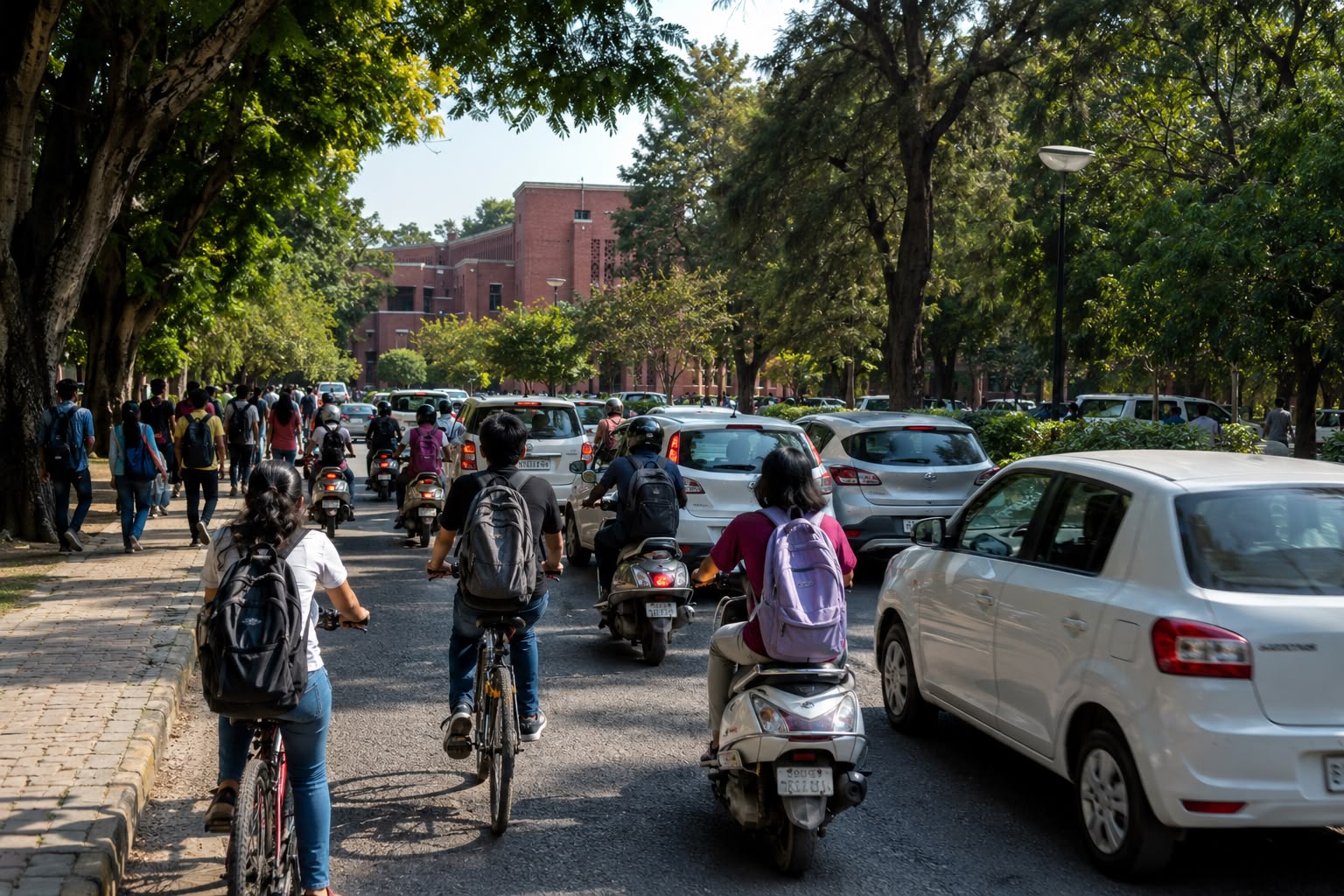
Panjab University’s push to promote cycling as a sustainable and student-friendly mode of transport on campus is facing practical challenges, as increasing congestion of private cars and two-wheelers continues to dominate internal roads, reducing both safety and convenience for cyclists.
The university has for several years encouraged eco-friendly mobility through initiatives such as bicycle-friendly movement, pedestrian prioritisation in select zones, and internal shuttle services aimed at reducing dependency on fossil-fuel vehicles. These measures are aligned with broader sustainability goals often adopted by educational institutions seeking to reduce carbon emissions and improve campus air quality.
However, the current ground situation reflects a growing contrast between policy and practice. Students and staff report that rising use of personal vehicles inside the campus has led to crowded internal roads, particularly during peak class hours. Cyclists, in particular, face difficulty navigating narrow stretches shared with cars and two-wheelers, raising concerns about safety and discouraging wider adoption of cycling.
Several students say they support cycling as an affordable and environmentally responsible option but find it increasingly impractical due to traffic density and lack of dedicated cycling lanes. Faculty members echo similar concerns, noting that congestion not only affects mobility but also slows emergency and institutional transport movement within the campus.
From an administrative perspective, university authorities and campus security personnel are responsible for regulating vehicle entry, managing parking zones, and enforcing traffic discipline. While no detailed official statement specific to recent congestion trends has been publicly released, campus management has previously emphasized the importance of regulated vehicle movement and sustainable transport planning.
Infrastructure limitations remain a key issue. The absence of fully segregated cycle tracks, combined with expanding parking demand, has contributed to competition for limited road space. Enforcement of vehicle restrictions also varies across different campus entry points, according to regular commuters.
Urban mobility and environmental experts argue that campuses like PU are ideal spaces to model low-carbon transport systems. They stress that reducing reliance on private vehicles and strengthening non-motorised transport infrastructure can significantly lower emissions while improving safety and accessibility.
Past and ongoing discussions within campus planning circles have included proposals for improved cycle pathways, stricter vehicle regulation, and enhanced shuttle connectivity, though implementation progress remains gradual.
Overall, Panjab University faces a complex balancing act between accommodating increasing vehicular use and advancing its sustainability goals. The challenge ahead lies in strengthening infrastructure and enforcement while encouraging a cultural shift toward safer and greener mobility on campus.