

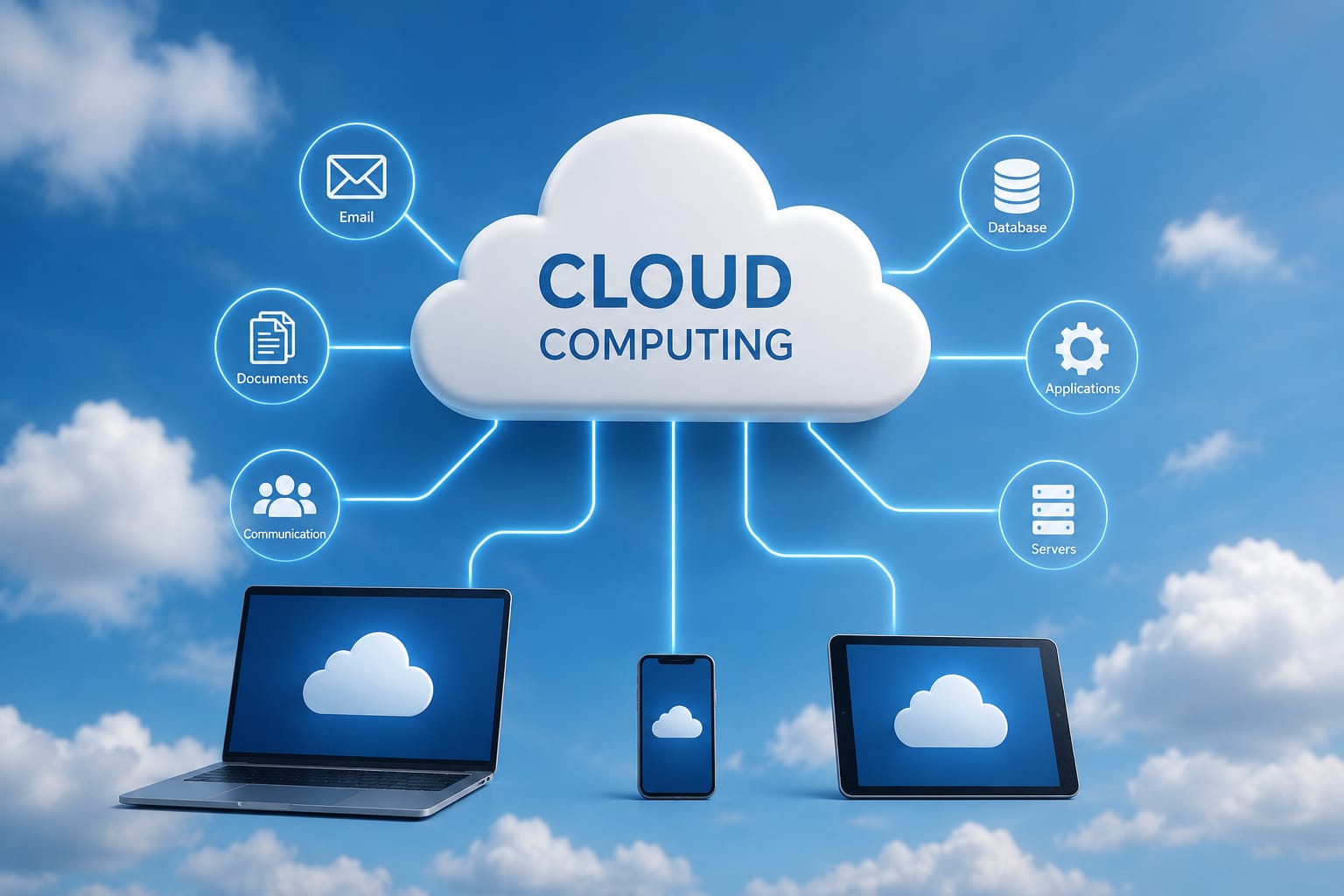
Cloud Computing and Its Applications
Introduction
Cloud computing has fundamentally transformed the way individuals, businesses, and governments store, process, and manage data. Rather than relying on local servers or personal computers to handle applications and data, cloud computing delivers computing services — including servers, storage, databases, networking, software, analytics, and intelligence — over the internet, commonly referred to as “the cloud.” This shift has ushered in a new era of digital flexibility, scalability, and efficiency, making powerful technology accessible to organizations of all sizes across the globe.
What Is Cloud Computing?
At its core, cloud computing is the on-demand availability of computer system resources, especially data storage and computing power, without direct active management by the user. It operates through a network of remote servers hosted on the internet, eliminating the need for on-premises infrastructure. Cloud services are typically provided by major vendors such as Amazon Web Services (AWS), Microsoft Azure, and Google Cloud Platform, each offering a vast ecosystem of tools and services.
Cloud computing is broadly categorized into three service models:
Infrastructure as a Service (IaaS) provides virtualized computing resources over the internet. Users rent virtual machines, storage, and networking on a pay-as-you-go basis. This model is ideal for businesses that want control over their infrastructure without the cost of physical hardware.
Platform as a Service (PaaS) offers a development environment in the cloud, allowing developers to build, test, and deploy applications without managing the underlying infrastructure. It accelerates software development cycles and reduces complexity.
Software as a Service (SaaS) delivers fully functional applications over the internet. Users access software through a web browser, while the provider manages everything from servers to security. Popular examples include Google Workspace, Microsoft 365, Salesforce, and Zoom.
Additionally, cloud deployments can be public (shared infrastructure managed by a provider), private (dedicated to a single organization), hybrid (a mix of both), or multi-cloud (using services from multiple providers simultaneously).
Key Characteristics of Cloud Computing
Cloud computing is defined by several essential characteristics that distinguish it from traditional computing models:
•On-demand self-service: Users can provision computing capabilities automatically without requiring human interaction with the service provider.
•Broad network access: Services are available over the network and accessible through standard devices like laptops, smartphones, and tablets.
•Resource pooling: Providers serve multiple customers using a shared pool of configurable resources, dynamically allocated based on demand.
•Rapid elasticity: Resources can be scaled up or down quickly to match workload demands, often automatically.
•Measured service: Cloud systems automatically control and optimize resource usage, with transparency for both the provider and consumer.
Applications of Cloud Computing
The applications of cloud computing span virtually every industry and sector, reshaping how work is done and how services are delivered.
Business and Enterprise Operations
Cloud computing has become the backbone of modern enterprise operations. Companies leverage cloud platforms to run enterprise resource planning (ERP) systems, customer relationship management (CRM) tools, and collaborative workspaces. Remote work became viable at scale largely because of cloud-based productivity tools, communication platforms, and virtual private networks. Businesses benefit from reduced IT costs, faster time-to-market, and the ability to scale operations globally without heavy capital investment.
Healthcare
The healthcare industry has embraced cloud computing to store and share vast amounts of patient data securely. Electronic health records (EHRs) hosted in the cloud enable seamless access for physicians, specialists, and hospitals across locations. Cloud platforms also support telemedicine, medical imaging storage, drug discovery research, and AI-powered diagnostics — all while maintaining compliance with data protection regulations such as HIPAA.
Education
Cloud computing has democratized education by enabling e-learning platforms, virtual classrooms, and collaborative tools accessible from anywhere in the world. Institutions use cloud infrastructure to deliver course content, manage student data, and support research. Platforms like Google Classroom, Moodle, and Zoom became essential during global disruptions, highlighting the cloud’s role in ensuring educational continuity.
Financial Services
Banks, insurance companies, and fintech firms rely on cloud computing for real-time data processing, fraud detection, risk analysis, and customer service automation. The cloud enables financial institutions to process millions of transactions per second while maintaining high security and regulatory compliance. It also facilitates the rapid development and deployment of innovative digital banking products.
Entertainment and Media
Streaming services like Netflix, Spotify, and YouTube operate entirely on cloud infrastructure, delivering vast libraries of content to millions of users simultaneously. Game developers use cloud platforms for online gaming, live updates, and multiplayer environments. Cloud rendering and storage have also revolutionized film production and post-production workflows.
Artificial Intelligence and Big Data
Cloud computing provides the computational power required to train machine learning models and process massive datasets. Organizations use cloud-based AI services to analyze customer behavior, forecast trends, automate processes, and develop intelligent applications. The convergence of cloud and AI is accelerating innovation across fields including autonomous vehicles, natural language processing, and predictive analytics.
Benefits and Challenges
The advantages of cloud computing are compelling: cost savings through reduced hardware investment, improved collaboration, automatic software updates, enhanced disaster recovery, and global accessibility. Start-ups can launch with enterprise-grade infrastructure at minimal cost, while large corporations can modernize legacy systems and expand globally with agility.
However, cloud computing also presents challenges. Data security and privacy remain primary concerns, as sensitive information stored on third-party servers can be vulnerable to breaches. Dependence on internet connectivity means that outages can disrupt operations. Regulatory compliance across different jurisdictions adds complexity, and hidden costs can accumulate if cloud usage is not carefully managed.
Conclusion
Cloud computing is no longer a technology of the future — it is the foundation of the present digital economy. Its applications permeate every sector, from healthcare and education to finance and entertainment, driving efficiency, innovation, and global connectivity. As technologies like edge computing, quantum computing, and artificial intelligence continue to evolve alongside the cloud, its role in shaping the digital world will only deepen. Organizations that strategically embrace cloud computing position themselves for resilience, agility, and sustained growth in an increasingly interconnected world.