

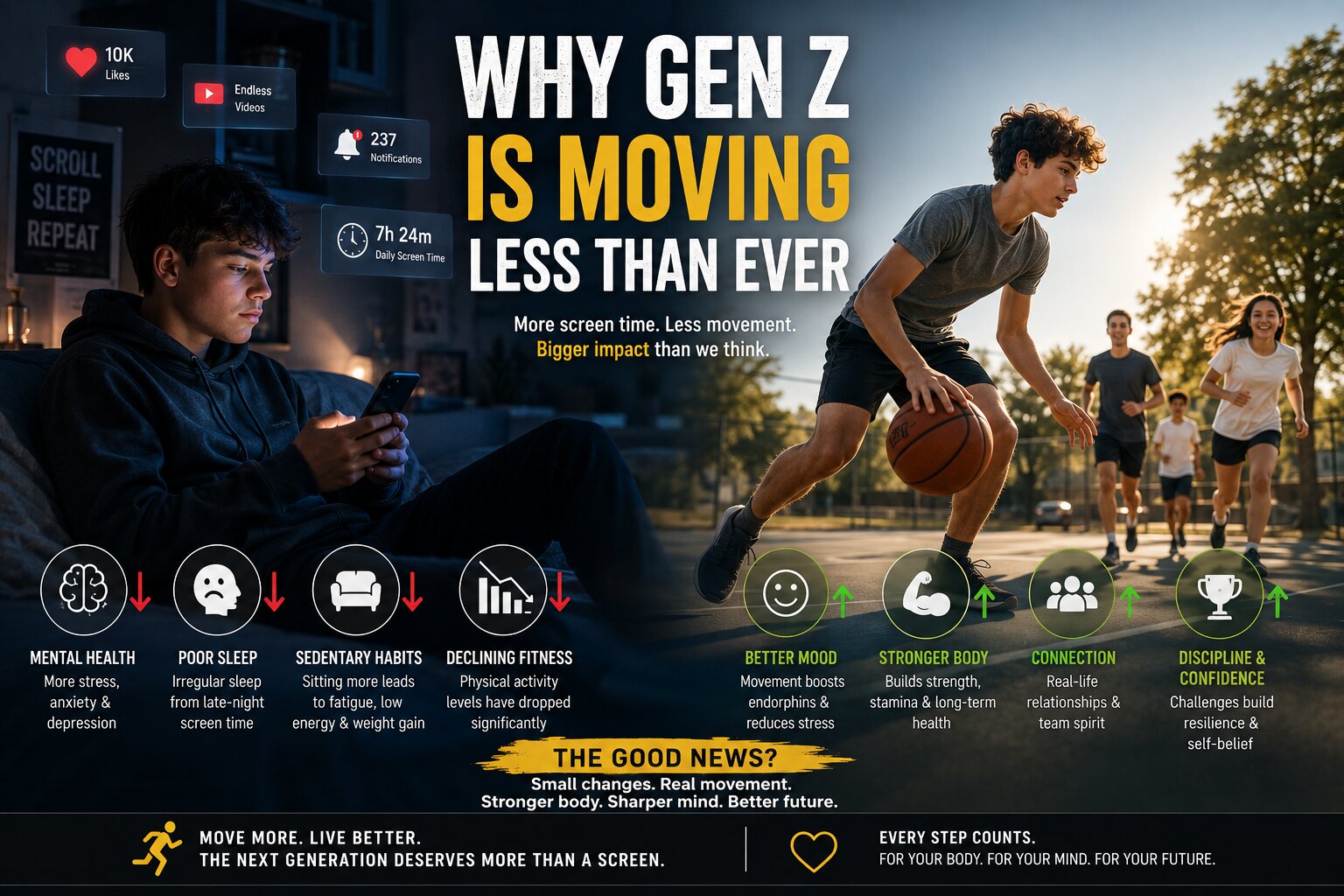
Watch any Gen Z teenager for an hour and you will likely see them consume more fitness content than their parents encountered in a month. Workout reels, step-count challenges, athlete vlogs, protein shake reviews: the content machine around physical culture has never been louder. And yet this same generation moves less, plays less, and competes less than any young cohort researchers have ever measured. That gap between knowing and doing is not accidental , it is exactly what happens when a generation grows up watching physical culture instead of living inside it.
When Watching Becomes a Substitute for Doing
Something specific happens when you spend years consuming elite performance as entertainment. The brain begins to associate physical culture with spectatorship rather than participation. A teenager who watches a thousand gym videos does not gradually feel more motivated to train , they feel more familiar with the aesthetic of training, which the brain quietly accepts as a reasonable substitute for the thing itself.
This is deeper than laziness. It is a neurological shift. Dopamine, which drives motivation and action, gets released through the scroll just as it does through physical effort , but the scroll demands nothing. Gen Z grew up in the first era where the brain could get its entire fill of stimulation without the body being involved at all. The result is a generation whose motivation system is calibrated for passive reward, and physical activity which front-loads effort and delays the payoff and sits entirely against that grain.
How Organised Sport Shut the Door on Most of Them
Organised sport did not just decline for Gen Z , it transformed into something that selected out the majority before they built any lasting relationship with movement. Early specialisation pushed children into single-sport commitments by age ten or eleven. Club fees climbed. Travel demands increased. Performance tracking arrived at ages where children should still be figuring out whether they even enjoy running.
The message sport sent to most Gen Z kids, whether it intended to or not, was this: if you are not exceptional, your presence here is provisional. That message worked efficiently. Participation rates dropped because sport stopped functioning as a space for everyone and started functioning as a filter for the talented. The children who left did not find another outlet. They found a screen, and the screen never told them they were not good enough.
Inactivity and Anxiety Are Feeding Each Other
Gen Z is the most anxious generation on record, and the conversation around that tends to point at social media as the cause. Social media is a factor. But the removal of physical activity from daily life quietly does as much damage, and it receives a fraction of the attention.
Exercise does not just reduce stress , it fundamentally alters how the brain processes threat. Regular physical activity lowers the baseline activation of the amygdala, which means a physically active person literally experiences the same stressor as less threatening than a sedentary one. Gen Z, moving less, operates with a nervous system that is more reactive by default. That heightened reactivity makes social media feel more destabilising, makes pressure feel more crushing, and makes the couch feel safer than the training ground. The inactivity does not just follow the anxiety. In a very real sense, it produces it.
Movement Builds Things the Mind Cannot Develop on Its Own
Physical activity was never really about fitness in the way the wellness industry frames it. Movement is how humans have always learned to tolerate discomfort, delay gratification, and read other people in real time. A teenager who trains regularly is not just getting fitter , they are repeatedly practising the experience of feeling bad and continuing anyway, which is the foundational skill underneath every form of resilience.
Gen Z, moving less, does not just miss the cardiovascular benefit. They miss the hundreds of small repetitions of choosing effort over comfort that build the psychological architecture for handling adult life. The discipline, the social intelligence, the ability to take a loss without collapsing , none of it develops in the abstract. It develops in the body, under conditions that are physically demanding and socially real.
The Way Back In Is Simpler Than Anyone Is Making It
The solution for Gen Z is not a motivational campaign or a fitness influencer with the right message. It is structural. Sport and movement need to re-enter their lives in forms that remove the two biggest barriers , the fear of being judged as a beginner and the absence of a social reason to show up.
Recreational leagues with no try-outs. Group training that measures effort rather than performance. School programmes that prioritise physical literacy over competitive results. These are not soft compromises , they are the actual on-ramps that restore the habit before the capability. An eighteen-year-old who finds a reason to move three times a week with other people will, within months, start building the same internal structure that organised sport once built automatically. The body responds quickly. The psychology follows. What Gen Z needs is not inspiration , it is access to an environment where movement feels like belonging rather than audition.
Screens did not break this generation. They simply occupied the space that physical culture used to fill before sport made itself exclusive and digital life made itself frictionless. Rebuilding that space means lowering the entry point, widening the door, and trusting that once a young person discovers what regular movement actually does to how they think, feel, and carry themselves , they will not need convincing to continue.