

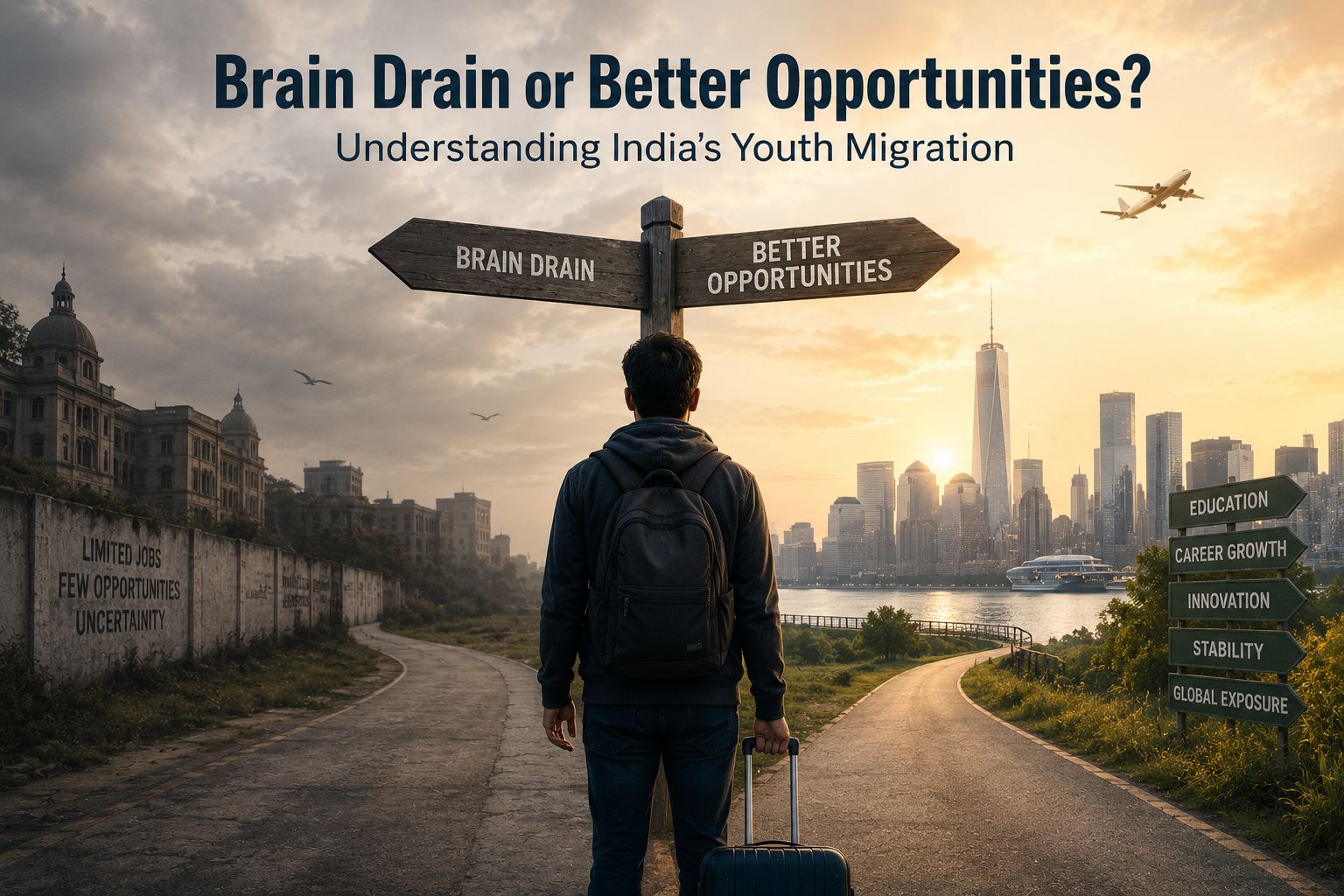
Introduction
Each year thousands of young Indians pack their bags and set out. Many leave to pursue higher education, while others move abroad for work.
Every year the same discussion bumps into them as they leave.
Is this the brain drain that India is losing its brains to other countries? Or perhaps it’s a bit more complex: young people are looking to make opportunities that are not yet available to them in their own country?
The truth, is that it is both. To find out, you should see the true picture.
How Big is the Migration?
India is always among the top countries in the world in terms of international migration. There are millions of Indians who reside and work overseas, namely in the United States, Canada, the United Kingdom, Australia, Germany and the Gulf countries.
However, it is not who is leaving that’s changing in recent years.
It is no longer individuals climbing out of the poor’s trap.People are no longer simply climbing out of the poor’s trap. India’s young educated, skilled and talented population, engineers, doctors, researchers, entrepreneurs are increasingly opting out for establishing their careers abroad. This is what has begun a serious national conversation.
Why Young Indians are leaving?
There is no single cause. Typically both push and pull factors are at play simultaneously.
What pushes them away from India:
- This is a problem because there are not many job opportunities available for high-paid jobs, even though they have a high qualification.
- Tight job market — too many talented, qualified applicants for too few jobs
- Inadequate research funding and innovation infrastructure
- Graduate unemployment and underemployment
- Air quality, urban infrastructure and quality of life concerns
- Desire to have personal freedom and social mobility
What makes them go to other countries:
- Increased income and higher purchasing power
- The best universities and research institutes in the world.
- Work-life balance and better working conditions
- clear immigration barriers and permanent residency routes
- Social cohesion and democratic and respect for human rights, and dignity of the individual
- Better healthcare and public services
If the two forces are aligned, it is very easy to make a decision to leave.
The Students Who Don’t Come Back
The most talked about form of migration by young is student migration, that is, higher education abroad by young Indians and then staying.
Other countries, such as Canada, Australia and Germany have immigration programs that allow students to easily become permanent citizens after completing their studies. The brightest minds of India go there to study, to get some work experience, to get stable, to start building roots.
For many of them coming back means losing a salary, lifestyle and a future they’ve worked to create. It’s a hard decision for someone to make.
Is This Bad for India? All the Time?
That’s where things get complicated.
The case for calling it brain drain:
- India spends vast resources on education, at the Indian Institute of Technology, Indian Institute of Management etc, and AIIMS etc, only to see them work in other economies.
- Industries such as healthcare and research have real talent deficits
- The opportunity for skilled people to create businesses and jobs in their own country is lost
Proponents of a contrary opinion argue that:
- Remittances from the Indian diaspora flow to India at a huge scale, being one of the highest in the world at $2.9 billion annually.
- There is a significant Indian community abroad with many maintaining strong business and cultural connections with India.
- Some come back later with world experience, networks and money.
- India has soft power and influence that is given to it by Indian professionals in Silicon Valley, Wall Street and various institutions around the world.
It is not a pure loss, so. That’s not painless too.
What Young Indians Actually Say
Speak with young Indians that have departed or would like to depart and you will hear the same answers.
“I did not leave India because I do not love India, I left because there was no way forward in India for me.”
“International competition is fierce, and the returns are not commensurate. “Hard work pays off abroad at least.”
“I always intended to return,” but “when you settle it’s not that easy.”
These are not people who are ungrateful. The majority of them have strong emotional, cultural and familial ties with India. They were practical and made practical decisions that were available to them.
What Needs to Change?
The solution to keep more educated young people in India is not to cajole them to stay. It’s to make it possible someone to stay feels like a real option.
That means:
- An increase in jobs that require and value skills of educated graduates.
- Stronger research and innovation environments — increased investment, improved labs, reduced barriers to research and innovation
- Better start-up assistance to retain entrepreneurs and help them thrive here
- Better way of life — cleaner cities, better public services, safer environments
- Merit-based, transparent, and fair systems of rewards for good work
Fortunately, India’s economy, startup ecosystem and digital infrastructure has begun to make it an increasingly appealing destination for skilled workers. This is something that was uncommon a decade ago, but is now chosen to stay or come back by many young Indians.
Conclusion
Brain drain and better opportunities do not have to be mutually exclusive. They are both related to the same issue.
This is not because the young are giving up on India, it is because they are giving up on the status quo. That’s because most of them are leaving because India has not created the environment they need to thrive in yet. Well, that is a problem — but it is also a fixable problem.
So, why are they going?
What’s the real question is, what will make them want to stay?
Which is a question that the policy makers, institutions and employers of India should answer. Fast.