

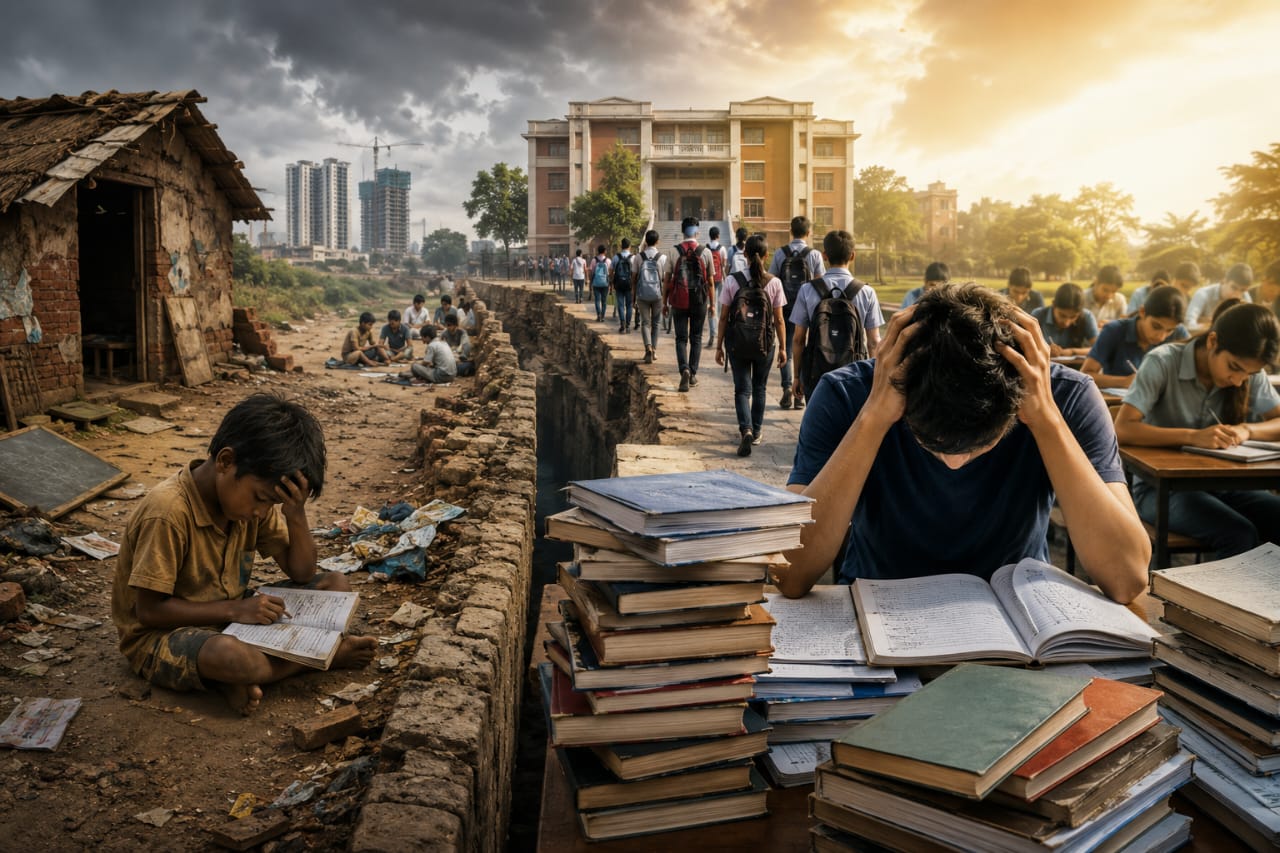
The Indian education system has faced both challenges and failures, and a need for reform.
Introduction
The catalyst of any country’s development is education. The educational system in India is one of the largest in the world, with millions of students attending schools, colleges, and universities. The country has attained considerable success in literacy and accessibility to education, but there are still some challenges that affect the effectiveness of the education system. There has been a concern whether the current system sufficiently prepares students for the future due to the following issues: rote learning, examination pressures, outdated curricula, skill gaps, etc.
A tendency to overemphasize Rote Learning.
One of the biggest shortcomings of the Indian education system is its dependence on rote learning.
Key Issues:
– The students are encouraged to remember the facts instead of comprehending the concepts.
Creativity and innovation are second class citizens.
There is a lack of emphasis on critical thinking and problem solving.
Consequently, students often do well in tests, but are unable to apply their knowledge in real life scenarios.
2. Examination-Centric Approach
Marks and rankings are the most important aspect of the education system.
Key Issues:
The emphasis is on board examinations and entrance tests.
Students are under a tremendous pressure to achieve high marks.
Marks are often the primary, if not sole, goal of learning.
This way they will feel stressed and anxious, and it will not lead them to be curious and self-learners.
3. Skill Gap and Employability Concerns
India has been producing millions of students every year, yet the problem of employability exists.
Key Issues:
– Absence of hands-on and industry related training.
Lack of emphasis on communication and soft skills.
– Lack of real-world experiences at work.
It is seen by many employers that graduates have knowledge but not the skills needed in the modern work environment.
4. Unequal access to quality education
The quality of education is greatly inconsistent throughout the nation.
Urban-Rural Divide:
– In urban schools, facilities and resources tend to be higher.
Rural schools can be short of teachers and equipment.
Digital Divide:
-Inability to access Internet at the same level.
– Inadequate digital learning resources in out-of-town locations.
These differences result in differential learning opportunities for students.
5. The challenges in teacher development
Teachers are instrumental in the formation of generations to come and have to grapple with a lot of challenges.
Key Issues:
-Lack of qualified teachers in various areas.
– Limited opportunities for professional development.
– Traditional approach to teaching.
Educational gains can be greatly enhanced by investing in teachers’ professional learning.
6. Outdated Curriculum
Technology is growing at a fast rate and the content of education needs to be updated accordingly.
Key Issues:
Often curricula do not keep up with industry developments.
– Not enough focus on new technologies and digital competences.
Lack of focus on entrepreneurship and innovation.
A new curriculum is necessary to equip students for future jobs.
7. Abandonment of Vocational Education
Traditionally, in Indian society, a preference is given to acquiring academic qualifications over vocational training.
Key Issues:
Careers based on skills are sometimes underestimated.
– Exposure to vocational options to students is limited.
Skilled technicians and workers are in short supply in the industry.
The improvement of vocational education contributes to linking education and employment.
8. Mental Health and Academic Stress
Academic competition can have a significant impact on students’ mental well-being.
Key Issues:
– High expectations by parents and society.
– Fear of failure in examinations.
– Higher stress levels, anxiety and burnout rates among students.
Schools need to develop safe and supportive environments with a student well-being focus.
The Indian education system has indeed achieved a lot for the positive.
Although Indian education system has its flaws, it has also made some good strides.
Key Successes:
The literacy rate has improved over the past decades.
Increase in higher education opportunities.
The creation of internationally acclaimed experts in scientific, technological, medical and business fields.
These achievements are an indication of the potentialities of the system, where successful reforms have been applied.
9. National Education Policy (NEP) 2020
The National Education Policy is an attempt to change the course of Indian education.
Key Reforms:
Move away from memorization to conceptualization.
Fostering education through several disciplines.
Focus in vocational training and skills development.
Use of technology in learning.
Many of the longstanding problems could be solved through these reforms, if implemented successfully.
The Way Forward
To make it a world class education system India should concentrate on:
Promoting critical thinking and creativity.
Modernizing curricula regularly.
Improving teacher training.
Improving access to digital learning.
Encouraging vocational and skills training.
Assisting students mental health and well-being.
Conclusion
While the Indian education system has played a crucial role in the advancement of the nation, it is also grappling with significant challenges. Students are still held back by rote learning, examination pressure, out-of-date syllabus and skill deficits. It’s not a system failure, it’s a system that needs a lot of reform. Finally, through providing quality education, hands-on learning, innovation and development of the student, India’s education system can equip its youth for a better future to meet the demands of the 21st century.